


Drawing, Design, Lettering, Etc. Applied To Wood And Metal Work. Continued. Continued
Description
This section is from the book "Handcraft In Wood And Metal", by John Hooper, Alfred J. Shirley. Also available from Amazon: Handcraft In Wood And Metal.
Drawing, Design, Lettering, Etc. Applied To Wood And Metal Work. Continued. Continued
All the articles shown in these pages have the names of the various metals of which they should be made; and on examination it will be found that there is a wide difference between what should be cast and what should be wrought, as a model that is designed for, and made in, wrought iron would not be suitable if made in cast iron. For instance, the cage handle illustrated on p. 107, though correct for wrought iron, would be wrong made of cast iron or wrought copper, and would cost a great deal more, because more difficult to make in these latter metals. It is not what is possible but what is proper and most suitable for the particular purpose. It is for many workers and students much easier to model a design for metalwork than to draw it, and it gives a better appreciation of form, bulk, and relief, than drawing ever can. It enters largely into the processes of blacksmithing (see p. 103), coppersmithing (see p. 84), silversmithing (see p. 89), casting, chasing, and embossing. A design that has been modelled, and is going to be made in metal, can be measured and gauged for the various heights of the relief, etc., which cannot be done with a drawing. It is thus more realistic, but it applies more particularly to cast, raised, and hammered work. Working from a model, there is less possibility of mistakes being made and consequently less waste of material. Many of the objects shown could be easily modelled the correct size, and the work made from the model without a drawing at all. The models Nos. 10, 11, 12 on p. 103, and No. 2 on Fig. 9, would have to be modelled, but in various ways and materials as described on p. 106. Models Nos. 6, 7, 8, 9, 10 on p. 78 could be modelled in a plastic material, then a plaster cast taken of them, and when suitable, such as Ch. ix, Fig. 6, Nos. 6, 10, 11, 12 on p. 103, they could be cast in brass or bronze. Letters could be treated in the same way, as letters are used largely for signs, shields, nameplates, etc., but good examples should be copied in the early stages. They could also be raised from thin sheet metal as shown in Fig. 8, or sunk and filled with coloured wax as shown in Fig. 11. A good practical exercise would be to draw a letter about 4, 5, or 6
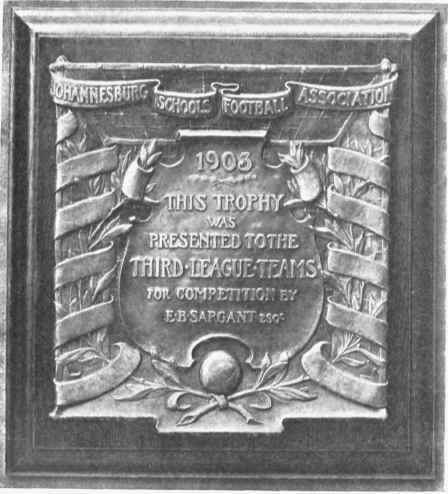
(1) Embossed and chased copper tablet on wood back.
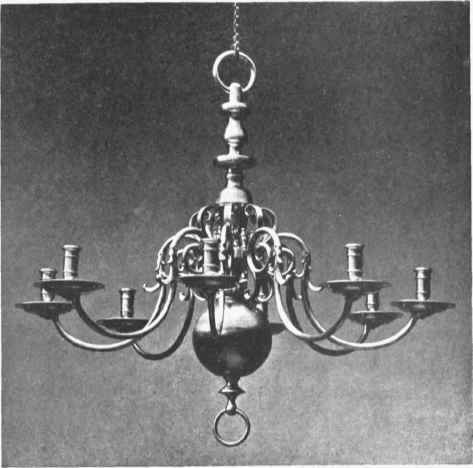
(2) Reproduction of a Dutch chandelier In brass.
Fig. 8.
inches high, transfer it by means of a tracing and pricking through with a pin to the modelling medium, model it and take a plaster cast from it, and from this to take a cast of the letter, strengthening it by means of galvanized iron wire. This would be a pattern from which a casting in metal could be made. This in turn could be filed up and finished, thus completing the letter from the drawing to the finished articles. Patterns for letters could also be made in wood.
Colours should also be considered when drawing and designing for decorative metalwork, as each metal has its own characteristic colour, and this can often be modified and altered by colouring. The methods are described on pp. 179-180. The arrangement of one metal with another is often dependent on the colour, and if we include enamelling, inlaying of another metal or of precious stones, etc., any arrangement of colour is possible, and highly artistic effects are obtained. The casket illustrated in Fig. 10 and the memorial tablet (Fig. 11) are good examples of metalwork in which colour is an important feature. The casket itself is made of mahogany and covered with richly tooled, painted, and gilt leather, mounted with bronze feet, handles, hinges, and lock. In the centre of the lid there is a heraldic crest in translucent enamel, thus forming a work of art in which colour is predominant. The memorial tablet (Fig. 11) is of copper on a green marble base. It is embossed, and the stars are of silver inlaid. Some of the lettering is raised from the back, and the rest is sunk and filled in with red wax of a tint different from the surrounding copper. The whole is emblematical of the man and his life.
The trophy in Fig. 8 (1) is of hammered copper mounted on a wood base, and the design is based on the apparatus-the net and posts and the ball used in the game-and the laurel or bay-leaf branches which were used by the ancients for making wreaths for the victors. The brass chandelier, or if fitted for the electric light, an electrolier, is a reproduction of an eighteenth-century Dutch one, and is made entirely of cast and turned brass, Fig. 8 (2).
The lock plates, see Fig. 9 (1), made of wrought steel, with forged handles, pierced and applied ornament, are of a design based on Elizabethan work of the sixteenth century. They are polished and have been hammered in the making and the marks have not been taken out. These give the metal a rich appearance.
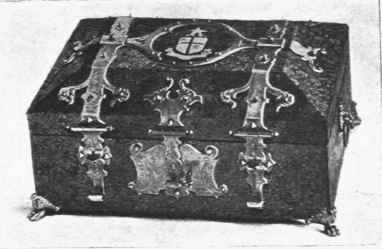
Fig. 10.-Casket covered with tooled painted and gilt leather and enriched with bronze mounts and enamelled crest.
The fire implements and stand, Fig. 9 (2), or as they are sometimes called, a fireside companion, are also of polished steel, and the dragons' heads have been forged and chiselled. This is modern; it could be made of wrought and cast brass, or of wrought and cast copper, or with cast and wrought copper handles and steel reins. This last treatment would be very effective. Examples are given on page 103.
The wrought-iron pediment of a gate shown in Fig. 12 (1) is a good example, not too intricate, of the use of natural forms treated in a conventional manner, and suitable for the material. Each small leaf has been welded separately on to each stem. They are all modelled, and as they vary in thickness, they have been forged from bar iron and shaped while hot. The larger leaves are cut from thick plate and modelled while hot, and then welded on to the scrolls, with the exception of the two end ones on the bottom bar.
The illustration, Fig. 12 (2), is of a wrought-iron grille of quite a different character. This is based on the palm leaf, and treated conventionally.
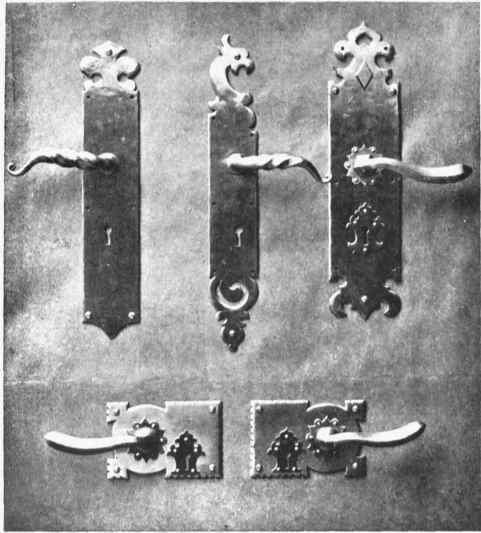
(1) Lock plates and handles of polished steel.
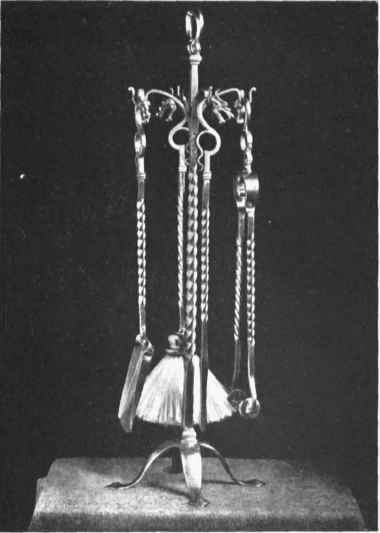
(2) A fireside companion in polished steel.
Fig. 9.
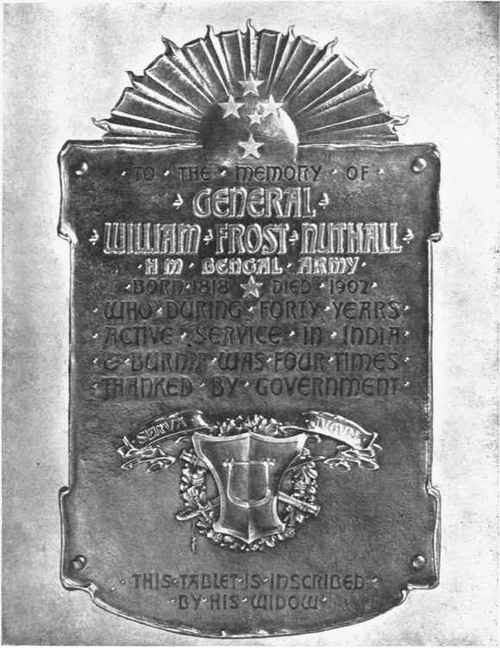
Fig. 11 -Memorial tablet of embossed and chased copper inlaid with silver and wax.
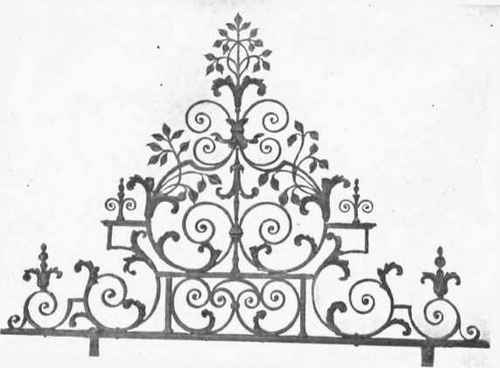
(1) Wrought-iron pediment for a gate.
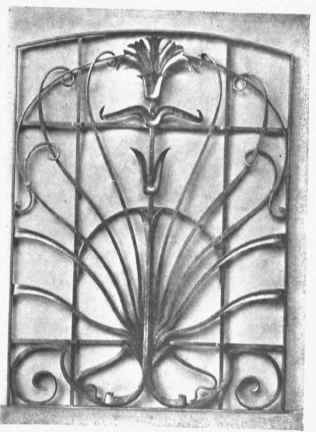
(2) Wrought-iron grille.
Fig. 12.
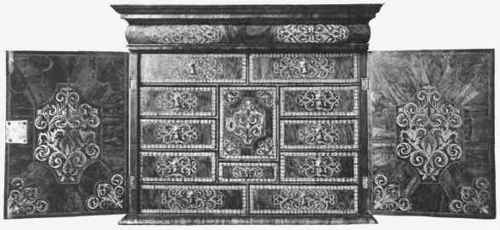
Fig. i.-Part of a Dutch cabinet showing marquetried floral ornament.
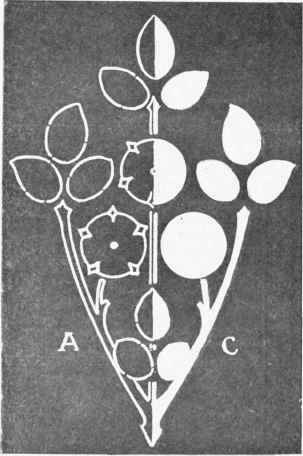
Fig. 2.-Diagram illustrating method of inlaying leaves, etc.
Continue to:


My Books

