


Worm Gearing
Description
This section is from the book "Machine Shop Work", by Frederick W. Turner, Oscar E. Perrigo, Howard P. Fairfield. Also available from Amazon: Machine shop work.
Worm Gearing
This is a term used to describe the device consisting of a gear similar to a spur gear driven by a worm-that is, a cylinder upon whose surface is a thread fitting into the teeth of the gear. The relative speed of the worm and gear are found by dividing the number of teeth in the gear by the number of threads on the worm. Worms are always understood to be of single thread, unless otherwise specified. The pitch of a single-threaded worm is equal to the circular pitch of the worm gear, and vice versa. The shafts of a worm and worm gear are usually (but not necessarily) at right angles to each other.
A simple form of worm gear is shown in Fig. 272, in which the worm B has a single thread having an inclination on each side of 14 1/2 degrees, or what is usually called a "29-degree" thread. The teeth of the worm are cut to a similar form, and the pitch circle located the same as in a spur gear; but, as the lines of the thread of the worm are not at right angles to the axis, but at an angle due to the pitch of the thread, the teeth of the worm gear must be cut at such an angle as to be tangent to the curved line of the thread, as shown at a. The calculations for this worm gear are made the same as for a spur gear. Thus the pitch of the thread, multiplied by the number of teeth, will give the circumference of the pitch circle, which amount, divided by 3.1416, will give its diameter. In consequence of the relatively large diameter of the worm compared with the thickness of the worm gear, enclosing an angle of only 14 degrees on the pitch line, the teeth of the latter may be cut on a line parallel to its axis, as they will conform quite nearly to the curvature of the thread of the worm. This is the simplest form of a worm gear, and one not often used, on account of the small amount of power it is able to transmit.

Fig. 272. Simple Worm Gear.
The usual practice, particularly where considerable power is to be transmitted, is to design the worm wheel as shown in Fig. 273, by which a much greater area of contact is secured, but making a much more complicated form, and one in which some new conditions must be considered. In this case the enclosing angle is 80 degrees, instead of 29 degrees, as in the former example. In the former example, the teeth were cut as in a spur gear, hence the pitch surface bb, Fig. 272, was straight, and the diameter of the pitch circle was therefore measured as in a spur gear. In this case the pitch line is considerably curved, being an 80-degree arc on the pitch circle a of the worm. It has sometimes been the practice to calculate the pitch diameter from the point b, usually called the throat of the gear. It is obvious that this is an arbitrary point, that the number of degrees contained in the enclosing angle is not considered, and that, for instance, if the number of degrees were much reduced, so as to materially flatten the arc, this point would vary considerably from its proper place. It has been found in practice that if we divide that portion of the pitch line a that lies between the vertical center line xy and the enclosing angle into three equal parts as shown, whatever may be the enclosing angle, the point c will indicate the correct diameter of the pitch circle. We shall then have the pitch diameter at C, the diameter at the bottom of the teeth at D, and the outside diameter at E.
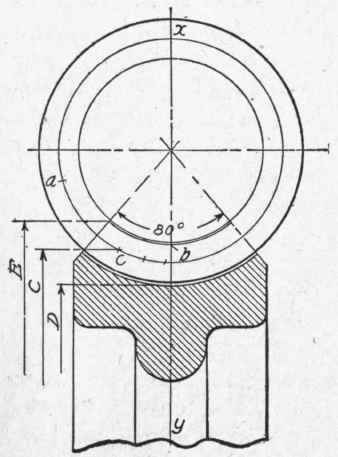
Fig. 273. Worm Gear with Large Enclosing Angle.
These relative diameters bear no fixed relation to similar dimensions of a spur gear, or to those of other worm gears of differing proportions.
To find the angle of the thread, we use the right-angled triangle, as shown in Fig. 274, in which the base equals the circumference of the worm, the height equals the pitch of the thread, and the hypothe-nuse is the development of the thread itself. Mathematically we find the angle of the thread by dividing the pitch (height) by the circumference (base) to get the tangent of the arc, and obtain the angle from a table of natural tangents. Should the worm have a double thread, the height of the triangle will be twice as great.
Continue to:


My Books

