


Less Common Or Specific Applications Of Circular Saws To Large Works. Part 4
Description
This section is from the book "Turning And Mechanical Manipulation", by Charles Holtzapffel. Also available from Amazon: Turning and Mechanical Manipulation.
Less Common Or Specific Applications Of Circular Saws To Large Works. Part 4
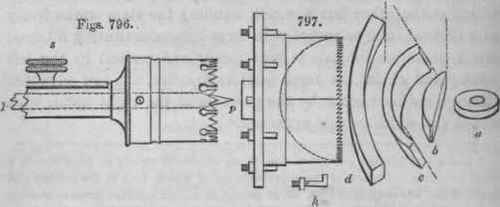
11. Sawing Curvilinear Works. - The trephine-saw used in surgery, and represented nearly full size in fig. 796, appears to have been by far the earliest of the circular saws of this kind. It consists of a thin tube of steel, with teeth cut on the edge, of the peculiar form represented, and at the opposite end of the tube is fixed, by small side screws, the stem by which it is attached to the mechanism whereby it is worked.
The motive apparatus of the trephine-saw, it usually a cross handle like that of a corkscrew, or a revolving brace like that used in carpentry. To guide the first entry of the trephine-saw, the shaft is drilled and fitted with a drill-point p p, which is fixed by a side screw s. In the commencement, the point makes a small central hole, and when the saw has once fairly penetrated, the point is loosened and allowed to fall back into the stem of the saw.
In another modification the center of the trephine-saw is dispensed with, as the "guide principle" is effectually introduced, saw is fixed at the one extremity of a cylindrical stem, which at the other has a winch handle; the stem works freely in a vertical tube or socket with three legs, constituting a tripod stand, therefore the axis is kept steady and vertical by the left hand; and whilst the teeth fulfil their office, the saw advances through its fixed collar by the pressure of the right hand, with which the winch-handle is turned.*
* The art of surgery has given rise to an enormous variety of instruments, a most complete collection of the representation of which, both of the earliest and latest times, was published by A. W. H. Seerig, in a work entitled Armamentarium Chirurgicum; oder moglichste volltandige Sammlung von Albildungen ehirurgiacktr Imtrwments dlterer und neuerer Zeit. The work contains 145 large and crowded lithographic plates, and was published at Breslau, in 1835.
It appears from plate 75 of this collection, that the trephine-saw was known in the time of Hippocrates, and that both the blades and the mechanism for moving them, have since assumed numerous varieties of form.
The amputating saws set forth in this work as having been contrived or used by various eminent surgeons, are modifications of the bow, frame, and piercing saws for metal, and the tenon and dovetail saws for wood; they vary from about 14 to 4 inches in length. Some of the small saws analogous to the dovetail saw, have edges more or lees curved, and the smallest of these dwindle down to a nearly circular plate of steel less than one inch in diameter, serrated around the edge, except where a slender wire, terminating in a wooden handle, is rivetted to the edge of the saw-plate. These last are known as Hey's saws, and are principally need for the cranium and the metacarpal bones.
A saw intended for dividing deeply-seated bones, is formed like the chain of a table clock, but with the one edge serrated; it is worked with two cross handles by the alternate motion of the two hands. One of the bandies is detached, whilst the end of the chain-saw is passed beneath the bone, by a kind of semicircular needle. The chain-saw was invented by Dr. Jeffrey of Glasgow.
A nearly similar chain-saw is arranged as an endless band, passing around the grooved edge of a taper staff like the blade of a poniard, but terminating in a small semicircle. There are guards to cover up portions of the edge, and a prop or strut to steady the instrument, whilst the endless chain is put in motion by a winch handle attached to a pin-wheel, around which also the chain circulates. This revolving mandrel, which carries the crown-saw and also a drill, is advanced through its collars, and rounds and bores the sheaves a, at the one operation, ready for the coaking-engine, turning-lathe, etc.*
The trephine-saw has given rise to various larger applications of the same kind of instrument, having teeth of the ordinary form, and known as crown saws, annular, curvilinear, drum, and even as washing-tub saws, the respective merits of which names it would be useless to discuss. Small saws of this kind, when mounted upon the lathe, are often employed for cutting out disks of metal and wood; the material is in general thrust against the saw, by a block of hardwood fitted to the front center of the lathe, and frequently, as in making buttons, the cutting out is combined with the shaping of the two faces of the button.
In the block machinery at Portsmouth the crown-saw is U3ed for rounding the sheaves, which are cut out of transverse slices of lignum vitae; the wood is held at rest by its margin whilst the singular instrument is ascribed to S. Heine, and is figured on plate 60 of Seerig's work, which also contains several schemes for using small circular saws, but some of the mechanical arrangements are not clearly defined in the figures.
A circular saw proposed for cutting deeply-seated bones, and as an occasional substitute for the trephine-saw, was invented by Mr. Thomas Machell of Durham, surgeon, and is accurately described in the Trans. Soc. of Arts for 1812, Vol. xxx., page 150. In Mr. Machell's saw the axis of rotation is constructed within the thick-net* of the blade, so that two thirds the area of the circular saw may be depressed in the saw cut. The saw is worked by a pin-wheel, the pins of which enter notches in the edge of the saw-blade, the pin-wheel has teeth, and is itself moved by a larger and more distant toothed wheel, having a small winch-handle.
The great difficulty encountered in almost all the surgical saws, arises from the removed particles of bone becoming mixed with the fluids, and forming a thick paste which clogs and nearly stops the action of the blades. To remedy this inconvenience, Mr. Weiss suggested that slits terminating in round holes should be cut in the edges of such blades as admit of these receptacles being made. - See Weiss on Surgical Instruments, page 10, plate 18; and figure 796 in the text. Small bones are now more frequently cut by strong nippers than by saws, and many nippers are drawn on Seerig's plate 134.
Continue to:


My Books

