


Ass
Description
This section is from "The American Cyclopaedia", by George Ripley And Charles A. Dana. Also available from Amazon: The New American Cyclopædia. 16 volumes complete..
Ass
Ass (equus asinus), the humblest member of the horse family, known to be of eastern origin. He is first mentioned in Genesis, in the history of Abraham, who, when he went down to Egypt on account of the famine in Palestine, found that Pharaoh was possessed of "sheep, and oxen, and he asses, and man servants, and maid servants, and she asses, and camels." At that time, probably, as was the case during all the historic ages of Greece, a species of ass was wild on the mountains of Syria, Asia Minor, and throughout Persia; and in the latter country and Armenia, in the region about the sources of the Tigris and the Euphrates, and the shores of Lake Van, it exists in a state of nature to the present day. Asses are mentioned in Xenophon's Anabasis as occurring in great numbers in parts of Mesopotamia. These animals, which he simply terms wild asses (ovot ayptot, of which words the specific Latin name onager is merely a corruption), were in company with ostriches, antelopes, and bustards; they were eagerly pursued by the horsemen of the army, and are described as being possessed of extraordinary speed and endurance. The wild asses of the same country are still possessed of the same characteristics.
They have always been the special quarry of the Persian monarchs, and Nadir Shah was indefatigable in his pursuit of them, and considered the running down of one with his greyhound a feat equal to the winning of a battle or conquering a province. The flesh was considered the most exquisite of venison. The wild ass of Xenophon, and that, probably identical with it, hunted by the shahs of Persia, is presumably the dziggetai, or equus liemionus of Pallas, which, as its specific name (hemionus, half-ass) indicates, possesses as much of the horse as of the ass in its character and qualities. The best breed of ass comes from the East, where he has been long carefully cultivated as a saddle animal. The rocky nature of the soil and mountainous face of the country in Palestine favored the employment of this hard-hoofed, sure-footed, patient, and enduring animal, as much as it discouraged that of the delicate, fine-limbed, high-bred courser of Syria and Arabia. Lieut. Col. Smith, who has devoted much attention to the equine families of the East, found near Bassorah a breed of white asses, remarkable for their excellence, which he had reason to believe are of a breed as ancient as the time of the kings of Judah. - The characteristics of the ass, as distinguishing him from the horse, are: 1, inferiority in size, although doubtless this in European countries is in great part in consequence of centuries of cruel treatment, scanty fare, and want of attention in breeding, the animal having been for ages regarded only as the drudge of the poor; 2, a rougher and more shaggy coat, capable, however, of much improvement by warm keeping and a little grooming; 3, the shortness and stiffness of his pastern joints, and the hard solidity of his sound upright hoofs, which seem almost incapable of lameness, and render him the safest and most surefooted of animals in difficult mountain passes; 4, the extraordinary length of his ears, resembling those of the hare more than those of his own race; 5, the peculiar cross which he bears on his back, formed by a longitudinal dark stripe along the course of the spine, and a transverse bar across the shoulders, which indicates his family connection with the untamable members of his race, the zebra and quagga, who are yet more conspicuously striped, and of whose character and disposition the ass possesses many points.
The usual color of the ass is gray, mouse-colored, or black; and as he tends to bay, dun, or chestnut, the horse colors, the quality deteriorates. The dental system of the ass assimilates that of the horse, and in like manner indicates the age of the animal by the changes and marks of the teeth. The male ass is capable of propagation at two years, the female somewhat earlier; the latter carries her foal 11 months, producing it in the beginning of the 12th. The sexual vigor in both sexes is excessive, which may explain the fact that in the hybrids of the ass and horse the offspring are much nearer, as well in organization as in temper and appearance, to the former than to the latter progenitor. In all cases the mule is an ass modified by a strain of the horse; not a horse modified by a cross with the ass. The hybrid foal of the male ass and the mare is the true mule; that of the stallion and the she ass, the hinny - the latter being less strongly tinctured with the blood and having less of the form of the ass, owing to the superior influence of the male in the physical form and external organization of the progeny.
The mule, like the ass, brays, owing to a peculiar construction of the larynx; while the hinny neighs, like its sire. - There is no doubt but that with careful breeding, grooming, stabling, and nutritious feeding, the ass might be improved at least as much as any other domestic animal. As it is, he is admirably adapted for a beast of burden in cold, mountainous countries, in which, on a quarter of the food required by a horse, he will safely carry burdens under which the more generous animal would break down, over places in which the other could not keep its footing. Under kind treatment, he is hardly inferior in docility to the horse or the dog. The female is excessively fond of her young, and both sexes are susceptible of strong attachment to their owner. In elevated countries, where the soil is light, asses are serviceable in an agricultural point of view; although in the United States, to which they were first introduced by Gen. Washington, they are little used except for the propagation of mules.
The best asses are obtained either from Smyrna, the island of Cyprus, or from Spain, where the race has been particularly cultivated, as it has also in Peru, with a view to the business of mule-raising, which in both these countries is important.
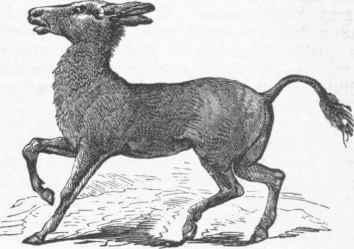
Wild Ass (Dziggetai).

Ass (Asinus vulgaris).
Continue to:


My Books

