


Artificial Mineral Waters
Description
This section is from "The American Cyclopaedia", by George Ripley And Charles A. Dana. Also available from Amazon: The New American Cyclopædia. 16 volumes complete..
Artificial Mineral Waters
Artificial Mineral Waters, imitations of mineral spring waters, made by dissolving the salts which constitute the basis of the natural mineral waters in ordinary water impregnated with gases, especially carbonic acid gas. Experiments in their manufacture were made as early as the 16th century, but they have been produced in perfection only within the past 50 years, since chemical analysis has become an operation of minute exactness. The merit of the discovery of their principles belongs to Berzelius and the German physician Struve; but the latter, who proved the practical value of the invention, and founded, as Berzelius did in Stockholm, the first manufactories or spas in Dresden (1818-'20), Leipsic, Hamburg, Berlin, St. Petersburg, and Brighton, is deservedly called the father of artificial mineral waters. By powdering the clinkstone of Bilin and subjecting it to the action of carbonic acid water, under a slight hydrostatic pressure, he pro-duced a mineral water identical with that of the natural spring of Bilin. Faraday and Lie-big pronounced his artificial Carlsbad and Friedrichshall bitter waters to be identical in chemical composition and physiological action with the natural waters which they represented. Artificial mineral waters have some advantages over natural waters.
The supply of the latter exported from the springs of continental Europe is inadequate for the demand, and most natural waters lose materially by bottling. The springs too are subject to many changes, and frequently vary in the quantity or the relative proportion of their mineral ingredients. Artificial waters, on the contrary, are prepared according to analyses which represent the natural mineral waters when in their best condition. They are always the same in composition, in consequence of the technical perfection of their manufacture, and they produce the same general effect as the natural waters. They are more highly charged with carbonic acid gas than the latter, which insures their keeping in any climate and renders them more pleasant to the taste. The manufacture of mineral waters also embraces composition waters, devised for special medical purposes, and the beverages soda water, seltzer water, etc. The most important constituent of all these waters is carbonic acid gas, which is prepared by decomposing carbonates of lime and bicarbonates of soda with acids, especially sulphuric acid, in a vessel called the generator. Carbonates of lime contain from 41 to 52 per cut. of carbonic acid; bicarbonates of soda, 47.62 of soda and 52'38 of carbonic acid.
Distilled water is used in making mineral waters, pure well or spring water for soda water, etc Water absorbs nearly its own volume of carbonic add gas at 60° F., and the absorption is increased by reduction of temperature, increase of pressure, or both. The principal substances or salts used in the manufacture of mineral waters are comprised in the following groups: 1, chlorides of magnesium, calcium, strontium, and lithium, carbonate of lime and of magnesia, and sulphate of magnesia; 2, the alkaline salts;3, the salts of iron and of manganese. Waters containing sulphuretted hydrogen gas can never be perfectly imitated, because the formation of this gas is a continual process of decomposition, originating from the reaction of organic matter upon the sulphates. In the cvoustruction of the manufacturing apparatus two different systems are followed: 1. The denevu system, an improvement of Struve's original apparatus. In this the carbonic acid gas passes from the generator through purifying vessels or bottles containing partly water, partly certain solutions of salts, and thence into the gasometer, out of which it is pressed by a pump into the mixing cylinder, where the water is impregnated with it.
Between the pump and the cylinder is placed the repurgator, a cylindrical tube of strong sheet copper containing fine charcoal, in which the gas undergoes a final purification. The water is then impregnated with the gas by revolving a paddling shaft which passes through the middle of the mixing cylinder. The latter is provided with a manometer which indicates the pressure of the gas, tubes through which the water enters, a safety valve, and a water gauge. Bramah's apparatus is of similar construction, but has some improvements. In it the water to be aerated and the expanded carbonic acid gas are pumped in the proper proportions into the receiving vessel, wdiere they are mixed and the aeration completed. This system is more generally in use in England and France than in Germany. 2. The self-generator system, after which the apparatus of Ozouf, Gappard, and Savaresse are constructed. It dispenses with the pump and gasometer, the water being impregnated by the pressure 'of the gas itself. The generator which contains the carbonates is tilled with hot water to a certain height, and a square cooling apparatus is therefore applied between the washing vessels and the cylinder.
This apparatus is not so expensive as the former, but is less recommended on account of the imperfect purification of the gas and its liability to explosion. The apparatus of Mr. John Matthews of New York, which is now widely introduced in Europe, is a combination of the Bramah and the self-generator systems, the mechanical devices of the former being greatly simplified, and the liability to explosion of the latter being obviated by a safety cap. This cap consists of a duplex disk, a, a nut, b, screwed firmly against it, a lead washer, c, to close joint on the generator bung, and an aperture, d, through which the gas escapes when the disk is ruptured by undue pressure. - After the mineral water is made, it is drawn from the apparatus into fountains (portable cylinders), siphons, or bottles, the faucets and filling and corking apparatus being so constructed as to prevent the loss of carbonic acid. For use, the fountains, which resemble the mixing cylinder in construction, are placed as reservoirs under or behind the marble case on the counter. The case contains ice in a cooling chamber, through which the connecting pipes from the fountains pass to the faucets in front.
The business of furnishing aerated waters in portable fountains has greatly increased since the improvements made by Matthews in the apparatus. The fountains previously in use were superficially coated with a wash of tin, and the contents were sooner or later contaminated by poisonous metallic salts. The Matthews fountains are composed of an inner container of pure sheet tin secured in a shell of fine cast steel. Although much lighter than the old style of fountains, the 15:gallon fountain weighing but 40 lbs., they will resist a pressure of 500 lbs. to the square inch; and the connections being made of solid tin encased in sustaining sheets, the water cannot be contaminated. There are now 10,000 of these fountains in use, furnishing 4,000 places for dispensing aerated waters. The most perfect and elegant dispensing apparatus, in which the sirups are contained in portable glass tanks where they do not come into contact with any metal, are now made in the United States and extensively exported to Europe. An important and novel improvement in bottling aerated beverages, an American invention, in which the bottle is closed from the inside by a glass stopper, has recently come into extensive use both in the United States and in Europe. - Soda water proper is a solution of carbonate of soda in water, impregnated with carbonic acid gas.
Webb's English soda water contains 15 grains of crystallized carbonate of soda in one pint of water. Chloride of sodium is frequently added. Bicarbonate of soda is sometimes used for generating carbonic acid gas, and from this has arisen the popular use of the name soda water for carbonic acid water, or water charged with an excess of carbonic acid. German and American soda water, or what is called in France eau de seltz, contains no soda. Priestley first produced it by pouring dilute sulphuric acid over carbonate of lime, and impregnating the water with the gas; a method which is still generally followed. Under the name of soda, carbonic acid water is mixed with sirups, and it forms a constituent of many of the American compound drinks. In Paris it is taken as eau gazeuse with hock and clarets. Carbonic acid water improves the taste and increases the sanitary effect of drinks, is the best antidote for alcohol, and lessens the desire for spirituous liquors. It has a generally exhilarating and invigorating effect upon the system, essentially promotes digestion, checks too great acidity in the stomach, and is a much esteemed remedy in febrile diseases.
Native wines are now extensively aerated in the United States, and American sparkling wines produced which will compare favorably with the best imported brands. This has been done only since the introduction of Matthews's apparatus, in which the receivers and all the parts that come into contact with the wine are lined with pure silver, a metal which does not affect it unfavorably. Mineral waters have recently been brought from the most celebrated natural springs to New York in casks lined with pure tin sheets and aerated. Large quantities thus prepared are bottled or dispensed from fountains, and this trade is supplanting to a certain extent the manufacture of artificial mineral waters. - The great therapeutical value of baths in carbonic acid water (champagne baths) is now established. They produce a pleasant burning sensation in the skin, give elasticity to the limbs, and are generally invigorating if used moderately. They are produced by adding to 10 or 15gallons of water at 110° F. an equal quantity of very strong carbonic acid water from a highly charged fountain, the escaping gas being finely divided by means of an apparatus constructed for that purpose.
Chloride of sodium and of magnesium are added for brine baths. - See Carl Schultz, "Review of the History of Mineral Waters" (New York, 18G5).
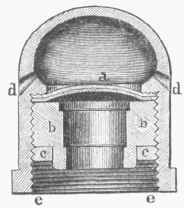
Matthews's Apparatus.
Continue to:


My Books

