


Shark
Description
This section is from "The American Cyclopaedia", by George Ripley And Charles A. Dana. Also available from Amazon: The New American Cyclopædia. 16 volumes complete..
Shark
Shark, an extensive family of marine cartilaginous fishes, with the rays or skates and the chimaera or sea cat forming the order of plagiostomes or selachians, elevated under the latter name to a class by Agassiz. The sharks may be distinguished from the rays by their elongated fusiform body, branchial apertures on the sides of the neck, pectoral fins of the usual form and situation, and large, fleshy, and powerful tail, which is the principal organ of locomotion; the nose is pointed and projects beyond the mouth, which is large and armed with formidable cutting teeth in several rows; the upper surface of the head often presents a pair of respiratory spiracles; the eyelids are distinct, with a free margin, and many have a nictitating membrane; the cartilaginous scapular arch is not attached to the spinal column, which contains more ossific matter than the other parts of the skeleton; the gills have their margins attached, the water escaping by five branchial openings (sometimes more); the skin is rough with osseous tubercles; the aortic bulb has several series of valves, and the shortness of the intestine is counterbalanced by an extended spiral valve.
They are essentially carnivorous, and, as in the birds of prey, the females are larger and fiercer than the males; they swim with great ease and rapidity, playing around the fastest ships and steamers; they devour either living or dead animal matters, but, from the situation of the mouth on the under side of the head, are obliged to turn on the side or back to seize a large object. Many of the smaller species have received the names of dog and hound, with various canine epithets, from their habit of following their prey in packs. Sharks are higher than ordinary fishes in the phenomena of reproduction; there is with them true sexual union, and they are ovoviviparous, that is, the eggs are hatched in the oviducts, though they are often expelled before the embryo has quitted them; the egg presents in its early development many peculiarities of those of the higher vertebrates. In some the eggs are received into the villous oviduct, in which as in a uterus the young are developed; under these circumstances ova are observed in different stages of development, and frequently one in each oviduct.
In others the egg is received in a horny, semi-transparent, oblong case, with long convoluted tendrils at each corner, deposited near the shore in the winter months, and moored by the tendrils; the case has an elongated fissure at each end for the entrance and exit of water; the young animal swims about for a time, deriving its nourishment from the attached yolk bag. The egg cases are often cast ashore by the waves, and are commonly known as sailors' purses. About 100 species of sharks are known, mostly in northern waters and the eastern hemisphere; some are almost cosmopolite, while others have a limited geographical distribution; the family contains the largest of the fishes, the great basking shark attaining a length of more than 30 ft. - In the family scylliidoe, generally called dog fishes to distinguish them from the sharks proper, spiracles are present; the snout is short and blunt; the gill openings are five, the last one over the base of the pectoral; two dorsals, far back and behind the ven-trals; an anal present; caudal long, truncated at the end, with a notch on the under side; no caudal pit; a furrow at the corners of the mouth; teeth with a pointed median cusp, and four or five small points on each side; the parts about the mouth and nose in some genera are divided into flaps and barbels, evidently organs of touch, necessary in their rapid passage along the bottom.
They are oviparous, and the eggs resemble those of a skate. In the genus scyllium (Müll. and Henle) the spiracles are close behind the eyes, and the nostrils near the mouth and valved; dermal scales tricuspid. Most of the species are found around the southern coasts of Africa; they are among the smallest of the sharks, and live near the ground. There are two species on the English coast, the S. catulus (Cuv.) and 8. ca-nicula (Cuv.). The former is 2 or 3 ft. long, brownish gray above, with a few large blackish and white spots, and whitish below; the food consists of fish, mollusks, and crustaceans; it deposits about 20 eggs, according to Cu-vier. The latter, the small spotted dog fish, about 2 ft. long, is more reddish, with more numerous and smaller spots; it is widely distributed, following ships and seizing whatever falls overboard; it eats chiefly fish, but has been known to attack fishermen and bathers; it lies in ambush in the mud or among weeds. Both these species are the pests of the fishing stations all along the coast, especially among the Orkney islands, robbing the lines at every opportunity, and not unfrequently caught themselves; the flesh is. white, but dry and fibrous, and, though eaten by the fishermen, is rarely brought to market; in the Orkneys they are skinned, split, and dried; the skin is used by cabinet makers as a fine rasp, and the liver is valuable for its oil.
Among the genera and species of N. E. Asia are many whose fins are used for soups by the Chinese. - Under the name of squali Cuvier comprehended all the other sharks, except the hammer-head and monk fish, of which he made distinct genera; Owen gives the name of nic-titantes to a portion of the squall, chiefly car-charladoe and galeidoe (described below), the presence of a nictitating membrane to the eye being accompanied with a greater induration of the skeleton. In the family carchariadoe there are two dorsals and an anal, the first dorsal over the space between the pectorals and ventrals; there are no spiracles, and the last two gill openings are over the pectorals; nostrils generally small, pupil perpendicularly oval, and mouth boldly convex; the teeth are compressed, triangular, with an entire or serrated edge, arranged in a linear series like those of a saw, in several rows, of which the anterior only are erected for use; the tail has a short under lobe and a notch near the end of the upper; there is a pit above and below the base of the tail; the intestinal valve is longitudinally and not spirally rolled; skin comparatively smooth.
The genus carcharias (Müll. and Henle) has been divided into various subgenera, but all have the nostrils midway between the mouth and end of the flattened snout, the labial cartilages very small, and the yolk bag connected with a kind of uterine placenta in the smooth or villous oviduct. The white shark (C. vulgaris, Cuv.) attains a length of 30 to 35 ft., and a weight of more than 2,000 lbs.; the color is ashy brown above and whitish below; the head is large, the gape enormous, and the body stout; the teeth form such a perfect cutting apparatus, that the body of a man may be cleanly divided at a single bite; some of the jaws of this species (which are not the true jaw bones, however) are large enough, even when shrunk by drying, to slip over the body of a man; it has been seen near Calcutta to swallow a bullock's head and horns entire. This is the man-eater shark about which so many stories have been circulated, and human remains have been found in its stomach; it is gluttonous, savage, and bold; its ordinary food consists of large fish, seals, cuttle fishes, and decaying animal matters. It is found in almost all oceans, though most abundantly in tropical waters, and is a rapid and surface swimmer; it occasionally makes its appearance in the Mediterranean and on the British coasts.
It is the terror of sailors, who always kill it when possible; as it follows ships to feed upon the garbage thrown overboard, and bites eagerly at any large bait dragging at the stern, it is not unfrequently caught, the precaution being taken to cut off the tail as soon as it is brought on board in order to prevent injury from its blows. The sense of hearing is very fine, if we can judge from the large size of the semicircular canals and vestibule of the ears. The young are born alive at different periods, until 20 or 30 are produced; they are 7 or 8 in. long at birth. This species meets with a formidable enemy in the sperm whale, and is often destroyed by it after a long and bloody combat; like all sharks, it is greatly infested with intestinal worms. The blue shark (C. glaucus, Cuv.) is a smaller species, rarely more than 8 ft. long; it is more slender and elegantly formed, and the most beautiful in color of the sharks, being fine slate-blue above and white below; the skin is granulated and rough.
It is distributed in most parts of the globe, and is very bold and voracious; its principal food consists of herring, shad, and other migratory fishes; it is a great pest to the British fishermen; when hooked, if it cannot divide the line, it rolls over and over so as to wind it around the body, sometimes beyond the power of extrication except by the knife; it also makes great havoc in the pilchard fishery, destroying the nets and devouring the fish. Like the white shark, this species is often attended by the pilot fish. (See Pilot Fish.) There are many stories of the affection of this species for its young, which are said to take refuge when alarmed in the stomach of the parent; there can be no doubt that small sharks are often found in the stomachs of the larger, but this is rather a proof of cannibalism than of parental affection. Of the American species of this genus may be mentioned the dusky shark (C. obscurus, Lesueur), attaining a length of 10 to 12 ft., dark brown above and dirty white below, occasionally found on the coast of the eastern and middle states; the small blue shark (C. coeruleus, Mitch.), 3 to 6 ft. long, slate-blue above and whitish below, found in the same waters; and At wood's shark (C. Atwoodi, Storer), coming nearest the great white shark, attaining a length of 13 or 14 ft., and a weight of 1,500 lbs.
The color of the last named is leaden gray above and white below; it has been caught off the coast of Massachusetts. - In the spinacidoe, piked dog fishes, spiracles are present; the anal fins are wanting, and the dorsals, two in number, are each preceded by a strong spine. The genus acanthias belongs to this family, and is described under Dog Fish. - In the family galeidoe, topes or hounds, the fins, nostrils, gill openings, and mouth are as in the carchariadoe; there are very small spiracles; the teeth are alike in both jaws, with cutting edges and a cusp pointing obliquely outward; the upper lobe of the tail is much the longer and notched near the end; the scales small, three-ridged, with a median cusp. In the genus galeus (Cuv.) the pupil is round above and angular below; the teeth smooth on the inner edge, serrated on the outer, with the cusp smooth; the median teeth straight, jagged at the base on each side; no tail pits, and the intestinal valve spiral. The common tope or penny dog (G. vulgaris, Cuv.) attains a length of 6 ft.; the body is fusiform, slate-gray above and grayish white below; it is less rapacious than the blue shark, and is a pest to the fishermen in summer on the southern coasts of England; when hooked, if it cannot bite off the line, it rolls itself up in it; the young, to the number of 30 or more, are born in May and June; the liver is of some value for its oil.
The genus mustelus (Artedi) of this family has been described under Dog Fish; in this the teeth are pavement-like as in the rays.
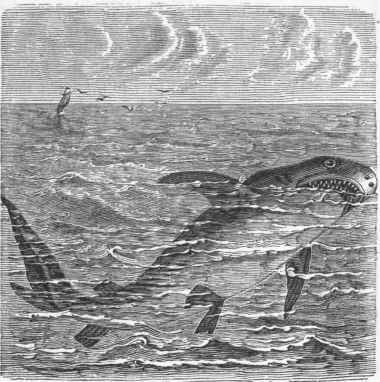
White Shark (Carcharias vulgaris).
In the family lamnidoe the gill openings are very large, all anterior to the pectorals; they have no nictitating membrane, and the spiracles are small, tail pits evident, caudal broadly forked and nearly crescentic, tail keeled on the sides, and the intestinal valve spiral. In the genus lamna (Cuv.) the snout is a three-sided pyramid with a short nasal flap, the spiracles far behind the eyes, and the mouth wide; the teeth are triangular, not serrated, with an acute toothlet at the base on each side, the surface resting on the jaw being deeply concave; there is a vacant space above and below instead of mesial teeth; skin comparatively smooth, and the scales very small. The porbeagle shark (L. cornubica, Cuv.), found on the northern coasts of Europe especially in autumn, attains a length of 9 ft.; it is uniform grayish black above and white below. They associate in small packs, from which and the porpoise-like form of the body the common name is derived; they feed chiefly on fishes and cephalopods; they are ovoviviparous.
The mackerel shark (L. [oxyrhina] punctata, Mitch.) of North America is greenish on the back, lighter on the sides, and white below; the teeth are narrow, long and nail-like, calculated for holding rather than cutting prey; the head and sides are punctured by a series of mucous pores. Like the English porbeagle, this species from its size and formidable teeth is the most dangerous of the common sharks, though it is not known to attack man unless in self-defence; it is common in summer on the New England coasts, and is a great pest to the mackerel and cod fishers; it may attain the length of 10 ft., but is usually not more than half this; it received its name from its following the shoals of mackerel on which it feeds; the liver is valuable for oil, a single fish often yielding, six or seven gallons; though generally used by curriers only, when made carefully from fresh livers it is as good as whale oil to burn. The gray shark (odontaspis griseus, Ag.) has the fore teeth simple, long, conical, with smooth edges and one or more basal toothlets; toward the corners the teeth are smaller and more incisorial; it attains a length of 4 to 7 ft., and is light bluish gray above, lighter on the sides, and white below; it is not uncommon in Long Island sound, and of late years in Massachusetts bay.
In the genus selachus (Cuv.) the snout is short and blunt, and the gill openings almost meet under the throat; the teeth are very small and numerous, conical, without serrations, curving backward, and without toothlets and notches; scales small, with radiating curved points, so that the skin feels rough; the eyes are very small. The great basking shark (S. maximus, Cuv.) is the largest of this class of fishes, attaining a length of 30 or 40 ft., and even over 50 ft., if the shark stranded at Stronsay in 1808, and described as the sea serpent, belonged to this species. It descends in summer from the neighborhood of Greenland and Spitzbergen to the English channel and the middle United States. Notwithstanding its size and strength, it is the least ferocious of the sharks; it does not appear to feed on fishes, but on cuttle fishes, crustaceans, medusae, and echini, and, according to Pennant, also on sea weeds. It is sluggish, and fond of reposing at the surface in the sun with the dorsal raised in the air, and hence called sun fish, sail fish, and basking shark; under these circumstances it is easily approached and harpooned; this is often done for the sake of the oil of the liver, which amounts to several barrels in a full-grown fish; from its speed and strength it is apt to pull a boat under water or overturn it; it has been known to drag a vessel of 70 tons against a fresh gale, and requires often 24 hours to fatigue and kill it.
It is dark slate-colored above, and lighter below. The S. elephas (Le-sueur) is probably the same species; it has been taken in the bay of Fundy 40 ft. long; on the New England coast it is called the bone shark by fishermen. - In the family alopeciidoe the snout is short and conical, the spiracles and nostrils very small, the gill openings small, the last one over the pectorals; mouth comparatively small, the teeth not serrated, triangular, sharp, and alike in both jaws; no tooth on the mesial line, and a crescentic fold of skin behind the upper teeth; the second dorsal opposite the anal and very small; pectorals large and triangular; upper lobe of tail as long as the body, with a pit at the root; scales small and three-pronged, and intestinal valve spiral. It contains the single genus alopias (Raf.), and the single species A. vulpes (Raf.), the sea fox, swingle-tail, or thresher shark; it attains a length of 15 ft., but is generally much smaller than this; the body is fusiform, bluish lead-colored above, white below, with light blue blotches on the outer edge of the abdomen. It attacks its prey and enemies and defends itself by blows of the tail; the food consists principally of herring, mackerel, and other surface and shoal fish.
It is found in the European seas from the Mediterranean to the coast of England, and also on the American side from the British provinces to the middle states; it has been known to attack fishing boats in the bay of Fundy. - In the family cestraciontidoe the nostrils are slit to within the mouth, which is at the fore end of the snout; the spiracles are rather behind the eyes; the gill openings small, the last one above the pectorals; a spine forming the front of each dorsal; tail short and wide, strongly notched below; teeth pavement-like, in rounded oblique scrolls; the body short and stout, head large, and eyes prominent. The genus cestracion (Cuv.) furnishes the only living representative of a family numerous in the secondary geological epoch; the C. Phillipsii (Cuv.) is 2 or 3 ft. long, brownish above and whitish below; it inhabits the Pacific from Australia to Japan; it is called nurse in Australia, and cat or kitten shark in China; the young are often seen in Canton insect boxes. - In the family scymnidoe the dorsals are without spines, and there is no anal nor nictitating membrane; the upper teeth are pointed, the lower broader and cutting and not denticulated; no tail pits; intestinal valve spiral.
In the genus scymnus (Cuv.) the spiracles are far behind the eyes, the gill openings small, the body short and thick, and the lobes of the tail not very unequal. The Greenland shark (S. borealis, Flem.) attains a length of about 14 ft., and is ashy gray; it inhabits the arctic seas, sometimes visiting the northern shores of Europe and America. It attacks whales fiercely, and scoops out at every bite a piece as large as a man's head, the mouth being 20 to 24 in. wide. According to Scoresby, they generally attend the cutting up of whales, helping themselves freely to blubber; the men often fall into the water among them, but are not attacked; they are so tenacious of life, and so insensible to wounds, that they will return to their prey after receiving lance stabs which would kill any other shark; the muscles, especially those of the jaws, retain their irritability for several hours after death; the heart is said to be very small, and its pulsations only six or eight in a minute, which would explain their tenacity of life and the difficulty of reaching any vital organ. They also eat small fishes and crustaceans.
They are liable to the attacks of a parasitic crustacean (lernoea elongata, Grant), 2 or 3 in. long, which fixes itself so often to the cornea of the eyes, that it was formerly supposed to be a natural appendage; this sometimes makes them apparently blind.
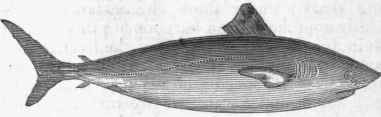
Mackerel Shark (Lamna punctata).
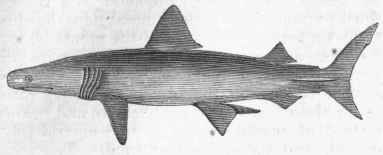
Great Basking Shark (Selachus maximus).
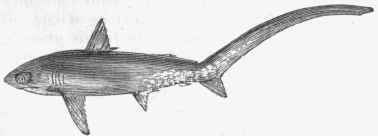
Sea Fox (Alopias vulpes).
The nurse or sleeper shark (S. brevipinna, De Kay; somniosus, Lesueur) attains a length of 8 ft.; the color is leaden gray, darkest on the back, with a black lateral line; the fins are so small that it must be rather slow in its movements, and it is generally regarded as a ground shark; the skin is rough and prickly; a few specimens have been caught on the coast of Massachusetts. - In the family squatinidoe, the only genus, squatina, has been treated under the title Angel Fish. - In the family zygoenidoe there is a nictitating membrane, no spiracles, and two spineless dorsals; the head is flat, with the orbits extended laterally in a most extraordinary manner, flexible and doubled on themselves in the foetus, but standing out at right angles and to a greater distance as age advances; on the end of these lateral processes are the large eyes. This strange form of head is found in no other vertebrate, and only in some dipterous insects (diopsis, &c), and in many decapod crustaceans whose eyes are at the end of long pedicels.
The snout is truncated, so that the head resembles a double hammer; the nostrils are on the front border, and have a small nasal flap; the teeth are alike above and below, compressed pyramids, sometimes with a serrated external basal ridge, and a mesial tooth in both jaws; tail pits distinct, and oviduct villous. Such are the characters of the only genus, zygoena (Cuv.) or sphyra (Van der Hoeven), of which the best known species is the hammer-headed shark (Z. [S.] malleus, Cuv.); it attains a length of 12 ft. or more, and is grayish above with head nearly black, and whitish below; the iris is yellow; the first dorsal is high, triangular, falcate, and toward the upper part of the back, the second smaller and near the tail. It is found in the Mediterranean and in the warm seas of most parts of the globe, especially of the East Indies, and generally in deep water. It is so ferocious as to attack persons bathing, and is very voracious, feeding chiefly on rays and flat fishes; great numbers of them are sometimes seen together; the flesh is leathery and unfit to eat, but the liver yields considerable oil; a female opened at Penang was found to contain over 35 living young.
The common species of America, between Massachusetts and Brazil, once considered the Z. malleus, has been described by Dr. Storer ("Proceedings of the Boston Society of Natural History," vol. iii., 1848) as the Z. arcuata; it attains a length of 11 or 12 ft., and is much dreaded by fishermen. - Large sharks abounded in former geological epochs, especially during the secondary and primary periods. In some of the tertiary formations, as at Malta, teeth of sharks have been found 7 in. long and 4 1/2 in. wide at the base. - The principal shark fisheries are on the N. and N. W. coasts of Iceland, in Norway, and on the arctic shores of Russia W. of the White sea, where they are pursued chiefly for the oil, and on the W. coast of Hindostan in the vicinity of Bombay, where they are pursued chiefly for the fins. These are sent to China, the annual exports from Bombay amounting to £15,000 or £20,000. The fins are also collected in the Indian archipelago.
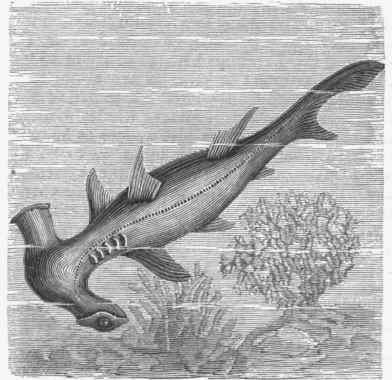
Hammer-headed Shark (Zygaena malleus).
Continue to:


My Books

