


Dacca. I
Description
This section is from "The American Cyclopaedia", by George Ripley And Charles A. Dana. Also available from Amazon: The New American Cyclopædia. 16 volumes complete..
Dacca. I
A district of the province of Bengal, in British India, between lat. 23° 12' and 24° 17' K, and lon. 90° 11' and 90° 58' E.; area, 2,897 sq. m.; pop. in 1871,1,853,416. It is almost entirely level, and traversed by numerous rivers which abound with fish. Of wild animals, there are the elephant, buffalo, tiger, bear, and leopard; of wild birds, the fishing eagle, vulture, kite, adjutant bird, and crane. The porpoise is seen in the large rivers, where the sharp-beaked and the blunt-beaked crocodile are also found. Snakes are numerous. The domestic animals are kine and buffaloes. The number of wild animals is diminishing, and land formerly covered with jungle has been cleared for cultivation. The land is inundated every year, and very fertile; rice, cotton, sugar, betel-nut, hemp, and indigo and other dyestuffs are produced to some extent. The cotton product has considerably declined since the closing of the fine muslin manufactories at Dacca, and the attempts to introduce American cotton have not been successful.
The British authority was established in 1765. In the N. part are *two distinct tribes, the Kunch and Rajbansi, more vigorous than the rest of the population, which is about equally divided between Brah-mans and Mussulmans; the latter, however, are considered more numerous. The Eastern Bengal railway, 159 m. long, runs from Calcutta to Goalundo at the confluence of the Brahmapootra and the Ganges, and intercepts the traffic which comes down these rivers. The section from Kootshe to Goalundo was opened for use Dec. 31, 1870. II. The capital of the district, situated on the Burha Gunga, an arm of the Brahmapootra, 150 m. N. E. of Calcutta, and 116 m. E. S. E. of Moorshedabad; pop. about 50,000, of whom more than half are Mussulmans. It was once a considerable and wealthy city, being the centre of the manufacture of fine muslins. The spinning of the almost impalpable threads for these goods was entirely by hand. The muslins, named from their fineness abrawan, or "flowing water," and shabnam, or "evening dew," were never imitated elsewhere. With the decay of the Indian courts, the chief customers, the demand ceased and the manufacture has entirely stopped. Dacca now exhibits little more than ruins, extending several miles along the river, and in many places overgrown with dense jungle.
The streets of the inhabited part are narrow and winding; the houses of the wealthy are of brick, but the bazaars and the cottages of the poor are only thatched. The extensive citadel, on the western side of the town, and the magnificent palace built by Aurungzebe's grandson, Azim Ushaun, toward the close of the 17th century, are in ruins. The city and suburbs possess a number of bridges, landing places, ferry stations, bazaars, and buildings for fiscal and judicial purposes, a jail and jail hospital, a lunatic asylum, an Indian hospital, an elephant depot, a large number of Mussulman mosques and Brahmanical temples, and Anglican, Greek, Armenian, Catholic, and Baptist churches. The last denomination maintains a missionary establishment and several schools. There is a college managed by a local committee, but under the control of the government. About $60,000 was paid to the city in 1850 as a bequest of Mr. Robert Mitford, for the benefit of the native poor. The climate here is not so hot and unwholesome as in some other parts of India, owing to its situation near rivers whose currents are rapid.
The unhealthy season is from August to October; throughout the rest of the year the city and vicinity are salubrious. - During part of the 17th century Dacca was the chief city of Bengal.. The disorders produced by the invasion of Nadir Shah injured its prosperity. Many ruins within the city and its suburbs bear witness to its ancient importance.
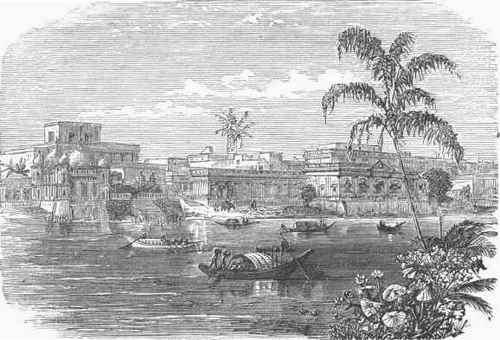
Dacca.
Continue to:


My Books

