


Grouse
Description
This section is from "The American Cyclopaedia", by George Ripley And Charles A. Dana. Also available from Amazon: The New American Cyclopædia. 16 volumes complete..
Grouse
Grouse , the name of gallinaceous birds of the family tetraonidoe, characterized by a short broad bill with culmen curved; the nostrils concealed by closely set feathers in the nasal groove; wings short, concave, and rounded; tarsi moderate and densely feathered; the toes usually naked, with scaly pectinations along the edges, but feathered to the claws in the snow grouse or ptarmigans. The tail varies in length and shape, and consists of 16, 18, or 20 feathers: there is generally a bare space about ! the orbits, with fringed processes above the upper lid; the hind toe is short, and slightly elevated. The old genus tetrao (Linn.) has been subdivided into many genera by modern systematists; it included both the grouse and the ptarmigans or moor fowl, the latter of which will be described under Ptarmigan. The grouse are the largest of the family, robust and round-bodied, frequenting heathy woods, feeding on young shoots, tender buds, and berries, in pine and spruce forests and cedar swamps in the northern regions of America, Europe, and Asia. - In the genus tetrao (Linn.) and the allied centrocercus (Swains.), the legs are feathered as far as the basal membrane of the toes; the tail is lengthened, slightly narrowed to the somewhat rounded tip, and the shafts stiffened; no ruff on the sides of the neck.
The largest species is the wood grouse or capercailzie (T. urogallus, Linn.), measuring nearly 3 ft. in length, and weighing about 15 lbs.; the feathers of the head and cheeks are elongated and erectile; the hind neck, back, and sides are minutely varied with black, brown, and gray; the lower breast and belly black, with a few white feathers; the fore part of breast rich glossy green, with metallic reflections. The females are much smaller, and, like the young males, are brown with black crescent marks. In size, strong hooked bill, and noble bearing, it resembles a bird of prey; it is nearly extinct in Great Britain, though it is found in Norway, Sweden, Russia, and northern Asia. It inhabits forests of pine and birch with an undergrowth of juniper; it is extremely shy, but will breed in confinement, and may be domesticated, in which state it feeds on grains and resinous twigs. This species perches in trees; the nest is placed amid brakes and underbrush; the eggs are 8 to 16, yellowish white, with darker yellow spots.
The T. hybridus (Linn.) is generally considered a hybrid between the capercailzie and the black grouse (T. tetrix, Linn.); it is found in northern Europe, and is from 2 1/4 to 2 1/2 ft. long; the general color is black, with purple and bronzed reflections, dashes of white on the belly, and on the secondaries a spot of the same; the scapulars and wing coverts deep brown, with delicate yellowish waves; tail slightly forked, the upper coverts black, the under tipped with white. The black grouse has been described under Blackcock. Among the American species is the Canada grouse, sometimes called erroneously the spruce partridge (T. Canadensis, Linn.). It is about 16 1/2 in. long; the prevailing color is black in the male, each feather of the upper parts waved with leaden gray; those of the sides, scapulars, and outer surface of the wings have a central white streak expanding toward the tip; the under parts are mostly uniform black, broadly tipped with white on the sides, this color sometimes forming a pectoral band; bar across base of upper mandible, spot on lower lid, line on cheeks and throat, white; quills dark brown; tail of 10 feathers, dark brown, tipped with a band of orange chestnut half an inch wide; chin, throat, and bill black; under tail coverts black, barred and tipped with white.
The female is smaller, but similar, with broader black bars above, and below barred with orange and white; the continuous black on the head and breast is wanting. They are found in the spruce forests and cedar swamps of the northern states to the arctic seas, and westward nearly to the Rocky mountains; their flesh, like that of the other grouse, is excellent, but in the winter it has the bitter flavor of the spruce on which they feed at that season. They are not very shy; when alarmed they resort to trees; the nest is made upon the ground, and the eggs, comparatively few, are varied with white, yellow, and black. - The pheasant-tailed grouse, sage cock, or cock of the plains (centrocercus urophcisianus, Swains.), is by far the largest of the American grouse, measuring about 30 in., with an extent of wings of about 40; the tail is very long, wedge-shaped, the feathers all lanceolate, and longer than the wings; the feathers of the lower throat and sides are stiff and spiny. Above, the plumage is varied with black, brown, and brownish yellow, the coverts streaked with the latter; black below, the breast and tips of tail coverts white, the lower part of the former with black streaks; the tail has 20 feathers.
It is found in the desert plains of the for west, especially about the branches of the Columbia river; it feeds on the various species of wormwood, which impart a bitter flavor to its flesh; it is not shy, and is a poor flier; the eggs are numerous, 13 to 17, of a wood-brown color, with irregular chocolate blotches on the larger end, and about the size of those of a common fowl. The sharp-tailed grouse (T, phasianellus, Linn.; genus pediocoetes, Baird) has a short, graduated tail of 18 feathers, the central pair elongated about an inch beyond the rest; the length is 18 in. and the extent of wings 20. Above, the color is light brownish yellow, varied with black, and with rounded white spots on the wings; below pure white, with dark V-shaped marks on the breast and sides; there are no elongated feathers on the neck, as in the next species, the bill is stouter, and the tarsi are more densely feathered. It inhabits the northern prairies and plains from Illinois to Oregon. Its food consists of the buds and sprouts of the beech, willow, aspen, larch, and similar trees, and of berries; the eggs, about 13, are white, with colored spots.
The pinnated grouse, prairie hen or chicken (T. eupido, Linn.; genus cupidonia, Reich.), has a tail of 18 feathers, short, truncate, and much graduated, and a tuft of long, lanceolate feathers on each side of the neck, covering a bare space capable of considerable inflation. The plumage is covered with transverse bands of white on a brown ground, the latter nearly black, and the former with a rufous tinge, above; long feathers of the throat black; different specimens vary much in color. The length is about 17 in., with an extent of wings of 28, and a weight of 3 lbs. This species, once common in the Atlantic states, is now mostly confined to the western plains; the old name in New York was heath hen. The food is acorns, buds, leaves, berries, and grains. They remain all the year in their favorite and barren grounds; in spring the males meet at break of day in what are called "scratching places," where they swell and strut with great pomp, and engage in fierce contests, uttering a peculiar sound rendered more intense by the large inflated sacs on the sides of the neck.
Their flesh, as well as that of the preceding species, is excellent. - The ruffed grouse, erroneously called partridge in New England and pheasant in the middle states (bonasa umbellus, Steph.), is familiarly known by its ruff of velvety black feathers on the sides of the neck, its broad tun-like tail of 18 feathers, partially crested head, and tarsi naked in their lower half. The sexes are nearly alike. It is reddish brown or chestnut above, varied with lighter heart-shaped spots and streaks of light brownish yellow; below, whitish, with transverse bars of dull brown; tail tipped with gray, with a subter-minal bar of black. The length is 18 in., and the extent of wings 2 ft.; it is found in the eastern states and Canadas, and probably as far as the Rocky mountains. The species of the Pacific coast, darker and with a longer middle toe, has been described as the B. Sabinii. The ruffed grouse prefers wooded regions, where evergreen trees and streams abound. They are rather solitary, usually seen in pairs or single, and fond of frequenting travelled paths; the males make a peculiar drumming sound, standing upon a log, inflating the body, and beating the air with short and quick strokes of the wings; this is most commonly heard in the morning and evening, but also at all times of the day.
The nest is built on the ground, early in May, and the eggs, 9 to 15, are clear brownish white; the female, like other birds of the family, exhibits signs of great distress when her young brood are approached, and makes use of various well known stratagems to lead the intruder from the spot. The flight is vigorous, and accompanied by a loud whirring noise; they are easily hunted with a good dog, generally betaking themselves to a tree; they are taken in traps and snares set in their favorite paths; in severe winters they are often found frozen under the snow, into which they dive for protection, a crust having formed above them. Their flesh is excellent, and in best condition in autumn, when the partridge berries impart a peculiar aromatic flavor; in winter they are sometimes forced to eat the tender buds of the laurel, and then their flesh may possess poisonous properties so strong as to cause death in delicate persons. - The willow or white, the rock, the white-tailed, the American, and the red grouse of Europe, belong to the genus lagopus (Briss.), and will be described under Ptarmigan. - The sand grouse (pterocles, Temm.) represents the family of tetraonidoe in the sandy deserts of Asia and Africa, and in some of the bare rocky plains of southern Russia. Their very long and pointed wings, with the first and second quills the longest, enable them to traverse vast distances with an ease and rapidity unnecessary in birds of the moor and forest; their bodies are light and slender, and the tail large and wedge-shaped; the tarsi robust, long, covered with feathers in front and on the inside; the short and stout toes, united at the base by a prominent membrane, enable them to run lightly over the soft sand.
Their prevailing colors are shades of brown, gray, and ochreous yellow, like that of the deserts in which they live. The banded sand grouse (P. arenarius, Pall.), found occasionally in Europe, has the belly deep brownish black, with a spot of the same on the throat and a band on the breast; the female is paler, without the patch on the throat. The food consists of seeds, bulbs, and insects; the nest is made upon the ground, and the eggs are only four or five in number. - The grouse are polygamous, and very tyrannical in their gallinaceous harems; after the short love season the males desert the females and lead a solitary life, caring for neither mate nor progeny. - The name of partridge cannot properly be given to any grouse; the genus perdix (Briss.), and indeed the whole family of perdicinoe, are not found in America; the term is equally inapplicable to the quail family.
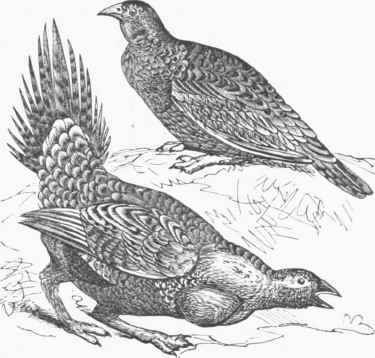
Cock of the Plains (Centrocereus urophasianus), Female (upper figure) and Male.
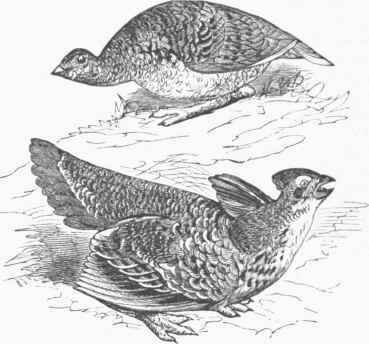
Pinnated Grouse (Tetrao cupido), Female (upper figure) and Male.
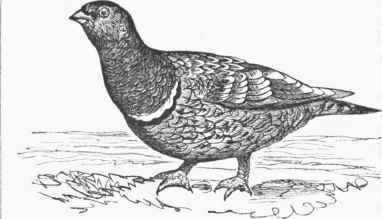
Banded Sand Grouse (Pterocles arenarius).
Continue to:


My Books

