


Florence. Part 15
Description
This section is from the book "Florence - John L. Stoddard's Lectures", by John L. Stoddard. Also available from Amazon: John L. Stoddard's Lectures 13 Volume Set.
Florence. Part 15
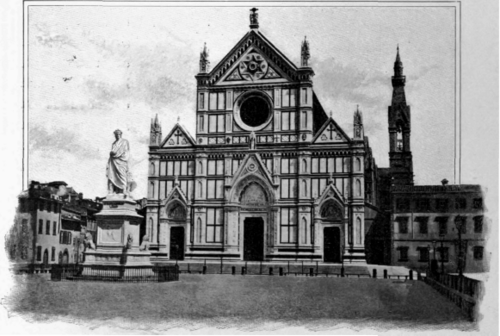

Monument To Luigi Cherubini.
The Church of Santa Croce is the Westminster Abbey of Florence, - the recognized shrine of Italian genius. Here are the tombs of Michelangelo, Galileo, and the poet Alfieri, who said that his first wish to acquire fame awoke within his breast while walking in the aisles of Santa Croce. Here, also, the subtle brain of Machiavelli finally found rest; while other tombs of prominence are those of Cherubini, the composer, and Raffaello Morghen, the engraver. It is especially appropriate that Michelangelo should be buried here; for not only was Florence the city of his love, but this particular spot in Santa Croce was chosen by him as his place of sepulture; since from this place, when the doors of the church are open, one can look out on the magnificent dome of the cathedral which he so admired.
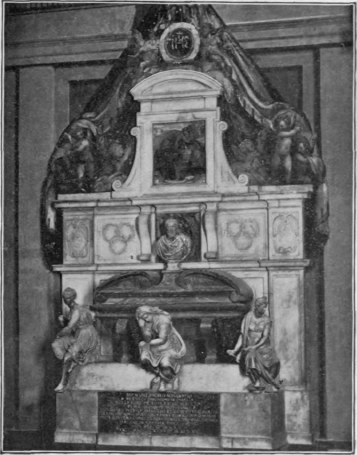
The Tomb Of Michelangelo.
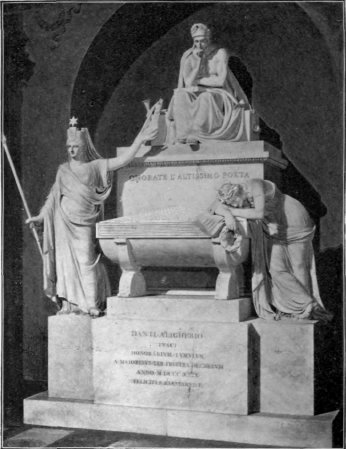
The Cenotaph Of Dante.
A most impressive feature of this edifice is the Cenotaph of Dante. Hoping to obtain his body from Ravenna, the Florentines erected this for its reception, but in vain, - the splendid sepulchre is tenantless. Yet there was justice in the answer of the Ravennese : "You exiled Dante when in life, and set a price upon his head. With us he found a home and grave; and here he shall remain forever." Under the circumstances, therefore, this monument seems a brand of shame upon the brow of Florence. It is, indeed, imposing, for all its figures are colossal. On one side, Poetry mourns her loss; while on the other, star-crowned Fame points upward to the statue of the bard, as though about to utter the quotation from the "Inferno," which appears on the sarcophagus, "Onovate l'altissimo Poeta." There is a burial-place in Florence, dearer by far to all American hearts in its simplicity than even the magnificent shrine of Santa Croce. It is the Protestant Cemetery. Its situation was formerly more beautiful than now, for the old city walls which sheltered it have been removed, and modern thoroughfares surround it. In fact, on account of its circumscribed area, no more interments will be made, and a new burial-ground has been provided in another part of the city. But English and American visitors will always reverently come to this, since in its hallowed precincts lies the precious dust of authors, poets, artists, and travelers, whose fate it was to die here, far from home. Among them are Walter Savage Landor, Arthur Hugh Clough, Mrs. Trollope, and Theodore Parker, and (dearest of all, to thousands of her readers), England's greatest poetess, Elizabeth Barrett Browning. Her resting-place is marked by a sarcophagus of pure white marble, bearing her initials, and, through the spring and summer months red roses bloom, and lilies lift their snowy heads above her silent heart. Her poet-husband acted wisely in giving her a burial-place in Florence rather than in England; for, partly on account of her long residence here for the sake of her health, and partly because of the birth of her child in Florence, this city had become the idol of her heart. The very air of Florence breathes of her presence, since almost every prominent portion of the city is associated with her by her glorious verse; and in the house called "Casa Guidi" where she died, in 1861, and at whose "windows" she so often wrote, a marble tablet has been placed by grateful Florentines, stating with truth that by her poetry she formed a golden link between Italy and England.
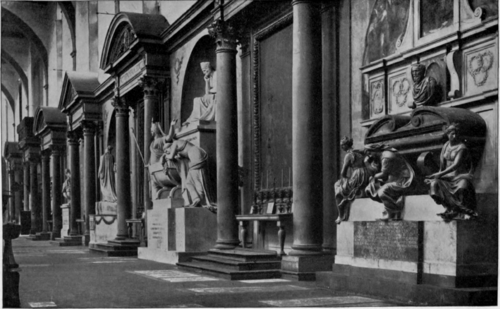
The Interior Of Santa Croce.
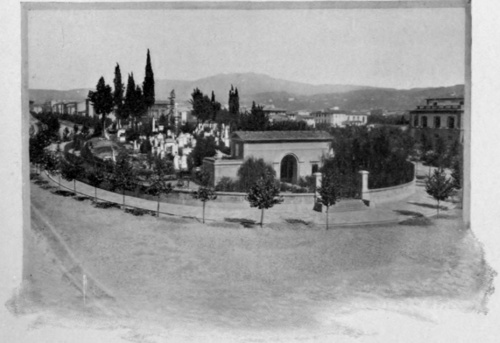
The Protestant Cemetery.
Whether or not the name of Florence is derived from the Latin Florentia, the Tuscan capital has been for centuries appropriately called the City of Flowers. A lily figures in the . Florentine coat of arms, and in the spring the hills environing Florence are literally carpeted with lilies, violets, tulips, and crocuses. Bouquets of roses, hyacinths, and carnations, also, can then be bought here for a few pennies. In walking for the first time through the streets of Florence, or driving in the park, you will usually be approached by a pretty flower-girl, who offers you with an engaging smile and a few words, in the most musical of languages, a beautiful bouquet.
Continue to:


My Books

