


South Tyrol. Part 14
Description
This section is from the book "South Tyrol - John L. Stoddard's Lectures", by John L. Stoddard. Also available from Amazon: John L. Stoddard's Lectures 13 Volume Set.
South Tyrol. Part 14
For the third time the Tyrol was free. The peasant leader now became the ruler of the country. Coins were struck with his effigy, and proclamations were issued in his name. Yet this was not in the least a usurpation. The hero was as loyal as he was powerful; as modest as he was brave. During his governorship, he lived, indeed, in the imperial palace at Innsbruck, but for his personal expenses and salary he drew from the treasury ninety cents a day ! His simple habits were the same as when he had been an inn-keeper in the Passeier Thal. He also declared emphatically that he was acting thus solely as the representative of the Austrian kaiser, until the latter should be once more sovereign of the Tyrol. "So, und nit cinders" he said.
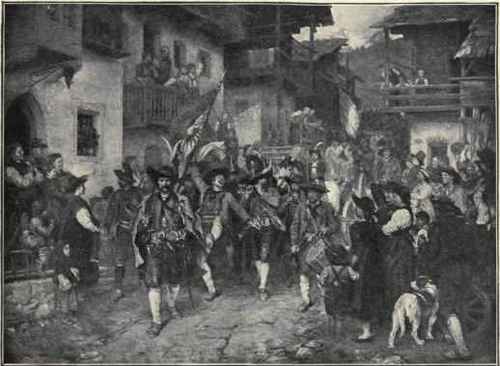
The Home-Coming Of The Conquerors.
At length, however, Napoleon's victory at Wagram and his second occupation of Vienna changed the face of affairs. The defeated Austrian emperor was obliged to sign a treaty, whereby he agreed to withdraw all troops from the Tyrol, and to consent to its reabsorption by Bavaria. When these appalling tidings reached the Tyrolese, they thought them an invention of the enemy. It seemed incredible that, after such fierce fighting, brilliant victories, and loss of precious lives, they must be thrust back into the condition from which they had so nobly freed themselves. Doubt was, however, soon dispelled by the arrival of a messenger from the kaiser, commanding the Tyrolese to make no further resistance, and to resign themselves to the inevitable. Hofer obeyed, and having yielded submission to Napoleon's stepson, Eugene, then viceroy of Italy, ordered his followers to lay down their arms. This many of them refused to do. Hundreds of desperate and unhappy peasants would not accept the situation, and begged their former leader to lead them out once more against the enemy. To influence him to do this, some willfully invented stories of victories of the Austrians over the French. Others reproached him for his cowardice in not completing what he had begun. In an evil moment Hofer yielded to this pressure, which doubtless coincided with his own desires, though not with his calm judgment, and called the Tyrolese again to arms.
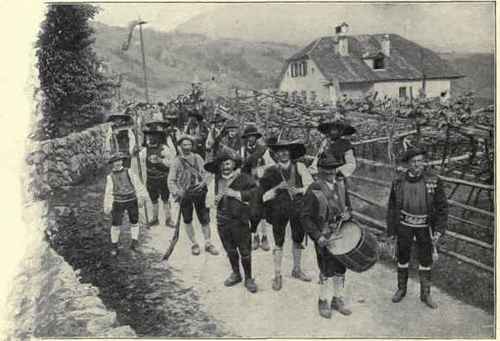
Tyrolese Militia.
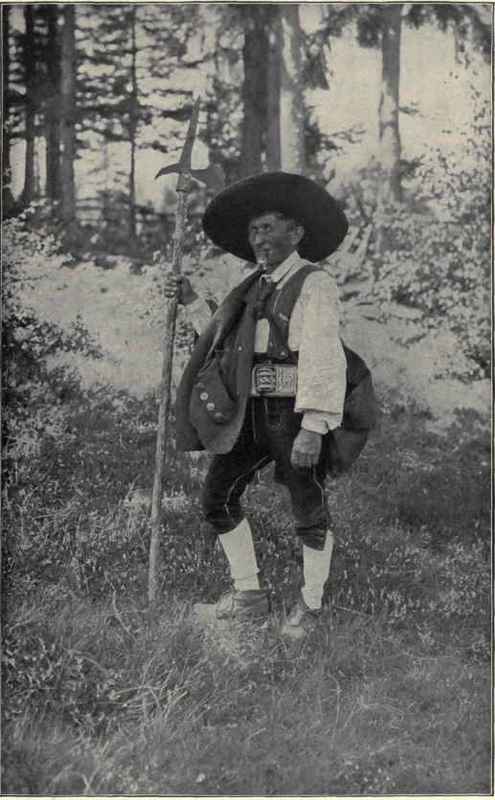
One Of The Heroes Of 1809.
Fierce fighting followed, especially near Meran and in Pas-seier Thal; but there was wanting now that national unity which had made all the previous attempts successful, and when another army of fifty thousand French and Bavarians entered the exhausted province, Hofer, unable to resist such overpowering numbers, retired to his mountain home. A price of fifteen hundred gulden was set upon his head, and for this sum a former friend, a man named Riffl, from Schenna, two miles distant from Meran, was base enough to play the role of Judas. Under his guidance a party of French soldiers reached at last the hut where Andreas had taken refuge; and at four o'clock in the morning, on the 28th of January, 1810, the patriot was captured.
The French troops brought him jubilantly to Meran, where one may still behold the house in which he passed the night before being taken on to Italy. It stands in the street known as the Rennweg, and on its front wall is a marble tablet with the inscription: " In this house, on the night of the twenty-eighth of January, 1810, Andreas Hofer, the hero of the , Tyrōl, was detained as a prisoner, before his painful journey to Mantua." A few steps from this structure, on the façade of the hotel "Graf von Meran," is a marble bust of the great leader, with a memorial tablet testifying to the fact that there, on the same night, he was formally questioned as a prisoner by General Huard.
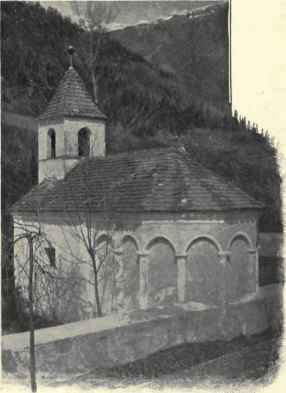
Old Chapel Near Hofer's House.
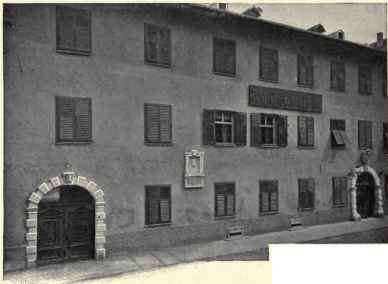
Hotel Graf Von Meran, With Hofer Memorial Tablet.
In Mantua, Hofer was promptly tried by court-martial, and sentenced to be shot. He met his fate with the courage which had always characterized him, and when led out to death refused alike to have his eyes bandaged or to kneel. Standing erect before his executioners, his last words were: "Long live Kaiser Franz! Fire!"
Continue to:


My Books

