


South Tyrol. Part 26
Description
This section is from the book "South Tyrol - John L. Stoddard's Lectures", by John L. Stoddard. Also available from Amazon: John L. Stoddard's Lectures 13 Volume Set.
South Tyrol. Part 26
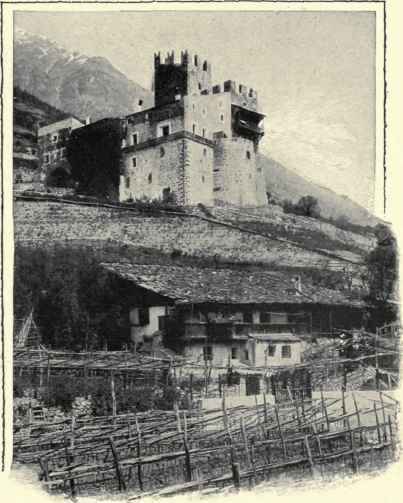
Schloss Naturns, In The Vintschgau Valley.
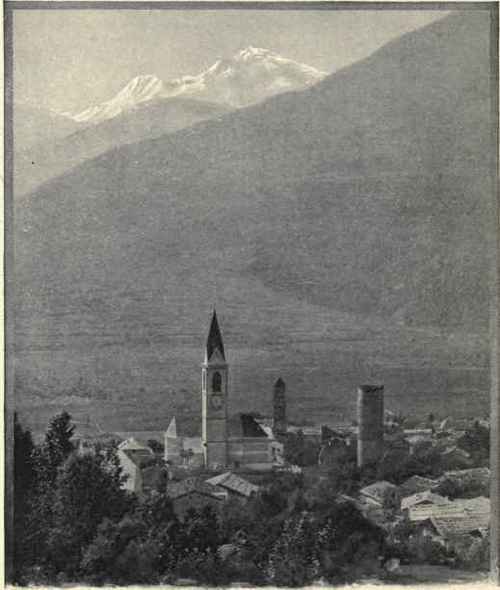
The Roman Tower At Mals, Looking Toward The Ortler.

A Spanish Chestnut Tree In South Tyrol.
The journey from Meran to the summit of the Stelvio falls naturally into three divisions, the first of which is ended at the parting of the ways in Neu Spondinig. The second is a glorious drive of about three hours to Trafoi, where one spends the night. The third stage is, of course, the Pass itself. Each of these sections is superior to its predecessor, not only in respect to altitude, but also in the increased ozone of its atmosphere and the grandeur of its scenery. The sight of Trafoi, when one enters it, - as is frequently the case in coming from Meran, - just as the sunset glow is reddening its snow-covered amphitheatre, is a wonderful revelation of supernal beauty. I have led thither more than one American friend, whose eyes have filled with tears before this vision of surpassing loveliness. Trafoi may be called the Tyrolese Chamonix. The gorge in which it lies is narrower than the valley of its Alpine rival, it is true; but for that very reason the mighty ice floods, which seem poised above it, are nearer to the visitor here than are the Mer de Glace and Argentière to the inhabitants of Chamonix; while close to Trafoi, also, is the noble Ortler, which dominates this landscape from its vast white throne with hardly less of royal splendor than is shown by the great sovereign of the western Alps, Mont Blanc. Moreover, there are striking points of resemblance between these highest peaks, respectively, of Switzerland and the Tyrol, and though the latter attains the altitude of only about thirteen thousand feet, its glorious summit, mitred with millennial snows, is undeniably sublime.
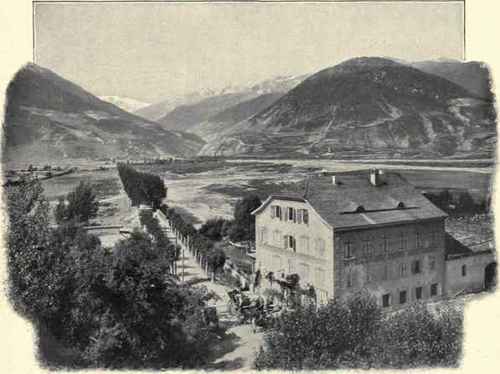
Neu Spondinig And The Road To The Stelvio.
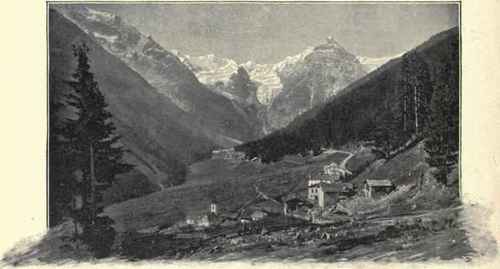
The Approach To Trafoi.
Perhaps the only adverse criticism to be passed on Trafoi is the appalling nearness of the mountains in whose ice-mailed grasp it seems to lie. To stand here, on the hotel balcony, at night, when the dark canon far below is black with shadows, while all the upper world is radiant with the whiteness of the moon, is something overwhelming in its grandeur and solemnity. Yet there is mingled with the scene's unearthly beauty a suggestion of the terrible. For the extremities of the long glaciers creeping toward the valley seem like the tentacles of a gigantic octopus, thrusting its glittering arms out toward the little hamlet to seize it with relentless grip and drag it to those gaping jaws into whose blue-green depths the moonlight weirdly falls.
Trafoi, however, though lying at the foot of the Stelvio, is far from being a mere temporary station for a single night, with no resources in itself to hold and entertain the tourist. Like Chamo-nix, it offers to the visitor many notable excursions to the heights; while, only a few hours distant from it by an admirable carriage road, lies Sulden, on the other side of the Ortler, the sight of which from that point, together with the panorama of the famous Koenigspitze and its glaciers, are by some deemed finer than the views obtainable at Trafoi. Personally, I prefer to linger in the latter place, and to drive thence occasionally to the Sulden valley.
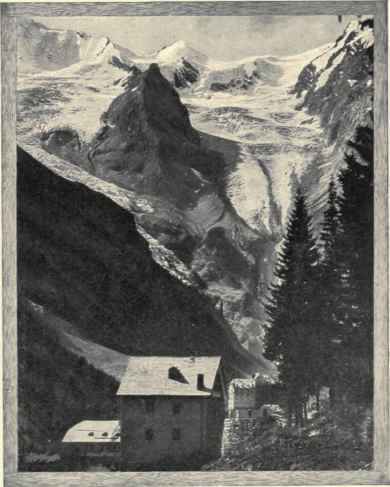
The Glaciers And Hotel Trafoi.

The Koenigspitze And Glaciers Seen From Sulden.
It is, however, the especial glory of Trafoi that it is the starting-point for the crossing of the Stelvio. I know not how to speak in moderation of this royal road. Yet if I praise it in superlatives, it is not the result of limited experience. Having been always a believer in seeing Switzerland from a carriage and on foot, rather than in hurrying through its finest areas by rail, I have repeatedly crossed in diligence or carriage, the St. Gotthard, Simplon, Splügen, Furca, and Great St. Bernard. Hence with the liveliest recollections of those routes, I nevertheless would give the palm for beauty and sublimity to the Stelvio. Nor is this eulogy enough; for, on account of the nearness and extent of its stupendous snow and glacial scenery, I think it more imposing than all the other Alpine routes combined. This is not strange. For since it reaches an elevation of nine thousand two hundred feet, it is the highest carriage road in Europe, surpassing both the St. Gotthard and Splügen by twenty-two hundred, and the Simplon by twenty-six hundred, feet. The route itself is a marvel of engineering skill and perfect workmanship. Firm, broad, and smooth, it zigzags up the fearful cliffs in leagues of easy serpentines, bordered alike by precipice and parapet. Where landslips have been feared, immense retaining walls protect the soil above it and below. Do mountain torrents sweep across its path? In all such places massive culverts have been built to guide the furious floods beneath the untouched thoroughfare. Do avalanches threaten it? Then from these cliffs themselves huge galleries have been hewn and blasted, from whose protecting roofs the deluge slides off harmlessly into the depths. I know nothing finer in the art of road-making than is presented by the Stelvio. Yet, though improvements and repairs are always being made, this route is not a modern one. It was completed by the Austrians in 1825 for military purposes, and offered formerly the best facilities for hurrying troops from the Tyrol to Lombardy. Even now grim fortresses defend it, as they do all Alpine passes which connect the neighboring countries, - Austria, Switzerland, and Italy. But now the only conflicts likely to occur here are those which take place in the winter months, when man has left the highway to its fate, and when the winds from Italy, Switzerland, and Austria meet here, like packs of howling wolves, and do their utmost to destroy it.
Continue to:


My Books

