


Steam Carriages. Part 6
Description
This section is from the book "The Engineer's And Mechanic's Encyclopaedia", by Luke Hebert. Also available from Amazon: Engineer's And Mechanic's Encyclopaedia.
Steam Carriages. Part 6
Mr. Neville, of Shad Thames, London, took out a patent for steam locomotion in 1827, the chief object of which appears from the specification to have been to prevent the wheels of a locomotive carriage from slipping round. To effect this he proposed the application of points and plates to the peripheries of the wheels. But as these contrivances were worse than useless, and the arrangements of the steam carriage contained nothing worthy of particular remark, we abstain from all detail.
Amongst the singular propositions for producing a locomotive action, was that invented by Mr. T. S. Holland, for which he took out a patent, in 1827. The invention consists in the application of an arrangement of levers, similar to that commonly known by the name of lazy-tongs, for the purpose of propelling carriages. The objects appear to be, to derive from the reciprocating motion of a short lever a considerable degree of speed, and to obtain an abutment, against which the propellors should act horizontally, in the direction of the motion of the carriage, instead of obliquely to that motion, as is the case when carriages are impelled by levers striking the earth. The drawings attached to the specification seem designed rather to explain the principle than to represent what the patentee would deem an eligible form of its application: and as such an application is not likely to be ever considered eligible, on account of the excessive waste of power from friction, we must content ourselves by referring the reader who may require more information on the subject, to the inrolled document.
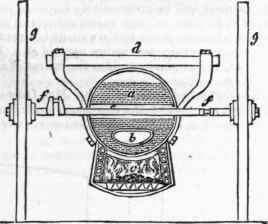
Andrews's Steam Carriage
Patent 1826.
Two days after the before mentioned grant, Dr. Harland, of Scarborough, received the great seal for supposed improvements, which we doubt not proved inefficacious; we shall therefore give but a brief sketch of the nature of them. On a phaeton-like frame at the back of the carriage, are situated the boiler (composed of two double cylinders), the fire-grate, ash-pit, chimney steam chamber, water reservoir, and working cylinder, etc. After the steam has passed through the latter, it is conducted to a series of tubes, underneath, and in front of the carriage, for the purpose of condensation by the cooling influence of the atmosphere. The fruitlessness of such attempts, which has been long before determined (owing to the slow conductibility of the air), together with the defects of construction, renders it needless to enter into details.
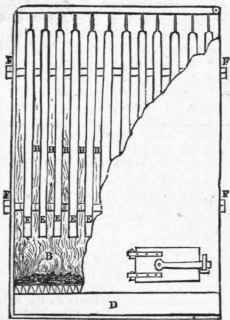
Mr. Walter Hancock, in the year 1827, took out a patent for a high pressure boiler, for locomotive purposes. In the annexed engraving is represented an elevation of the first modification of this boiler, with a part of the casing removed to show the interior structure. At B is the fireplace; D the stoke-hole; E E are a series of flat parallel chambers to hold the water, made of the toughest sheet iron, and placed side by side, at a sufficient distance apart for the flames and heated air to pass up between them, as shown at H H. Each of these flat vessels extends across the furnace chamber, so as to fill its whole area in a vertical plane; and they are all connected at the bottom, for keeping the water in each at a uniform level; and at the top of each of the chambers there is a steam-pipe that leads into another larger steam-pipe, common to them all, and by which the engines are supplied. To keep the individual water chambers E E at uniform distances apart, and confer, at the same time, adequate strength to them, a series of vertical bars or fillets are fixed between each pair.
Therefore, instead of the flames ascending between each pair of plates in one unbroken sheet, it is subdivided, and made to pass through a number of rectangular channels, representing in their outline so many square tubes. This combination of water chambers and alternate flues is bound together by a system of very massive bolts externally, proved to be capable of sustaining a vastly greater pressure than the boiler is ever subjected to; and it is unquestionably a great merit in this boiler, that the thinness of metal, and consequent weakness of the individual water chambers, constitutes each, in effect, a safety valve. An increased efficiency was afterwards obtained by "embossing" the plates; by pressing them between dies, so as to cause a series of hemispherical bosses, of nearly the shape and size of watch-glasses, to be projected all over their external surfaces; so that when the chambers are brought together, the tops of these come into contact, and thus a series of spaces are formed between them, through which the heated gases ascend in a devious course, impinging successively upon each boss in their passage.
Mr. Hancock being satisfied that he had obtained in this boiler the requisite means of generating adequate power, turned his attention to the various arrangements of the carriage and propelling machinery. His first carriage was constructed upon three wheels, and the power was applied through the medium of two vibrating engines fixed upon the crank axle of the fore wheel. Finding this mode of applying the power direct to the crank axle practically ineligible, Mr. Hancock next placed the engine quite behind; new difficulties occurred in this arrangement, and a third carriage was built, and called in reference to the infancy of the undertaking, the "Infant."

Hancock's Steam Carriage "Infant."-1830.
At a is the fire-place, b the ash-pit, and g a blower. The fire place and ash-pit are made close, that is, admitting only of a current upwards. The fireman, who sits on a small seat behind the boiler, views the state of the fire through eyeholes, and supplies coke through a feeding hopper at q. Steam is supplied to the engines d, of which there are two, through a pipe r, regulated by a valve at s. At t is the parallel motion, converted into rotary by the connecting rod v, actuating a crank e in the axis of a pair of. chain wheels. There are two other chain wheels on the axis of the running wheels; and two endless chains communicate the force and motion to the latter. The engines are fixed securely upon springs, also the cranks and pumps. Several subordinate contrivances we have not room to describe. This carriage was the first that ran on a common road for hire, which it did for several weeks together, between Stratford and London. Mr. Hancock built several carriages subsequently to the Infant, which were at different periods on the public roads for hire, for months together.
Continue to:


My Books

