


Copper Oxide Battery
Description
This section is from the book "American Library Edition Of Workshop Receipts", by Ernest Spon. Also available from Amazon: American Library Edition Of Workshop Receipts.
Copper Oxide Battery
Lalande and Chaperon have introduced a new battery with a single liquid and a solid depolarizing element, by associating copper oxide, caustic potash, and zinc. This battery possesses remarkable properties. Depolarizing electrodes are easily formed of copper oxide; it is enough to keep it in contact with a plate or cell of iron or copper constituting the positive pole of the element. Fig. 33 represents a very simple arrangement. At the bottom of a glass jar a is placed a box of sheet iron 6, containing copper oxide c. To this box is attached a copper wire insulated from the zinc by a piece of indiarubber tube. The zinc is formed of a thick wire of this metal coiled in the form of a flat spiral d, and suspended from a cover e, which carries a terminal /, connected with the zinc; an indiarubber tube g covers the zinc at the place where it dips into the liquid, to prevent its being eaten away at this level. The jar is filled with a solution containing 30 or 40 per cent. of potash. This arrangement is similar to that of a Callan element, with this difference, that the depolarizing element is solid and insoluble.
To prevent the inconveniences of the manipulation of the potash, a quantity of this substance, in the solid state necessary for an element, is enclosed in the box which receives the copper oxide, and is furnished with a cover supported by a ring of caoutchouc. It suffices then for working the battery to open the box of potash, to place it at the bottom of the jar, and to add water to dissolve the potash; then pour in the copper oxide enclosed in a lag. Also the copper oxide forms very conveniently into blocks: thus, mix the copper oxide with magnesium oxy-chloride in the form of paste, so as to convert the whole into a thick mass, and introduce it into metal boxes. The mass sets in a short time, or very rapidly by the action of heat, and gives porous blocks of a solidity increasing with the quantity of cement employed (5 to 10 per cent.).
Fig. 33.
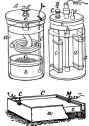
B represents an arrangement with blocks. The jar a is provided with a copper cover b, screwing into the glass. This cover carries 2 vertical plates of sheet iron c, against which are fixed the prismatic blocks d, by means of india-rubber bands e. The terminal C, carried by the cover, constitutes the positive pole. The zinc is formed of a single pencil f, passing into a tube fixed to the centre of the cover. The indiarubber is folded back upon this tabs so as to make an air-tight joint. The cover carries, besides, another tube g, covered by a split indiarubber tube, which forma a safety-valve. The closing la made hermetical by means of an Indiarubber tube h, which presses against the glass and the cover. The potash to charge the element is in pieces, and is contained either in the glass jar itself or in a separata box of sheet iron. Applying the same arrangement, hermetically-sealed elements are formed with a single plate of very small size. The employment of cells of iron, cast iron, or copper, which are not attacked by the exciting liquid, allows the easy construction of elements exposing a large surface C
The cell a, forming the positive pole of the battery, is of iron plate brazed upon vertical supports: it is 14 in. long by 7 in. wide, and about 3 1/2 in. high. The bottom is covered with a layer of copper oxide, and in the 4 corners are porcelain insulators b, which support a horizontal zinc plate c, raised at one end and kept at a distance from the copper oxide and from the metal walls of the cell; 3/4 of this is filled with a solution of potash. The terminals C and M, fixed respectively to the iron cell and to the zinc, serve to attach the leading wires. To avoid the too rapid absorption of the carbonic acid of the air by the large exposed surface, cover it with a thin layer of heavy petroleum (a substance uninflammable and without smell), or, better still, furnish the bat-easily packed so as to occupy little space.
Following are the principal properties of the battery. As a battery with a solid depolarizing element, it presents the advantages of only consuming its elements in proportion to its working; amalgamated zinc and copper are, in fact, not attacked by the alkaline solution; It is therefore durable. Its electromotive force is very nearly one volt. Its internal resistance is very low, 1/2 or 1/4 ohm for polar surfaces 4 in. square, separated by a distance of 1 1/2 in.; the rendering of these couples is considerable: the small cells shown in A B give about 2 amperes in short circuit, the large one gives 16 to 20 amperes. Two of these elements can replace a large Bunsen cell. They are remarkably constant. With a depolarizing surface double that of the zinc, the battery will work without notable polarization, and almost until completely exhausted, even under the most unfavourable conditions. The transformation of the products, the change of the alkali into an alkaline salt of zinc, does not perceptibly vary the internal resistance. This great constancy is chiefly due to the progressive reduction of the depolarizing electrode to the state of very conductive metal, which augments its conductivity and its depolarizing power.
The manganese peroxide, which forms the base of an excellent battery for giving a small rendering, possesses at first better conductivity than copper oxide, but this property is lost by reduction and transformation into lower oxides. It follows that the copper battery will give a very large quantity of electricity working through low resistances, whilst under these conditions manganese batteries are rapidly polarized.
The energy contained in a copper oxide and potash battery is very great, and far superior to that stored by an accumulator of the same weight; but the rendering is much less rapid. Potash may be employed in concentrated solution at 30,40, 60 per cent.; solid potash can dissolve the zinc oxide furnished by a weight of zinc more than J of its own weight. The quantity of copper oxide to be employed exceeds by nearly 1/4 the weight of zinc which enters into action. These data allow of the reduction of the necessary substances to a very small relative weight.
The copper oxide batteries have given interesting results in their application to telephones. For theatrical purposes, the same battery may be employed during the whole performance, instead of 4 or 5 batteries. Their durability is considerable; 3 elements will work continuously, night and day, Edison's carbon microphones for more than 4 months without sensible loss of power. The elements will work for 100 hours through low resistances, and can be worked at any moment-after several months, for example; it is only necessary to protect them by a cover from the action of the carbonic acid of the atmosphere. Potash is preferable to soda for ordinary batteries, notwithstanding its price and its highet equivalent, because it does not produce, like soda, creeping salts. Various modes of regeneration render this battery very economical. The deposited copper absorbs oxygen pretty readily by simple exposure to damp air, and can be used again. An oxidizing flame produces the same result very rapidly. Lastly, by treating the exhausted battery as an accumulator - that is to say, by passing a current through it in the opposite direction - the various products are restored to their original condition; the copper absorbs oxygen, and the alkali is restored, whilst the zinc is deposited; but the spongy state of the deposited zinc necessitates its being submitted to a process, or to its being received upon a mercury support.
Again, the copper oxide employed being a waste product of brazing and plate works, unless it be reduced, loses nothing of its value by its reduction in the battery; the depolarization may therefore be considered as costing scarcely anything.
With reference to this battery, Hos-pitalier gives the following account of a trial made with a cell weighing 1914 grm. and containing 200 grm. of copper oxide and 800 grm. commercial solution of potash at 40 per cent. The E.M.F. 1 hour after setting up was 0.98 volt, and the cell was put in circuit for 6 whole days through a resistance of 0.8 ohm. The current supplied was, on an average, £ ampere during 6 days, or 518,400 seconds. The total quantity of electricity supplied was 259,000 coulombs, the weight of zinc consumed 88 grm., which corresponds to a theoretical production of 260,000 coulombs. This is a most important point, and very favourable to the battery, for it shows that the local action is practically nil. The energy that the battery is capable of supplying is therefore available at will, without it being necessary to disturb the elements in order to withdraw the zinc from the liquid, as in the potash bichromate batteries, for example. The useful available rendering is 0.02 kilogrammetre per second. In 6 days, therefore, the battery supplied 10,368 kilogrammetres of available electrical energy. This exceeds the results obtained up to the present with accumulators of the same weight; but the supply is much slower than from these latter.
It is, however, easy to increase this rendering by increasing the surface of the elements and by diminishing the distance of the oxide from the zinc plate. The result then increases more rapidly than the weight, and tends to approach that of the accumulators. The remarkable constancy of the rendering must be attributed chiefly to the fact that the product of the reduction is metallic copper, which is a good conductor, and that the solution of an alkaline salt of zinc which is formed presents a conductivity almost equal to that of the solution of potash. For a given weight of zinc dissolved, about 3 times the amount of solid potash is required, and a quantity of copper oxide equal to 1.25 times the weight of the zinc.
Continue to:


My Books

