
![previous page: 1. Viola [Tourn.] L. Sp. Pl. 933. 1753.. Part 15](../../../images/nav/page_prev.gif)


1. Viola [Tourn.] L. Sp. Pl. 933. 1753.. Part 16
Description
This section is from the book "An Illustrated Flora Of The Northern United States, Canada And The British Possessions Vol2", by Nathaniel Lord Britton, Addison Brown. Also available from Amazon: An Illustrated Flora of the Northern United States, Canada and the British Possessions. 3 Volume Set..
1. Viola [Tourn.] L. Sp. Pl. 933. 1753.. Part 16
47. Viola Rafinésquii Greene. Field Pansy
Fig. 2969
Viola tenella Muhl. Cat. 26. 1813. Not Poiret. 1810. Viola Rafinesquii Greene, Pittonia 4: 9. 1899.
Glabrous, annual, with slender stem, 3'-8' high, often branched from the base; leaves small, the lowest 3"-5" wide, suborbicular, on slender petioles, the upper obovate to linear-oblanceolate, sparsely crenulate, attenuate at the base; stipules pectinately cut, the upper segment elongate, narrowly spatulate, mostly entire; internodes usually exceeding the leaves; flowers small, but the obovate bluish-white to cream-colored petals nearly twice the length of the lanceolate sepals; seeds light brown, a little more than \" long.
In fields and open woods, New York to Michigan, south to Georgia and Texas. April-May. Field-violet.
48. Viola Tricolor L. Pansy. Lady's-Delight. Heartsease
Fig. 2970
Viola tricolor L. Sp. Pl. 935. 1753.
Glabrous or pubescent, 4'-12' high; stem angled and often branched; upper leaves oval or lanceolate, 1/2' - 1' Iong, the lower ovate, often cordate, all crenate-serrate; stipules foliaceous, laciniate or lyrate-pinnatifid; flowers 8"-1' broad, variously colored with yellow, purple or white.
In waste places, sparingly escaped from gardens. May-July. Introduced from Europe. English names from 40 to 50, among which are johnny jump-up or johnny jumper, monkey's face, love-in-idleness, fancy, biddy's eyes, herb trinity, cats' faces, flamy, garden gate. Garden- or trinity-violet. Kisses. Kiss-me. Hearts'-pansy. Battlefield flower. Stepmother. Cupid's-delight. None-so-pretty. Usually more or less impure, the garden pansy being the product of frequent crosses of Viola tricolor with allied species of the Old World.

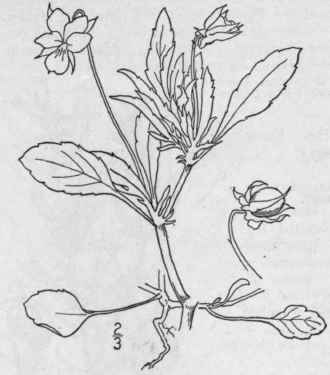
49. Viola Arvénsis Murray. European Field Pansy
Fig. 2971
Viola arvensis Murray, Prodr. Stirp. Goett. 73. 1770.
Similar to V. Rafinesquii but stouter, often io'-I3' high, erect, or branching and decumbent; leaf-blades ovate to lanceolate, noticeably crenate; stipules more coarsely pectinate, the upper lobe usually much enlarged, oblanceolate and sparsely crenate; petals usually shorter than the lanceolate acute sepals, pale yellow, sometimes the upper with violet tips, and the spurred petal deep yellow at the base; capsule globose; seeds brown, narrowly obovoid, about $' long.
Cultivated fields, naturalized from Europe, Newfoundland and Ontario, south, occasionally, to North Carolina. April-Oct.
Continue to:


My Books

