


Isomerism In The Alcohols
Description
This section is from the book "Alcohol, Its Production, Properties, Chemistry, And Industrial Applications", by Charles Simmonds. Also available from Amazon: Alcohol: Its Production, Properties, Chemistry, And Industrial Applications.
Isomerism In The Alcohols
Whilst only one methyl alcohol is possible, and only one ethyl alcohol, the formulæ show that two propyl alcohols, four butyl, and eight amyl alcohols can exist. In the last three classes, isomerism may be produced (1) by the OH-group taking up different positions in the molecule; (2) by the branching of the carbon chain; and (3) by both these causes acting together.
Consider, for example, butyl alcohol, C4H9OH. The normal primary formula is: -
4 | 3 | 2 | 1 | ||
CH3 | .CH1 | .CH1 | .CH1 | .OH...... | (i) |
where the carbon atoms are marked 1, 2, 3, and 4 for convenience of reference. Instead of being attached to a terminal carbon atom as shown, the OH group might be united to one of the intermediate carbon atoms giving in either case the normal secondary alcohol, or giving isobutyl alcohol, remaining as shown in (i), the straight carbon chain,


CH3.CH1.CH(OH).CH3 ..... (ii)
Or, the group may be replaced by the branching system can be likewise replaced by the branching system giving the tertiary butyl alcohol, trimethyl carbinol,

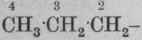
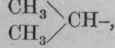
(CH3)2CHCH1OH...... (iii)
Finally, the straight chain shown in formula (ii),
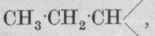
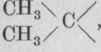
(CH3)3.C.OH.......(iv)
These, then, are the formulae of the four possible butyl alcohols.
In the same way, it can be shown that eight different amyl alcohols are theoretically possible, and all are known. The following table gives particulars of the alcohols above referred to, and further descriptions of the higher members are included in a subsequent chapter: -
Name. | Formula. | B.p. | Sp. gr. at 20°/4°. |
Methyl alcohol ............... | CH3.OH. | 66° | 0.796 |
Ethyl alcohol................... | CH3.CH1OH. | 78.3 | 0.78945 |
Propyl alcohols, | |||
C8H7OH: - | |||
Normal propyl................ | CH3.CH1.CH1.OH. | 97.4 | 0.8044 |
Isopropyl ....................... | CH3.CH(OH).CH3. | 82.7 | 0.7887 |
Butyl alcohols, | |||
C4H9OH: - | |||
Normal primary ............. | CH3(CH1)2.CH1.OH. | 116.8 | 0.8099 |
„ secondary........ | CH3CH1.CH(OH).CH1. | 99 | 0.827 |
Isobutyl......................... | (CH3)2.CH.CH1.OH. | 108.4 | 0.8020 |
Trimethyl carbinol ..... | (CH3)3.C..OH. | 83.5 (m.p. 25.5) | 0.7788 at 30° |
Amyl alcohols. | |||
C6H11OH: - | |||
Normal primary ....... | CH3(CH1)3..CH1..OH. | 137 | 0.8168 |
Isobutyl carbinol..... | (CH3)2.CH.CH1.CH1.OH | 131.4 | 0.8104 |
Secondary butyl carbion............................ | CH3.CH(C2H6).CH1.OH | 128.7 | 0.816 |
Methyl propyl carbinol ................. | CH3(CH1)2.CH(OH).CH3 | 118.5 | 0.824 at 0° |
Methyl isopropyl carb -inol .................... | (CH3)2.CH.CH(OH).CH3 | 112.5 | 0.833 ,, |
Diethyl carbinol ......... | C2H6.CH(OH).C2H5. | 116.5 | 0.832 ,, |
Dimethyl ethyl carbinol ...................... | (CH3)2.C(OH).C2H5. | 102.5 | 0.827 „ |
Tertiary butyl carbinol .................... | (CH3)3C.CH1OH. | 112 (m.p. 48-50) | 0.812 |
General methods for preparing alcohols.
Alcohols are produced in various chemical reactions, the chief of which are described below. It will, of course, be understood that these methods are adduced, primarily, as exemplifying the chemical attributes of alcohols generally, not as processes for the commercial preparation of the particular alcohol employed as illustration.
(1) When an alkyl iodide (e.g., ethyl iodide) is brought into contact with freshly-precipitated, moist silver oxide, the substances react, producing an alcohol and silver iodide: -
C2H5I + AgOH = C2H5OH + Agl.
Here the silver oxide and the water present together react like silver hydroxide, as shown in the equation.
A similar conversion is effected by heating the alkyl iodide with lead oxide or zinc oxide and water, and even with excess of water alone at 100°. Or the iodide may first be converted into the corresponding acetate (ethyl acetate in the example given) by heating it with potassium acetate: -
C2H6I + CH3CO2K = CH3CO2C2H6 + KI.
Ethyl acetate (Ethyl acetic ester).
On then hydrolysing the ester by boiling it with a solution of sodium hydroxide, it is transformed into the alcohol and sodium acetate: -
CH3CO2C2H5 + NaOH = CH3CO2Na + C2H5 OH.
To effect this hydrolysis, the ethyl acetate is boiled with an excess of sodium hydroxide solution in a flask connected with a reflux condenser until the conversion is complete, as shown by the eventual disappearance of the undissolved portion of the acetate. The condenser is then reversed, and the resulting alcohol distilled off.
(2) An essentially similar reaction to the foregoing is one by which ethyl alcohol can be obtained from ethyl sulphuric acid, C2H5HSO4. On distilling this acid with water, it yields alcohol and sulphuric acid: -

This reaction is of both theoretical importance and historical interest. Ethyl sulphuric acid (sulphovinic acid, hydrogen ethyl sulphate) can be obtained by the interaction of ethylene with sulphuric acid, and ethylene itself is obtainable from acetylene, which in turn can be synthesised from its elements carbon and hydrogen. Thus the series of reactions forms a method whereby alcohol itself can be synthesised. This method, in fact, was the one by which, starting with ethylene, alcohol was first synthetically produced (Hennell, 1828; and later, by Berthelot, 1854).
Other unsaturated hydrocarbons besides ethylene {e.g., propylene) furnish the corresponding sulphates and alcohols in a similar manner. Some (e.g., isobutylene) are even dissolved by dilute nitric acid, and yield the corresponding alcohols on absorbing the elements of water.
(3). Primary amines, when treated with nitrous acid, yield alcohols, with elimination of nitrogen: -
C2H5.NH1 | + | HNO2 | = | C2H5.OH | + | N2 | + | H1O. |
Ethylamine. | Ethyl alcohol. | |||||||
A convenient method of showing this reaction is to distil a solution of ethylamine hydrochloride with potassium nitrite, which supplies the nitrous acid by interaction with the HC1 of the ethylamine salt.
(4). Aldehydes, acid chlorides, and acid anhydrides may be reduced by sodium, sodium amalgam, iron filings, or zinc dust, employed with dilute sulphuric acid or acetic acid, and yield the corresponding alcohols: -
(a) | C2H5.CHO + | H1 | = | CH3.CH1.CH1.OH. |
Propyl aldehyde. | Propyl alcohol. | |||
(b) | CH3.COCl + | 2 H1 | = | CH3.CH1.OH + HC1. |
Acetyl chloride. | Ethyl alcohol. | |||
(c) | (C2H3O)2O + | 2 H1 | = | C2H5.OH + CH3 .COOH. |
Acetic anhydride. | Ethyl alcohol. Acetic acid. |
Theoretically, this reaction is important as one of the steps by which we can "ascend the series "of alcohols, passing from one alcohol to another containing more carbon atoms.
Thus starting with methyl alcohol, by acting upon it with phosphorus and iodine we obtain methyl iodide. This treated with potassium cyanide gives methyl cyanide, which on hydrolysis yields acetic acid. By means of phosphorus chloride or oxy-chloride, acetic acid can be converted into acetyl chloride, which, reduced as shown in equation (b) above, gives ethyl alcohol.
Continue to:


My Books

