


Isomerism In The Alcohols. Part 2
Description
This section is from the book "Alcohol, Its Production, Properties, Chemistry, And Industrial Applications", by Charles Simmonds. Also available from Amazon: Alcohol: Its Production, Properties, Chemistry, And Industrial Applications.
Isomerism In The Alcohols. Part 2
Similarly, ethyl alcohol itself can bo transformed into propyl alcohol, and so on. The foregoing series of reactions may be summarised thus: -


Whilst the aldehydes, acid chlorides, and anhydrides give primary alcohols when reduced as above, the reduction of ketones yields secondary alcohols, together with di-tertiary alcohols or "pinacones." Thus when acetone is reduced with sodium amalgam the chief product is isopropyl alcohol, but pinacone is also produced: -


The pinacone is a solid (m. p. 42°, as the crystallised hydrate).
(5). Secondary alcohols are also obtained by converting poly-hydric alcohols (e.g., glycerol) into the iodides with phosphorus and iodine, the iodide being then transformed into the alcohol as in reaction (1), ante: -
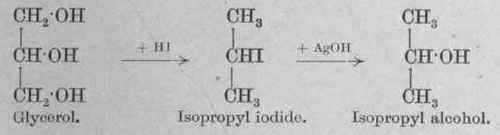
For preparing the iodide, amorphous phosphorus in the proportion of 25 grams, and iodine 140 grams, are used for 100 grams of anhydrous glycerol, the phosphorus being added gradually to the other ingredients, and the mixture distilled in a slow current of carbon dioxide gas. With half the weight of iodine and using yellow phosphorus, the same operation yields allyl iodide as the main product. Alternatively, the glycerol may be diluted with an equal volume of water and distilled with 150 grams of iodine and 28 grams of yellow phosphorus, added gradually. The first portion of the distillate is returned to the retort and re-distilled. Admixed allyl iodide may be removed from the isopropyl iodide by treating the mixed iodides with hydriodic acid.
(6) Two notable synthetic methods of obtaining secondary and tertiary alcohols are available, depending upon the use of alkyl compounds of zinc and magnesium respectively. The first was originally described by Butlerow (1864). By means of zinc methyl and zinc ethyl, acting on the acid chlorides, tertiary alcohols are produced; with aldehydes or with esters of formic acid instead of acid chlorides, secondary alcohols result.
Take, for example, the synthesis of tertiary butyl alcohol by Butlerow's method. Acetyl chloride, CH3COC1, is dropped slowly into well-cooled zinc methyl. The mixture is allowed to stand two or three days in the cold, until the whole has become crystalline, when it is decomposed by adding water, yielding the required alcohol. There are three stages in the reaction. First, one molecule of the zinc methyl combines with one molecule of the chloride to form an additive product': together with zinc hydroxide and ethylene.

If this product is decomposed by adding water at this stage, it yields acetone, not an alcohol. But if a second molecule of zinc methyl is allowed to react with the new compound, it gradually replaces the Cl atom with a CH3-group, giving the crystalline compound
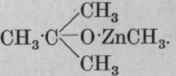
On now treating the product with water, it is decomposed, the tertiary alcohol being produced, together with zinc hydroxide and methane: -

At the second stage it is possible to employ a different zinc alkyl - for example, zinc ethyl instead of zinc methyl. The Cl atom would then be replaced by a C2H5-group, and the final product would be the tertiary amyl alcohol, (CH3)2C(OH)C2H5 - i.e., dimethyl ethyl carbinol.
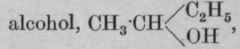
If, however, aldehydes are used instead of acid chlorides, secondary alcohols result: -

Decomposed with water, this product yields secondary butyl
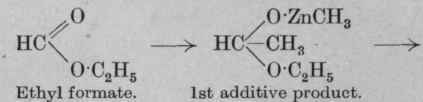
As already mentioned, secondary alcohols are also obtained by using formic acid esters with zinc alkyls. The reactions are quite similar to the foregoing, an additive product of the zinc alky] with the ester being formed, which yields the alcohol on decomposition with water. When zinc methyl, for instance, reacts with ethyl formate, two methyl groups are eventually introduced, and isopropyl alcohol obtained: -
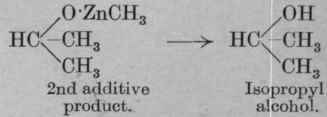
Instead of the zinc alkyl, a mixture of alkyl iodide and metallic zinc can be employed. By using different alkyl iodides or different zinc alkyls in the first and second stages, different alkyl groups can be introduced, and different alcohols obtained as the resulting products.
It will be seen that all these syntheses by means of zinc alkyls depend upon the fact that the doubly-linked oxygen atom in the acid chloride, aldehyde, and ester, respectively, becomes singly-linked, with eventual formation of the alcoholic hydroxyl group.
(7) Secondary and tertiary alcohols are, however, more conveniently obtained in many instances by the use of Grignard's reagent. This is prepared by adding magnesium-turnings to an ethereal solution of an alkyl iodide or bromide, one molecule of the alkyl compound being used for each atom of magnesium. The metal forms a combination with the alkyl halide and dissolves in the ether. Thus with ethyl iodide we obtain an ethereal solution of C2H5MgI, ethyl magnesium iodide.
Continue to:


My Books

