


Preservation Of Food By Low Temperatures
Description
This section is from the book "A Manual Of Home-Making", by Martha Van Rensselaer. Also available from Amazon: A Manual of Home-Making.
Preservation Of Food By Low Temperatures
Preservation Of Eggs
Eggs should be preserved during March, April, May, and June, when the production is greatest and the price lowest. Spring eggs will keep better than summer or fall eggs. Only absolutely fresh eggs should be preserved (see page 534). Infertile eggs are better than fertile ones for preserving. Dirty eggs or eggs that have been washed should not be preserved.
Of the many ways of preserving eggs in the household, a water-glass solution seems to give the best results. Earthenware jars are the most suitable vessels to use. Danger of loss through the presence of one bad egg is reduced by using several small instead of one large vessel. Eggs should not be left in the preservative longer than one year. The same liquid preservative should not be used more than one year. If the solution evaporates and becomes thick and jelly-like, water should be added. Eggs should be rinsed in clear water when they are taken from the water-glass solution. They will generally remain good for about two weeks after being removed from the preservative, but the sooner they are used, the better. If it is desired to boil them, a small hole should be pricked through the large end of the shell before they are placed in the water, in order to prevent their breaking when heated.
* Condensed from Preservation of Eggs, by Earl W. Benjamin in Cornell Heading-Course for the Farm Home, Bull. 21.
To use water-glass solution (for thirty dozen eggs):
(1) Mix thoroughly 1 1/2 quarts of commercial water-glass solution with 18 quarts of boiled water; (2) pack clean eggs into clean earthenware jars or tight odorless tubs, two 6-gallon, or three 4-gallon jars being sufficient for preserving thirty dozen eggs; (3) cover the eggs with the water-glass mixture, and if the solution does not cover the eggs at least 2 inches, as much as 5 additional quarts of water may be added for each 1 1/2 quarts of commercial water-glass solution used; (4) cover the jars to prevent evaporation; (5) keep the eggs in a cool dark place.
Preservation of butter (E. S. Guthrie).
Butter can be laid down during the summer season to give a satisfactory supply for winter use. Sweet cream of good quality should be used. It should be pasteurized by keeping the container in hot water for 30 minutes at a temperature of 145° F. The cream should be stirred frequently during the process. It should then be cooled to approximately 50° F. It is important that the butter should be made from sweet cream rather than from sour cream, since the keeping quality of sweet-cream butter is better. This cream should be churned in the usual way, and the butter should contain the usual amount of salt. It may be packed solid in stone jars, or it may be made into pound prints and packed in jars, either with or without the regular parchment paper wrappers. The jars should be thoroughly scalded and free from taint or odors. The butter should then be completely covered with a salt solution in which the amount of salt used is about one-fourth the weight of the water. A large plate or a header made of some odorless wood should be placed on the butter. Clean stones or bricks may be used to weight it. The butter must be kept covered with the brine solution. Butter packed in this way and stored in a cool cellar should keep all winter.
Persons who are not making their own butter can secure satisfactory results by getting fresh butter made from sweet cream and packing it as described. Such butter may be obtained of near-by creameries in wholesale lots. The best time to buy is from the middle of May to the middle of July.
Storage Of Fruit
Fruit should be picked carefully and without bruising, and should be placed in storage as soon as possible. It may be packed in barrels or boxes or placed in open trays. When the latter method is used and it is desired to keep the fruit in particularly fine condition, the specimens should not be allowed to touch one another. Apples that are to be kept for a considerable time, whether exposed or in packages, should be wrapped separately. Light manila wrappers, 10 by 10 inches, may be used.
Fruit stored in the cellar frequently does not keep well; it either shrivels or becomes spongy and decays. This fault, which often lies in the storage room, may be corrected wholly or in part. A fruit cellar should be well ventilated. The principle of physics that warm air rises and cool air settles, is applicable here. Warm air should be permitted to pass out at the top of the room through ventilators, and cool air from outside should be admitted to the room at the bottom (Fig. 121). In a cellar this can be accomplished by means of a shaft leading down the wall from a window and opening near the floor. A few windows at the top of the wall constitute the system of ventilation for most farm cellars. Although this arrangement is accepted as sufficient and in many cases gives fairly good satisfaction, the temperature cannot be kept so nearly uniform and correct as when intake shafts are used.
* C. S. Wilson, Cornell Reading-Course for the Farm Home, Bull. 21.
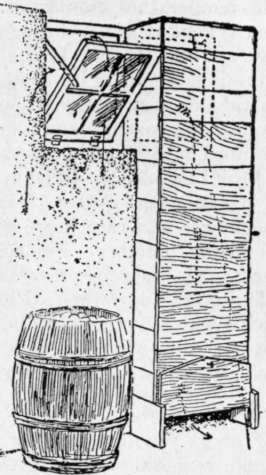
Fig. 121. - Cellar ventilation.
A uniform temperature of 50° F. in the cellar will keep fruit in good condition for months. The ideal temperature is about 31° or 32° F., but this cannot usually be maintained in a cellar. The temperature should not be permitted to fluctuate. Fruit that is kept at 34° F. during the night and at 60° F. during the day will soon decay. In the farm cellar, uniformity of temperature is maintained by means of the ventilation, which should be watched very closely. In cellars where it is impossible to control the temperature and humidity as desired, the fruit may be wrapped in paper and packed in hardwood sawdust.
Fruit may also be stored in pits. This method is described by L. H. Bailey as follows: "Many apples, particularly russets and other firm varieties, keep well when buried after the manner of pitting potatoes. Sometimes, however, they taste of the earth. This may be prevented by setting a ridge-pole over the pile of apples in forked sticks, and making a roof of boards in such a way that there will be an air space over the fruit. Then cover the boards with straw and earth. Apples seldom keep well after removal from a pit in spring."
Continue to:


My Books

