


Medical. Common Ailments and their treatment. Part 4
Description
This section is from "Every Woman's Encyclopaedia". Also available from Amazon: Every Woman's Encyclopaedia.
Medical. Common Ailments and their treatment. Part 4
How To Treat Particular Fractures
1. Fracture of Lower Jaw This is always a compound fracture. The mouth cannot be closed, the teeth are uneven, there is bleeding inside the mouth, and a gap may be felt outside. Place the palm of the hand under the chin, and press the lower jaw gently against the upper one. Apply the middle of a bandage to the chin, and tie the ends at the back of the head. Fold another bandage, pass it under the lower jaw, and tie it at the top of the head. In this case Nature provides the splint, which is the upper jaw (Fig. 1.).
2. Fractured Collar-bone. The arm on the injured side is almost useless, the patient supports the elbow of it with the other hand, and leans the head over to the injured side.
Take off the coat, observing the rule of removing clothing from the sound side first. Make a pad, about two inches thick and four inches in the other dimensions, from a hard substance, such as a purse, small book, or folded magazine, and press it upwards in the armpit of the injured side. Gently bend up the forearm, keeping the elbow well back and implanted against the side. Tie a narrow bandage round the body and arm to keep both in this position. Put the arm in a broad sling, with the hand above the level of the elbow and with the thumb pointing upwards (Fig. 2.).
bandage round the body and arm, and put the arm

Fig. 2. For a fractured collar-bone tie a narrow in a broad sling
3. Broken Shoulder-blade. Apply the same treatment as for a broken collar-bone, but omit the pad in the armpit.
4. Fractured Humerus, or Arm-bone.
(a) Neck of Humerus - i.e., the part of the bone which fits into the shoulder-blade. Treat as for a broken shoulder-blade.
(b) Middle of Humerus. Bend the forearm at a right angle to the arm, with the palm of the hand inwards and the thumb pointing upwards. Apply splints reaching from shoulder to elbow on the outer and inner sides of the arm, and, if procurable, short ones to the front and back also. Keep the splints in position by a bandage above and one below the seat of injury, and place the arm in a narrow sling. (See illustration in last issue.)
(c) End of Humerus. Lash two splints together to form an acute angle, taking care that one stretches easily from elbow to arm-pit. Place one end of the splint into the arm-pit, and bend up the forearm to rest against its lower portion. Bandage the arm to the two ends of the splint, adding outside the arm, for extra support, a piece of stiff substance, such as a rolled newspaper, a piece of cardboard, or the straw cover of a wine-bottle. Apply a broad sling (Fig. 3).
5. Fractured Elbow. Treat exactly as the end of humerus; but, if the accident occurs indoors, it is best not to bind up the arm, but to place a pillow to support the arm comfortably, and apply cold water dressings till the doctor arrives.

Fig. 3. Splints and broad sling for a broken forearm
6. Fractured Bone or Bones of Forearm. Bend the forearm to a right angle, see that the thumb points upwards, and apply splints on either side. See that the splints only reach to the roots of the fingers, which must be kept warm and exercised to prevent them becoming stiff. Apply a wide "sling.
7. Fractured Rib (without complications). Fold a towel to form a band eight inches wide; draw this tightly round the chest and secure it with safety pins. Place the arm on the injured side in a broad sling (Fig. 4).
8. Fractured Thigh: Grasp the foot of the injured side and pull it to the level of the other foot. Make both feet rest on the back of the heels, and tie them together. Procure a long, stout splint reaching from the arm-pit to beyond the foot, and place it in position along the injured side. Apply a splint to the inner side from the top of the thigh to the knee. Arrange the bandages as shown in Fig. 5, so that they may be quickly tied by passing one end through the folded loop and tying it to the other (Fig. 5). Arrange the bandages (a) Round the chest just below the armpits;
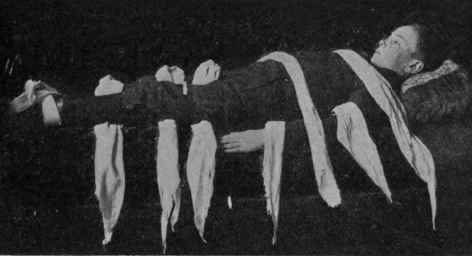
Fig. 5. For a fractured thigh the bandages should first be applied in this manner
(6) Round the pelvis over the hip-joints;
(c) Above the fracture;
(d) Below the fracture;
(e) Round the leg; (/) Round both ankles and feet; (g) Round both knees. When made rigid with splints, a patient may be lifted on to a couch, bed, or stretcher (Fig. 6), but no attempt must be made to move a patient until the injury has received attention.
9. Fractured Leg. Draw the foot into its natural position, and tie both feet together. Apply splints on the outer and inner sides of the leg, reaching from above the knee to beyond the foot. Apply bandages (a) and (b) Above and below the fracture; band should be drawn round the chest, and the arm

Fig. 4: For a fractured rib a towel folded into a on the injured side supported in a broad sling
(c) Above the knee;
(d) Round both ankles;
(e) Round both knees.
10. Fractured Vertebrae. Fix a long splint down each side, tying the bandages over the bony parts of the trunk, and seek immediate medical aid.
. 11. Fracture of the Skull. No injury to the head should ever be neglected.
Even if no symptoms of injury are apparent, the patient should lie quietly in bed for twenty-four hours.
With fractured base of the skull involving pressure on the brain surface there are well - defined symptoms which are easily recognised. The patient is insensible. There is a puffiness about the eyes. The eyeballs are bloodshot, and the lower half resembles a clot of blood. There is a discharge of blood or serum from the car.
Seek medical aid. Keep the patient quiet, and apply the rules for the treatment of insensibility, which will be given in detail in a later article.
When The Doctor Comes
A dislocation is a displacement of one or more bones at a joint.
No attempt must be made by the helper to reduce a dislocation. Medical aid must be sought, but while awaiting the arrival of the doctor, the limb should be supported so as to give most ease, and jolting must be minimised. If the accident occurs indoors, the clothing should be removed (from the uninjured side first), the limb should be supported with pillows, and ice in a rubber bag, or cold-water dressings, applied to the joint.
When cold dressings fail to ease the pain, apply flannel wrung out of hot water.
It should be remembered that the patient is suffering from shock, and therefore he, or she, must be treated accordingly.
in position
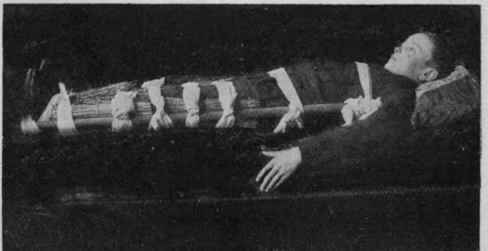
Fig. 6, The bandages for a fractured thigh with the improvised splints
Continue to:


My Books

