


Large Trees
Description
This section is from "The Horticulturist, And Journal Of Rural Art And Rural Taste", by P. Barry, A. J. Downing, J. Jay Smith, Peter B. Mead, F. W. Woodward, Henry T. Williams. Also available from Amazon: Horticulturist and Journal of Rural Art and Rural Taste.
Large Trees
IT is curious that the large trees of the United States east of the Mississippi river, and especially the size to which the different species attain have received little attention since the time of Michaux. 1 have been collecting information on the size of trees and measured many during the last few months, and intend to publish through the Horticulturist a few notes on the subject, in hopes that others will also measure them and note their relative size. It would be useful also to know the ordinary age of each species of tree. They are the oldest living things on our globe, serving as links binding us to the past and connecting us with the future. I love to gaze on a very large tree; it excites reverential feelings. It has lived before Columbus discovered the New World, it has afforded shelter to the Indian, a refuge to the weaker animals, and a resting place for birds ages ago. Aye, it may have lived when the mastodon roamed through the old forests. Through many summers and winters it has survived the companions of its youthful days, and now its huge trunk and great diameter preserve it from the attacks of the woodman. Long may it live and flourish.
An enlightened spirit of agriculture is now dawning upon our country, and the public attention is directed to the importance of protecting trees and engaging in their cultivation.
Liroidendron tulipifera; this is called the tulip tree in New England, white wood in western New York and in northern Ohio, and poplar in some of the western and all of the southern States. It is extensively diffused, and taking in all its dimensions is probably the largest tree east of the Mississippi river. It is much used for building and cabinet purposes, probably more so than any other tree excepting the White Pine. In New England and New York, it is rarely more than four feet in diameter, but in the western States it is often five and six feet in diameter. Michaux measured one near Louisville, Kentucky, which'was nearly eight feet in diameter, and he relates that he saw much larger ones in other parts of the State. During the past summer I measured several in Indiana and Kentucky, which were between six and seven feet in diameter. In the rich coves at the base of, and among the southern mountains, these trees grow to their greatest size. There is one near Cold Spring, on the banks of the Pigeon river, among the Smoky mountains, in Haywood County, North Carolina, which is 83 feet in circumference, at 4 feet from the ground, and I measured another recently in Siveur County, Tennessee, near the base of the Smoky mountains on the Little Pigeon river, which is 29 feet 3 inches in circumference, at 4 feet from the ground, and my friend T. J. Lenvir, Haywood County, North Carolina, measured another near Waynesviile, North Carolina, which is 27 feet in circumference.
Besides these I have measured many among the mountains of North Carolina, ranging from 6 feet to 8 feet in diameter during the present autumn.
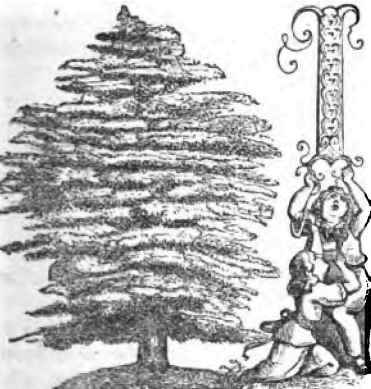
These trees generally have a trunk nearly cylindrical, and of nearly uniform size, to the height of 60 or TO feet, the whole tree being from 120 to 140 feet high. When cultivated they send forth numerous expanding branches affording an ample shade. Their neat, glossy, singular leaves, and beautiful tulip shaped flowers, render them very ornamental and worthy of general cultivation. They belong to the natural order Magnoliacea, their fruit resembling the Magnolia or Cucumber tree.
Large Trees #1
The American Plane tree or Sycamore, (Platanus occidental is), called also Button-wood in some sections, is a well-known tree, being found in nearly all the States east of the Mississippi, river. It prefers the alluvial banks of streams, and attains its greatest size near the Ohio river and its tributaries. There is a "big sycamore" forty miles below Cincinnati, three miles east of "Rising Sun," in Indiana, on the farm of Israel Loring. It is near the main road, - along which the telegraph wires are stretched, - on the banks of a small stream, not far from a large gate and tenant house belonging to Mr. Loring, whose tenant told me that the tree was seventy-five feet in circumference. I asked him to hold one end of the tape line to measure it We found its dimensions to be somewhat less than he supposed, and he then told me that a gentleman had ascertained its circumference by stepping around it It is thirty-nine feet nine inches in circumference, at four feet from the ground; at three feet from its base, forty-one feet in circumference; and at the ground, fifty-five feet three inches in circumference. It is hollow, and a section of its trunk would be an oblong ellipse, whose greatest diameter is about twenty feet.
At about eight feet from the ground it divides into two large branches, which have numerous spreading, healthy limbs. There is but a small opening of a few inches in diameter into the hollow trunk, which should not be made larger, but the tree should be protected and suffered to live yet many summers and winters. Its age will always be a subject of mere conjecture, still it is not improbable but that it may be the oldest thing east of the Mississippi. A true history of the principal events which have taken place in the valley of Ohio during its life, would be exceedingly interesting to many, especially to those who are trying to solve the still mysterious origin of the Western Mounds.
There are two plane trees about a mile above Louisville, Kentucky, on the bank of the Ohio river. One is twenty-seven feet in circumference, and the other twenty-eight in circumference. They are mere shells or hollow trunks, united at the base and dividing at about three feet from the ground. Their tops have been blown off at ten or fifteen feet high, and their huge, limbs lie scattered around (June, 1858). A few green, small branches were struggling to preserve alive the standing stumps of these huge horns, whose hollow trunks but a short time before would have afforded a comfortable dwelling for a small family. At the same locality are other plane trees. One is twenty-one feet six inches in circumference; another twenty-one feet in circumference, and two of nineteen feet in circumference. A large portion of the sycamores at the West have an unhealthy appearance. They abound in dead branches, having probably had the same disease which a few years ago killed many of the plane trees in the vicinity of Philadelphia. The diseases of trees and the ordinary age of each species are as yet but little understood, but that some die young, while other specimens of the same species attain a great age, is well known.
Michaux calls the sycamore the largest tree east of the Mississippi river.
We saw one on the north bank of the Ohio river, thirty-six miles from Marietta, which was forty-seven feet in circumference at four feet from the ground; another measured by him on the banks of the same river, between Cincinnati and the rapids, at Louisville, was fourteen feet in diameter.
It must be remembered that all, or nearly all, the large sycamores are hollow, and they are rarely more than sixty or seventy feet high'; hence, we have other trees which probably contain more solid feet. Its wood is brittle, and of no use in the arts. It has been planted for ornament, but now is rarely cultivated. There is another more showy species west of the Rocky Mountains.
Continue to:


My Books

