


Massachusetts Vs. New Jersey (2). Continued
Description
This section is from "The Horticulturist, And Journal Of Rural Art And Rural Taste", by P. Barry, A. J. Downing, J. Jay Smith, Peter B. Mead, F. W. Woodward, Henry T. Williams. Also available from Amazon: Horticulturist and Journal of Rural Art and Rural Taste.
Massachusetts Vs. New Jersey (2). Continued
After considering the natural habits of the violet, Mr. Calder decided to follow a different system of treatment. The violet is a spring plant; blossoms most freely before the weather is warm, when the temperature by day is about 60°, and by night about 40°. It seems to prefer rather damp and low places, and to select as soil decaying leaves and carbonaceous matter. Mr. Calder followed nature's method in his treatment. His first experiments were with five kinds of soil. He planted some of his well-rooted cuttings in sand, in loam, in manure, in manure and leaves, and in pure leaves. The leaves were not decomposed, but had been used to bank hot-beds during the winter.
All the violets grew - those in the manure being sickly, while those in the leaves surpassed all their rivals; they made stout, stocky plants with short dark green leaves, and set a plenty of flower-buds. During their season of growth he frequently lifted the plants to examine their progress, and found the clean white roots had, as it were, sewed masses of leaves together; and when he lifted a violet it would raise by its roots a mass a foot in circumference. Accordingly, when he prepared his tables for win ter forcing, he covered them with a thick bed of leaves, and no more loam than would fill the space between the plants.
After beginning to force, the thermometer was kept as nearly as possible at a spring temperature - an average of 60° by day and 40° by night; and as a consequence of the moderate heat and good food, the violet houses were purple with blossoms from the 1st of February. The flowers were engaged by a florist at 1 cent each, more or less; in the week ending Feb. 22, there were 13,000 gathered, without seeming to be missed; on the 28th of February 3,300 were gathered; and yet the following day their places were all filled.

Fig. 65. - Sectional View of Colder's Houses.
A, A, Outside posts and plank frame.
B, B, Inside do.
C, C, Plank bottom of tables.
D, D, Joists spiked to posts to sustain water-pipes. E, E, Water-pipes.
F, Floor of alley. G, G, Fixed sashes. H, Movable sashes.
J, Ratchet for opening and fastening movable sash at ridge.
K, Plank ridge with half round molding for stop.
L, Gutter. M, M, Outside earth.
N, N, Mushroom beds (not in Calder's house). O, O, Lettuce beds.
P, Violet beds. Q, Q, Subterranean ventilation (not in Calder's house) to introduce air warm. R, R, Air space between tables and walls' (not in Calder's house).
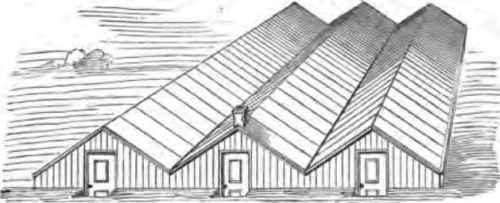
Fig. 66. - Perspective View of Calder's Houses - Hot water, boiler, etc., in end of middle house.
Gardeners who visited these houses during the winter predicted their failure because they were so cold; but the result has proved that cold is better for the violet than heat. But violets have not been allowed to monopolize ail the room; the lettuce has been of the best quality, and has sold in barrels readily, to go to New York, at $1 25 per dozen heads.
Mr. Calder intends to stock his new houses with roses, violets, and carnations, reserving space for salads, strawberries, and cucumbers. He has at present 2,500 pots of Triomphe de Gand strawberries, which are beginning to grow, and occupy a part of the space left empty by the marketed lettuce. These strawberries will be kept at a low spring temperature, so as to bring them into bearing about the middle of May. Should they net 25 cents per pot, they will pay all the expenses of his season's experiments, leaving the other crops for profit.
I might have selected some other market gardener florist to illustrate my argument; there are many in the vicinity of New York who are pioneers, and very successful in this kind of culture, but I wished to show that Massachusetts is not debarred by climate from successful market gardening. This sketch shows that the careful and intelligent man may make his own climate and soil, at no very great cost. It is obvious that this kind of forcing is much cheaper than any other. To heat a house 136 feet long and 16 feet wide will require 8 tons of coal for the winter and spring, or $64. To put 100 feet of hot-beds 6 feet wide into working order would have required 14 cords of manure, which would have cost $140. The manure, as we have seen, for forcing purposes would have been valueless when once used, and to re-make the beds would have cost another $140. The labor of the two fillings and removals would have cost at least $25, or $380 against $64.
Mr. Calder has also shown in strawberry field culture that Massachusetts need not yield the palm to any other State. He has cultivated his strawberries for several years in a peculiar manner: he sets the vines in beds 30 inches wide, the strawberries 10 inches apart in the row, the rows being 10 inches and the beds 18 inches apart. The plants were not allowed to make any runners, all runners being cut off as soon as they appeared, consequently each plant started making five or six heads. When strawberries grow in this single and individual manner, it is easy to keep them free from weeds; with the hoe or the hand; if any grow large, they can be pulled up without fear of unsettling the new runners, which are the staple of most strawberry beds. By giving wide alleys and narrow beds, there is no temptation to the picker to kneel on the bed and crush the ripe or green fruit; and as the plants are all of the same age, the fruit is an of uniform quality from the first picking to the last. From one eighth of an acre cultivated in this manner with strawberries, Mr. Calder sold $600 worth of fruit, which was equal to the value of the crop which his father gathered from an acre.
Without wishing to discourage emigration to the vinelands of any State, may we not reasonably ask all who wish to get their living by cultivating the soil, to first try what careful and well-directed labor will do with the lands where they have their homes at present. If these facts which I have given are of universal application, no NewEnglander need despair of getting a rich reward from the soil of his native State.
I give a section and birds-eye view of Mr. Calder's hot-beds, to show the method of heating, and their general arrangement.
Continue to:


My Books

