


Cranberries (2)
Description
This section is from "The Horticulturist, And Journal Of Rural Art And Rural Taste", by P. Barry, A. J. Downing, J. Jay Smith, Peter B. Mead, F. W. Woodward, Henry T. Williams. Also available from Amazon: Horticulturist and Journal of Rural Art and Rural Taste.
Cranberries (2)
CRANBERRY culture for a few years past has been fully tested, and entered into with strong enthusiasm. In some places their cultivation has been quite a success, in others a complete failure, until, by experience, they have overcome the difficulties they encountered in their first efforts. It may be of use to those who wish to raise cranberries to know the difficulties they have to encounter, as well as their success. About twelve years since six acres were taken up that had been wet and covered with bogs and brush; it was drained, cleared of roots, and made smooth (soil clear peat) without sand; the vines set in rows about two feet apart and kept clean for two or three years. They covered the ground with a rank growth of runners eight to twelve feet long, with very few fruit buds. Tho following season they grew in the same way and formed a mat several inches through; a lease of the ground was taken for ten years, on shares; during that time the average crop was not over 100 bushels, except one year, when there was gathered about 500 bushels; two years since it was not flowed, and nearly all the. plants died except where a small part had been sanded the year previous and new plants set, which have done finely, and this year they are bearing a crop.
So much for the failure.
A portion of these vines with other portions of the ground has been covered with puro sand two or three inches thick, and new vines planted out and have grown finely, with a short bearing stem. Those vines this season are full of fruit. Pure sand should be used; where there is any soil with it weeds and grass grow more freely and largely increase the labor in keeping it clean. On this plot there have been a number of varieties planted out which are distinct in their growth and habit. One that is most marked is the Mansfield Creeper. It was found growing in Mansfield, Conn., and transplanted to a cranberry bed; the original vine the next year was destroyed. In its new position it was found to be entirely different in its growth and habit from all other varieties - it seemed to creep over the ground and catch root at every joint with great freedom, throwing out long vines from ten to fifteen feet, and bearing shoots every two or three inches on the vine, two to four inches in height. It throws out fruit buds for another year. Also another shoot, as seen in the engraving, for a fresh start. It is difficult to get rooted vines to transplant, and are planted out in vines or shoots as represented above. It excels all others in size and bearing qualities and is found to be quite early.
They were picked this season (1873) fifth of September. The flesh is more tender and not as acid; fine keeper; color, dark scarlet on one side, the other nearly white with a slight mottle; shape roundish oval.
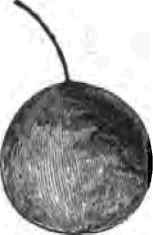
Mansfield Creeper.
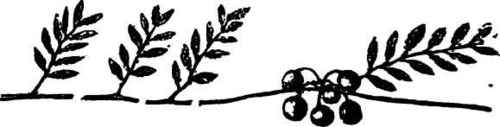
Bell Cranberry
This and other varieties are inclined to grow more upright, as represented in cut. When cultivated in sand the vines throw out runners which take root and throw up bearing shoots, the bud starting from the end of the vine or shoot in the fall, in the spring throwing out slender bearing stems with fruit, as shown in cut. Also a bearing stem for fruit next year. The fruit is early and of good size and is a prolific bearer. They can be picked for use very early, even before they are quite matured, and continue long on the vines; even after the water is let off in the spring they will be superior to fruit picked earlier. They will bear the fruit better than any other variety, and are adapted to moist or retentive upland soil. The color is a very dark red or nearly black when fully ripe, but they often vary in shape and color, sometimes quite a light red and egg-shaped on different soils, as grown on Cape Cod and other localities; but their bearing and ripening qualities are the same.
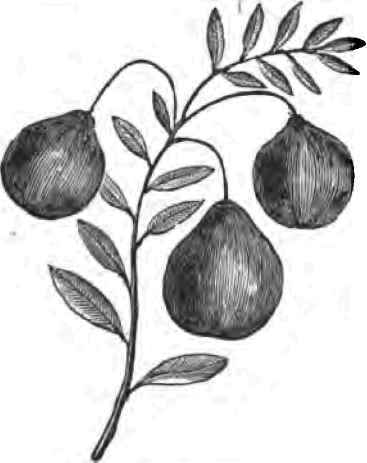
Bell Cranberry.
Mottled Bell
Mottled Bell - large size; color cherry red on white ground, beautifully mottled; good bearer; medium ripening qualities, and extra keepers.
Cherry Cranberry
Cherry Cranberry - medium to large size; round shaped; bright red color; good bearer; late in ripening and best adapted to moist soil, and not as well adapted to general culture as other varieties.
Bugle Cranberry
Bugle Cranberry - one of the earliest to ripen; medium to large size; good bearers and good keepers; color dark scarlet. Cranberries of each variety vary in size, shape and color. The most successful culture of the cranberry is on muck or peat covered with pure sand two or three inches, or more, if necessary, to level the ground, with a perfect underdrain to bring the water within ten or twelve inches of the surface. Another very important matter is to have an overflow under control, so as to let on or off in a very few hours. In case of drought or worms, it can be flowed at once, while the vines are growing in flower or fruit; twenty-four hours flow will not hurt them. Milford, Conn. F. Trowbridge.
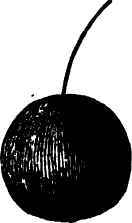
Cherry.
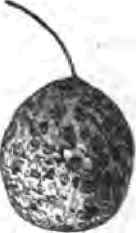
Mottled Bell.
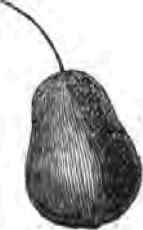
Bugle Cranberry.
Cranberries #1
As to the comparative merits of different varieties of cranberries, we supposed that no one would ever forsake the old Bell.
Cranberries #2
This fruit is seldom cultivated in gardens; it being better adapted to low, wet grounds than those usually selected for gardens. But a small bed is admissible, even if for no other purpose than ornament; and if well cared for, in the way of keeping the weeds from smothering the plants, and the ground liberally watered, a fair crop may be obtained. Of course, the cranberry is not particularly valuable as a garden fruit; still, it is worthy of trial.
Continue to:


My Books

