


Cranberry Culture
Description
This section is from "The Horticulturist, And Journal Of Rural Art And Rural Taste", by P. Barry, A. J. Downing, J. Jay Smith, Peter B. Mead, F. W. Woodward, Henry T. Williams. Also available from Amazon: Horticulturist and Journal of Rural Art and Rural Taste.
Cranberry Culture
Can yon give something in the pages of your periodical, relative to the culture of the Gran-berry. Perhaps some of your numerous subscribers might be induced to relate their experience in this matter. A Cranberry meadow is said to be a very profitable investment, yet very little attention seems to be paid to the subject. A Subscriber. - Princeton, Ill.
Will some of our New England correspondents, familiar with this culture, reply!
Will yon be kind enough to inform me where I can purchase a general assortment of fruit Hew true to name, especially Peach and Plum, and at the moat reasonable prices, one year from bud? (1)
Also a list of twenty-four of each of the best, most hardy, and productive kinds, for market Also twenty-four of the beat Mods of Apples for market (1) J. E. W. - Meriden, Ot.
(1) We must refer you to oar advertising pages for the names of nurserymen, any of them will send you priced catalogues if you ask for them. Our rule is not to recommend any establishment We can only advise you to deal with those who have a reputation for honesty and accuracy.
(2) Profitable market fruits tor your locality: - Peaches - Early York Serrate, Crawford's Early, Cooledge's Favorite, Crawford's Late, and Old Mixon Free. Plume - Imperial Gage, Prince's Yellow Gage, Smith's Orleans, Lombard, and Reine Claude de Bavay. Applet - Early Harvest, Sweet Bough, Fall Pippin, Hubbardson Nonesuch, Rhode Island Greening, Baldwin, and Roxbury Russet. In twenty-four you can not go far wrong in taking equal numbers of each sort above named.
Cranberry Culture
The kind most known and best adapted to all kinds of soil, is the Bell variety or Egg shaped, and most cultivated in New England. A round variety raised about Cape Cod is a larger fruit, handsome, and only grows on very wet, marshy land, and not as well adapted to general culture; there are also several other varieties which mature late, larger fruit than the Bell variety, but not as productive. They can be propagated from the seed, or from cuttings or by transplanting. The last method is most frequently adopted. The first crop obtained by planting the seed will be one or two years later than that produced by transplanting. When cultivated, the berries are large and abundant; after being gathered, they turn from light scarlet to deep red, and sometimes almost black. They will keep a very long time if not gathered too early - they should remain on the vines until it is necessary to gather them from the frost - they should be properly dried by spreading them thin for three or four weeks; they can then be packed and sent to any part of the-world. If gathered too early, while some of the berries are green, they will not keep.
The soil most suitable for their growth is low, moist meadow land that is not too cold and spongy. In that case, a drain should be cut to let off surplus water, which should always be within twelve inches of the surface, and sand covered over the top three or four inches will be of service, although not indispensable where it is not easily procured. When the ground is uneven, sand can be carted on to level it. They also do well on muck or any poor swampy land, where nothing else will grow; they grow naturally on watery bogs and marshes - on the border of streams and ditches, and by draining wet land and then taking off the top of the ground to remove the wild grass or vegetable matter and carry to the manure heap; then cart on beach or other sand to the depth of two or three inches to level the ground and to prevent grass and weeds from choking the vines, and to keep the ground loose around the plant. They bear abundantly on marshes covered with coarse sand, entirely destitute of organic matter of any kind, but accessible to moisture - on pure peat covered with sand, and on every variety of soil, except clay liable to bake or become hard in dry weather, on soil that can be worked with a plough and harrow; it can be prepared as you would do it for planting out garden and other plants; sometimes it can be burnt over, so as to get it in a condition to set out the plants.
They can also be raised on moist loam where corn and potatoes will grow, but not so abundantly on dry or sandy soil unless covered two or three inches with muck or spent tan. No animal or vegetable manure should be used, as the fruit draws most of its moisture from the atmosphere. The poorer the soil, the less cultivation is needed.
If you have a peat swamp and design converting it into a cranberry yard, your first step to be taken is to find a level that is not too wet, and then clear off the turf or grass sods, and bring the rest of the swamp to the same height. When it is thus cleared and levelled off, it is not then ready for the reception of the vine.
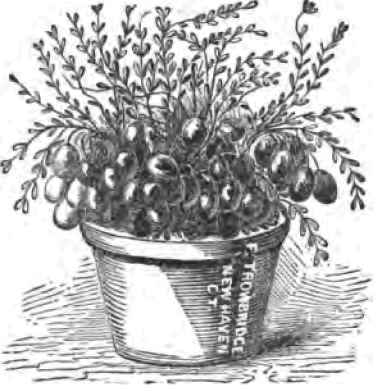
Should the vine be planted, it will do well through the winter and spring, but in the hottest weather the peat will bake and become hard; it will therefore be impossible to take in the moisture of the atmosphere, which is absolutely required by the vine. The absence of this moisture will cause the plant to die, and thus both labor and money are lost. This will be prevented by leaving the prepared swamp exposed to the action of the frost for one winter, when it will, after it is thawed, crumble and present a light gravelly appearance, the largest lump of which will not exceed an ordinary pebble. When the swamp has thus been treated, it will not afterwards bake and become hard; its surface will be light and porous.
When vines are planted, it is often the case that in the summer following they will appear as though they were dead; and the cultivator, having this impression on his mind, will take them up, believing that it is impracticable on his soil to raise any fruit.
The plant is very tenacious of life, and if there is but half a chance it will take hold and lire, though it may not yield much fruit. These vines should not have been taken up, for it is evident that their natural stunted appearance was mistaken for death. They ought to have remained in the soil at least another year, when it could have been fully determined whether they were living or dead.
Continue to:


My Books

