


The Crops
Description
This section is from "The Horticulturist, And Journal Of Rural Art And Rural Taste", by P. Barry, A. J. Downing, J. Jay Smith, Peter B. Mead, F. W. Woodward, Henry T. Williams. Also available from Amazon: Horticulturist and Journal of Rural Art and Rural Taste.
The Crops
The fruit crop in this neighborhood is highly satisfactory. Pears and cherries never promised better; of peaches, too, we shall probably have an average crop, both in Pennsylvania, New Jersey, and Delaware. At the Northwest, and in Ohio, there is less to hope for. Of the grain crops, the best accounts reach us.
Wodenethe, Fishkill Landing, 26th March, '56. My dear Sir: In looking over, last evening, a back volume of 1837 of the English Gardeners' Chronicle, I found the annexed directions as to planting trees, which seem to me so admirable, and so little known here, that I think them worthy of being quoted in the Horticulturist. I don't believe trees are ever planted so in this country - I at least never saw them, and yet, the philosophy is excellent. I remember seeing a small Deodar Cedar planted in this method at Eaton Hall, eight years ago, in holes 12 feet in diameter. Everybody, in this country, plants either in round or square holes.
Truly yours, Henry Winthrop Sargent.
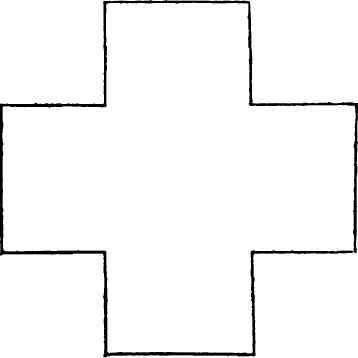
"All trees ought to be planted in pits of prepared soil. These pits ought to be 4 to 5 feet deep, and not less than from 12 to 16 feet in diameter, or to occupy from 16 to 20 superficial yards of surface. The pits should be neither round nor square, but star-shaped, or cross-shaped, of such a form as would be produced by placing one equilateral triangle upon another, or two parallelograms across each other, so as to form a Greek cross.
" The object of departing from the square or round form, is to introduce the growing fibres of the young trees into the firm and poor soil, by degrees, and not all at oncei as in the round or square hole method.
"When a tree is planted in the round or square pit, dug in hard, bad soil, it is much in the same situation as if its roots were con-fined in a pot or tub. The dovetailing, so to speak, of the prepared soil, and of the moisture which it will retain, with the hard, impenetrable soil by which it is surrounded, will gradually prepare the latter for being penetrated by the roots of the trees, and prevent the sides of the pit from giving the same check to these roots which the sides of the pot or tub do to the plant contained in it".
This advice is so admirable, that I trust you will publish it for the benefit of the few, and, I regret to say, they are very few, who are willing to take the trouble and expense to plant properly. H. W. S.
Fig. 1.

Fig. 2.
Thanks to Mr. Wm. Bright, for a collection of new and beautiful bedding-out plants. Mr. Bright is establishing a commercial garden and nursery near the city of Philadelphia (in fact, in it), from which good results may be expected. We have none too many - indeed, we doubt if there are half enough. Mr. Buist leads the van with his extraordinary variety, and if it were not for him, we should not have many of the novelties which make the members of our Horticultural Society a sort of pioneers in America. Others are active and intelligent, and we are glad to see Mr. Bright about to be added to the list. From Joshua Pierce, of Washington, we have his "Perpetual Raspberry," which is under trial by a jury of his countrymen, who will all rejoice if it equals his expectations. Mr. Snow's verbenas promise already more than could have been expected. Ellwanger and Barry have kindly sent us two specimens of the great California tree, Sequoia Gigantea, in fine order, together with handsome plants of Cryptomeria Japonica, and the Cupressus fanebris; the latter,, in the form of young, unestabllshed plants, has not withstood the two last hard winters, but may yet be found hardy.
The cryptomerias came out of their last trial better than usual, partly, we doubt not, from their increased age.
J. Jay Smith, Esq. - Dear Sir: As it is probable a number of your subscribers may possess the Memorials of Bartram and Marshall, published a few years since, the editor of that work would like to point out, while he may, some of his unlucky mistakes. Believing the Horticulturist to be an appropriate medium for the purpose, he begs permission thus to ask the owners of the volume to make, with a pencil, the corrections here indicated: -
At page 64, "the Virginian Guelder Rose" is inadvertently supposed to be the "Spiraea opulifolia, L." - when it was intended to write Viburnum optdus, L.! At pages 241, 244, 249, 258, and 411, a remarkable plant is mentioned by the names of " Tipitiwitchet" and "Tipitiwitchet sensitive," which the editor rashly conjectured might be "Schrankia uncinata, Willd.," or sensitive Brier: whereas, Prof. T. G. Porter, of Franklin and Marshall College, has conclusively shown, in the Mercersburg Review for March, 1850, that those names refer to the Dionaea muscipula, Ellis, now commonly called Venus's Fly-trap. At page 352, a "pretty kind of Lychnis" was heedlessly supposed to be the "Arenaria stricta, Miohaux." It is not doubted, now, that the plant intended was the Phlox subulata, L. At page 422, a little " glorious evergreen" is mentioned; and, by a lapsus penna, suggested to be "Cyrilla racemi-flora, L.;" whereas, it was intended, at the time, to write the true name, viz: Ceraliola ericoides, Miohaux.
If these corrections may gain admittance to the "Editor's Table," or find a convenient place among the familiar " Gossip" of your valuable journal, the privilege will be esteemed a favor by your obliged friend and well-wisher, William Darlington.
Westchester Pa, May 8,1856.
Continue to:


My Books

