


A Good Tomato - Cedar Hill Early
Description
This section is from "The Horticulturist, And Journal Of Rural Art And Rural Taste", by P. Barry, A. J. Downing, J. Jay Smith, Peter B. Mead, F. W. Woodward, Henry T. Williams. Also available from Amazon: Horticulturist and Journal of Rural Art and Rural Taste.
A Good Tomato - Cedar Hill Early
Some seven years since we received plants of a tomato from John Sill, Esq., of Cedar Hill, Albany Co., N. Y., with a statement that among a large number of varieties cultivated by him, this was the earliest and best The plants were placed separate from all others in our garden, and no more than ordinary pains taken in their cultivation. The fruit ripened the latter part of July, in advance of two or three other varieties, and was superior to them in every respect. We carefully saved the seed, and have since cultivated the variety side by side with each season's novelty. Thus far no tomato has equaled it in earli-ness, freedom from indentations, productiveness, solidity, or flavor. Many kinds produce a full crop which ripens up at once and is gone, and the vine, exhausted by its efforts, ceases growth and further production of fruit during the season; while the kind under consideration will continue in fruit until cut down by October frosts. Our neighbors all strive to be ahead of us with their early vegetables, and sometimes succeed in doing so with peas and corn, but for the past four years we have been able to send them baskets of ripe tomatoes before their own were scarcely tinged with red.
The fruit is of a medium size, very uniform, has few seeds, and, as far as our observation goes, is distinct in appearance from any other variety. Mr. Sill informs us that he has grown the variety extensively for the Albany market, and has found it more profitable than any other.
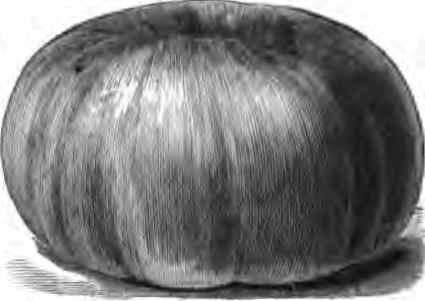
Fig. 192. - Cedar Hill Early.
In our notice of this tomato we have no private interests to serve, but simply desire to call the attention of our readers to a tomato that an experience of seven years in its cultivation justifies us in saying has with us surpassed all the much lauded varieties of former years. Our illustrations are made but one quarter the actual size of the fruit
Fruit in bins or barrels should be occasionally looked over, and all specked or decayed specimens removed. Do not rub or wipe the fruit unless it is moist from an associate decayed specimen; if all the fruit is moist, give air freely and assist to dry the place of deposit or it will soon all decay.
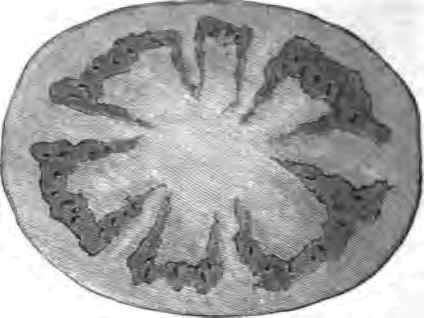
Fig. 198.
Continue to:


My Books

