


Grafting (2)
Description
This section is from "The Horticulturist, And Journal Of Rural Art And Rural Taste", by P. Barry, A. J. Downing, J. Jay Smith, Peter B. Mead, F. W. Woodward, Henry T. Williams. Also available from Amazon: Horticulturist and Journal of Rural Art and Rural Taste.
Grafting (2)
"To be short in this point, cut your graft, in any sort or fashion, two inches long, and ioyne him cleanly and close to any other sprig of any tree in the latter end of time of grafting, when sap is somewhat rife, and in all probabilitie they will close and thriue: thus: or any other fashion you thinks good".
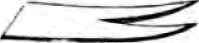
The Sprig.
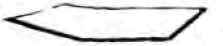
The Graft.
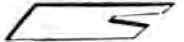
The Twig.

The Graft.
"Inoculating is an eye or bud, taken barke and all from one tree, and placed in the roome of another eye or bud of another, cut both of one compasse, and there bound. This must be done in summer, when the sap is proud.
"Much like unto this is that they call grafting in the scutchion. They differ thus: That here you must take an eye with his leafe, or (in mine opinion) a bud with his leaues, and place them on another tree, in a plaine (for so they teach). The place or barke where you must set it, must be thus cut with a sharpe knife, and the barke raised with a wedge, and then the eye or bud put in, and so bound up. I cannot denie but such may grow. And your bud, if he take, will flowre and beare fruit that yeere: as some grafts and sets also, being set for bloomes. If these two kindes thriue, they reforme but a spray, and an undergrowth. Thus you may place Roses on Thornes, and Cherries on Apples. Many write much more of grafting, but to small purpose".

Tour under-gardeners must labor to keep down weeds, "with a skrapple of iron thus formed, for netties and ground-ivy after a showre".
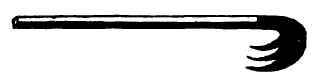
Trimming is illustrated in the fashion of the adjoining cut, which might be given as the style in vogue with the city trimmers, to make a long pole, but little shade. This mode is recommended to make good timber. The author says: -
"How many Forests and Woods, wherein you shall haue for one liuely thriuing tree, foure (nay sometimes twenty foure) euill thriuing, rotten and dying trees, euen while they liue? And in stead of trees thousands of bushes and shrubbes. What rottennesse? what hollownesse? what dead armes? withered tops? curtailed trunkes? what loads of mosses? drouping boughes? and dying branches shall you see euery where? And those that like in this sort are in a manner all unprofitable boughes, cankered armes, crooked, little and short boales: what an infinite number of bushes, shrubs, and skrogs of hazels,thornes, and other profitable wood, which might be brought by dressing to become great and goodly Trees. Consider now the cause: The lesser wood hath beene spoiled with carelesse, vnskilfull, and vntimely stowing, and much also of the great wood. The greater Trees at the first rising hane filled and ouer-loaden themseluee with a number of wastfull bonghes and suckers, which haue not only drawne the sappe from the boale, but also haue made it knottie, and themselues and the boale mossie for want of dressing, whereas if in the prime of growth they had beene taken away close, all but one top (according to this patterne) and cleane by the bulke, the strength of all the Sap should haue gone to the bulke, and so he would haue recouered and couered his knots, and haue put forth afaire, long and streight body (as yon see) for timber profitable, huge great of bulke, and of infinite last," If all timber Trees were such (will some say) how should we haue crooked wood for wheeles, coorbs, Ac.
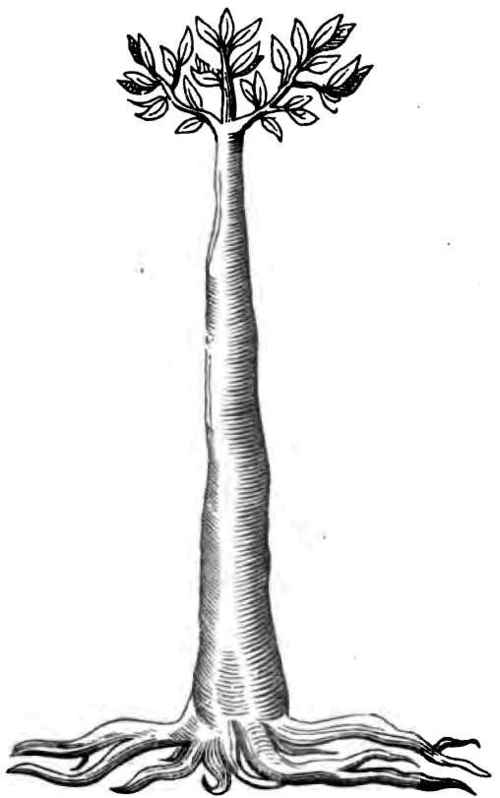
Imagine the root to be spred farre wider.
"Answ. Dresse all you can, and there will be enough crooked for those vses.
"More than this, in most places, they grow so thicke, that neither themselues, nor earth, nor any thing vnder or neere them can thriue, nor sunne, nor raine, nor aire can doe them, nor any thing neere or vnder them any profit or comfort".
Grafting #1
Dr. Regel describes a new method of grafting, as practiced by Herr Freundlich, one of the Russian court gardeners, with remarkable success. Instead of taking the cions from the previous year's wood, with the bud ju9t beginning to swell, the still soft growing lateral shoots are selected when from half to 1) inch long, and either bark or tongue-grafted, care being taken not to draw the ligature too tight, as they swell much more rapidly than hardwood cions. Success, he says, is certain, if care be taken that the sap of the stock is in motion at the time the operation is performed. He recommends this mode as superior to all others, especially for hard-wooded trees, such as quercus, fagus, etc., which are usually difficult to propagate from the old wood. New roses and other plants, which it is desirable to increase as rapidly as possible may also be advantageously worked in the same manner Florist and Pomologist.
Celery for winter use should be stored in trenches made the exact depth of the plant, and ten to twelve inches wide. Take up the plants on dry days only, and pack closely in the trenches. On the approach of severe frosts, cover with two or three inches of straw litter, increasing the quantity as the weather grows colder, until the covering is at least one foot in thickness.
Fern Creek, Jefferson Co., Kt., Oct, 22, '67. F. W. Woodward - Sir: Please find inclosed two dollars and fifty cents, the price of my subscription to the Horticulturist for this year. The particular excellency of the number for October I regard as well worth the price of the year's subscription. Respectfully, Henry F. Vail.
Continue to:


My Books

