


The Grape (2)
Description
This section is from "The Horticulturist, And Journal Of Rural Art And Rural Taste", by P. Barry, A. J. Downing, J. Jay Smith, Peter B. Mead, F. W. Woodward, Henry T. Williams. Also available from Amazon: Horticulturist and Journal of Rural Art and Rural Taste.
The Grape (2)
WHILE writing the article on the " Progress of Horticulture" in the last number, the cultivation of the Catawba & Isabella grapes for market might have been successfully dwelt upon. Dr. Underhill who supplies New York with these grapes from his vineyard at Croton Point, on the North River, writes to the author of that valuable work, " A practical treatise on the Culture and Treatment of the grapevine, By J. Fisk Allen,' that when the greater part of the community who can afford it partake freely of this delightful fruit, which they will in a few years, if they can obtain it, it is my belief, from a close scrutiny into the vine and progress of the grape culture on the Atlantic sea coast,' (he might have said, in the United States,) a hundred vineyards will not supply the demand for this fruit in New York, Philadelphia, and Boston, at renumerating prices." It is understood that his culture has been very profitable.
Mr. Allen's work may be perused with great advantage; himself a successful cultivator, the book would seem to have been the result of much practice, reading and inquiring, and in recently looking over it again we find the contents full of various information and instruction. He quotes the remark of Dr. Underhill that " An Isabella grape vineyard properly planted, with acclimated vines, and planted as they should be, will, in this climate, give a more certain annual crop than Indian com." In fact, nature seems to have pointed out to us, by the abundant growth everywhere of native grapes, that we might safely employ our time in America in producing wine-If slow to improve the idea, now that the way to do so has been pioneered in the West and the South, there is little doubt that it will be prosecuted to ultimate and entire success in places where, as yet, it has not been thought of. Dr. Kirtland finds on the shore of Lake Erie, at Cleveland, Ohio, the grape-vine ripens its fruit equally well, if not better, than at Cincinnati, there being, in his opinion, a conservative property in the waters of the Lake which suits the culture.
We find the best native kinds succeeding perfectly as far north as New York, and also in North Carolina, in the west at St. Louis, and we can see no reason why it should not be a profitable culture in all the intermediate points. Mr. Allen has inquired, and he gives the result of his inquiries as regards the kinds that will suit, as the Catawba and Isabella in the north, and the Souppernong in Carolina, while in Florida the Malaga was pronounced as far superior to the imported as a ripe peach to a green one, and the Muscat of Alexandria has been produced in the open air weighing 8½ pounds to the bunch. On this subject the reader will do well to consult Mr. Allen's book, which we have been tempted to notice both for its intrinsic merits and to afford an opportunity to introduce a copy of his frontispiece; representing a Grapery of a model appearance, as it should look when the vines are properly cultivated ; and as several do look which we have this season been delighted to visit ; and to partake of their products.
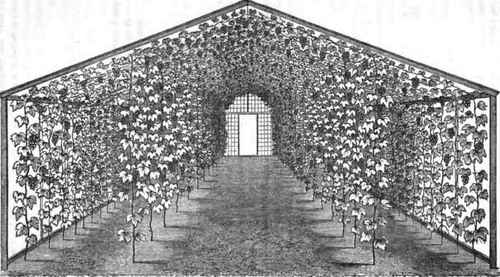
GRAPERY.
Our author says of this house; "it had four sets of vines planted in it; it was a matter of doubt with me at first whether or not the vines were too much crowded ; but since they have matured a fine crop of Grapes, and the fruit on the two inside sets of vines was fully equal in quality and quantity to those where the roots were in the open border, and had more room to ramble and extend themselves".
There is every encouragement from all that has passed; to plant the Grape vine both in Graperies and in the open air, and this book will tell the best ways of doing each.
Grapes #1
W. Riggs, (New-York.) Neither the Ohio nor the Herbemont, are equal to the Elsingburgh as table grapes in the climate of New-York. The Isabella is a better grape here than in Ohio; the Catawba, except in the warmer parts of New York, not quite so good. The latter is the only profitable wine grape yet tested in the United States.
Continue to:


My Books

