


IV. Exercises For The Rotators Of The Trunk. Part 15
Description
This section is from the book "Massage And Medical Gymnastics", by Emil A. G. Kleen. Also available from Amazon: Massage and medical gymnastics.
IV. Exercises For The Rotators Of The Trunk. Part 15

Fig. 133.
2. (Left) Neck-firm (Left) Side-leg-lying Correction with pressure + Side-arch - Leg - Lying Holding (Fig. 133). -
When the patient has been placed in the starting position the gymnast, standing behind, grasps him with his left arm from below, just below the axilla; the right is placed, as in the preceding exercise, on the angles of the ribs on the convex side at the maximum convexity. At this point firm pressure is exerted obliquely forward and inward, while the patient makes small forcible side-bendings (to the right) assisted by the gymnast's left arm. Care must be taken to avoid any forward rotation of the upper shoulder. Finished by Side-arch-leg-lying Holding.
C. Exercises with Active Work, chiefly for the Muscles on the Convex (Right) Side.
1. (Left) Neck-firm (Left) Hip-lean-walk-st. Side-bending (to right) with pressure (Fig. 134). - The patient takes (left) Walk-st. position, with (left) hip supported against a boom. The gymnast stands on the other side of the boom and grasps the patient's thorax at the middle of the curve, and with the heel of one (right) hand, assisted by the other, gives firm pressure on the angle of the ribs obliquely forward and inward, while the patient performs forcible Side-bendings to the right.
2. (Right) Wing-stoop-std.-sitting (Left) Arm-upstretching and -downpressing (see Single Arm-upstretching, p. 223).
3. Free-standing (Left) Shoulder-lifting (Fig. 135). - The gymnast stands behind the patient and with one hand (right) gives pressure on the convexity; with the other (left) he grasps the patient's (left) wrist and gives resistance, while the latter lifts his left shoulder and at the same time contracts the back muscles on the right side, so that the curve is straightened out or even bent to the left. The patient then resists slightly while the gymnast draws the shoulder down again to the starting position. (N.B. - This movement is a combination of Shoulder-lifting and Side-bending.)

Fig. 134.

Fig. 135.
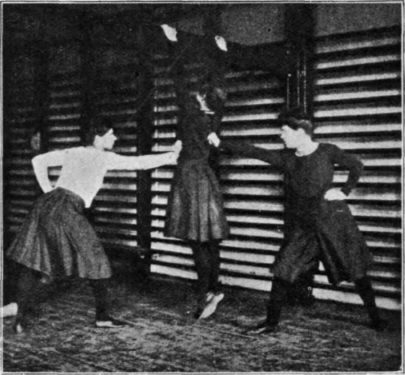
Fig. 136.
D. Exercises which Correct Deformity of the Thorax by Pressure.
1. Hanging Correction by Diagonal Pressure on the Thorax (Fig. 136). - The gymnast stands in Fall-out position behind the patient and gives pressure with his (right) hand on the angles of the ribs on the convex side, obliquely forward and inward. An assistant gives counteracting pressure from in front on the protruding ribs of the opposite (left) side.
Can also be given to the patient in Standing position by one gymnast. The patient's arm on the concave (left) side is then carried slightly forward so that it lies against the protruding ribs in front of the thorax. The gymnast stands on the patient's (left) side, encircles him with both arms, and gives pressure with the hands on the angles of the ribs on the convex (right) side, while he presses him against his own chest, which gives the counter-pressure in front.
Exercises to Correct Single Lumbar Curve (Convex to the Left).
A. Stretching Movements.
1. Side-lying over boom.
2. Stretch-grasp-side-against-st. Forward-drawing. These are both given in a similar way to the corresponding exercises for a dorsal curve, but modified according to the position of the curve.
3. Hanging Passive 2 (double) Leg-carrying to (left) side with pressure (Fig. 137). - Best given at a wall-bar. With one hand (right) the gymnast gives firm pressure forward and inward on the lumbar convexity; with the other (left) he grasps the patient's legs and carries them to the (left) side and slightly backward. At the extreme limit of movement a few over-stretchings are made. (N.B. - The pressure must be given on the transverse processes near the spinous processes, and so firmly that the trunk remains fixed while the legs are carried to the side.)
4. Forward-lying Passive 2 (double) Leg-carrying to the (left) side with pressure (Fig. 138 shows Leg-carrying to the right). - Two gymnasts, standing at the patient's (left) side. One gives pressure with one hand (right) on the lumbar curve forward and inward, and with the other (left) hand fixes the patient's trunk. Grasp immediately under the (right) axilla. The other gymnast grasps the patient's legs and carries them to the (left) side as in the preceding exercise.
5. Standing Weight-carrying on to the Leg of the Convex Side. - By quickly bending the knee on the concave (right) side and carrying the weight of the body over to the other (left) leg the patient himself reverses the curve, if it is still mobile, so that the originally concave (right) side is stretched. Repeated several times with a "jerk." (N.B. - The side-flexion of the spine must take place in the lumbar region and complete stretching of the spine be made between each weight-carrying.)
6. (Right-) Neck-firm (left-) Spring-sitting Trunk-rolling with pressure (Fig. 139). - The gymnast stands behind the patient and steadies the posterior leg by grasping it between his own. With one (left) hand flexed at the metacarpophalangeal joints he gives pressure on the convexity of the lumbar spine; with the other he grasps the patient below and in front of the shoulder on the concave (right) side, and helps by pressing the trunk over to the convex side while the patient performs the rolling. (N.B. - Rolling is done more strongly towards the convex side.)

Fig. 137.

Fig. 138.

Fig. 139.
Continue to:


My Books

