


IV. Exercises For The Rotators Of The Trunk. Part 16
Description
This section is from the book "Massage And Medical Gymnastics", by Emil A. G. Kleen. Also available from Amazon: Massage and medical gymnastics.
IV. Exercises For The Rotators Of The Trunk. Part 16
B. Exercises which partly Stretch the Ligaments and Soft Parts on the Concave Side, and partly Work the Muscles of the Convex Side in strong Shortening.
1. (Right-) Neck-firm-h.-r.-s. Side-bending (to left) with pressure.
2. (Right-) Neck-firm (Right-) Side-leg-lying Correction with pressure + slde-arch-leg-lying holding.
These are both performed in a similar manner to the corresponding exercises for a dorsal curve, naturally with such modifications as the position of the curve requires.
C. Exercises with chiefly Active Work in strong Shortening for the Muscles on the Convex (left) Side.
1. (Right) Neck-firm (right-) hip-lean-walk-standing Side-bending (to left) with pressure. - Given like the corresponding exercise for a dorsal curve, but the pressure is naturally given on the lumbar part of the spinal column.
2. Hanging Active 2 (double) Leg-carrying to (left) side (Fig. 140 shows Leg-carrying to right). - The gymnast stands behind the patient and resists with one hand above the patient's ankles; with the other (right) hand he supports the patient's hip (at the right side). The patient carries both legs to the left as far as possible against resistance of the gymnast, who afterwards presses them back to the starting position against the patient's resistance.
3. Stretch-grasp-lying or Reach-grasp-standing (left) Hip-updraw-ing. - The gymnast grasps the patient's ankle (left) and resists while the patient draws up the hip and leg as far as possible; then the gymnast draws down the leg to the starting position against the resistance of the patient.
4. High - reach - grasp - standing (left) Leg-outward-carrying and -inpressing (see Leg Exercises, p. 206).
5. (Right-) Stretch- (left-) spring-sitting Holding (see Starting Positions, p. 184).
Exercises for a Cervical Curvature (Convex to the Left).
A. Stretching Movements.
1. Hanging-in Apparatus (see Movements which increase the mobility in the joints of the Spinal Column, p. 277).
3. Passive Head-side-bending (to left) with pressure on the convexity.
B. Exercises chiefly with Work in Shortening for the Muscles of the Convex (left) Side.
1. (Left) Talk-grasp-standing Active Head-side-bending (to left) and -raising (Fig. 141). - Given so that the muscles work concentrically and eccentrically in shortening, i.e., in the inner part of their range of movement (see Head-side-bend-ings). This form is used if the left shoulder is raised.
2. (Left-) Crutch-standing Head-sidebending (to the left) (Fig. 142 shows bending to the right). - Used when the left shoulder is lower than the right (when the cervical curve is compensatory to a severe primary dorsal curve).

Fig. 140.

Fig. 141.
Exercises for S-shaped Scoliosis (Right Dorsal, Left Lumbar).
A. Stretching Movements. 1. Leg-forward-lying Correction with Pressure On Both Curves (Fig. 143).
(N.B. - Convexity of the upper curve in this case to the left). - The patient grasps the hips of the gymnast, who stands in front of him (head close to the right hip). The gymnast grasps with one hand (right) just below the patient's (left) axilla and carries his trunk first slightly over to the (right) side, when an assistant lays his hand (flexed at the metacarpo - phalangeal joint) on the lumbar curve and gives firm pressure. The patient's trunk is now carried over to the left while pressure on the lumbar curve is maintained, so that a strong stretching is produced on the concave side. The upper convexity is pressed by the free hand of the gymnast firmly inward and forward by pressure on the region of the angles of the ribs, while the upper part of the trunk is bent to the right. In this way there is also correction of the upper curve.
2. Forward-lying Passive 2 (double) Leg-carrying to (left) Side with pressure on both curves. -
Given like the corresponding movement for a simple lumbar curve (p. 283), but with this difference, that an extra assistant gives pressure on the upper curve. Chiefly affects the lower curve, but is not used much because respiration is considerably hindered by the pressure on the upper curve causing compression of the patient's chest.

Fig. 142.

Fig. 143.
B. Exercises which partly Stretch the Soft Parts of the Concave Side, partly give Work to the Muscles of the Convex Side.
1. (Left-) Neck-rest-h.-r.-s. Side-bending to the side of the upper curve (right) with pressure on both curves. - Given similarly to the corresponding exercise for a dorsal curve, but an assistant gives firm pressure on the lumbar curve throughout. Affects chiefly the upper curve.
In this group may also be reckoned : -
2. Neck-rest- (or Left-neck-Rest -Right-Wing-) stoop-leg-lean - standing Back-raising with pressure On Both Curves
(Fig. 144). - The gymnast, standing behind the patient, gives pressure with his hands on the convexities of the curves, while the patient raises the trunk as in ordinary Back-raising. Often the pressure is given so strongly that an assistant, standing in front of the patient, must help in raising, at least during the last part, by pressing in front of the patient's shoulders.
C. Exercises with chiefly Active Work in Shortening for the Muscles on the Convex Side of the Curves.
1. (Left-) Stretch- (left-) fallout-standing Holding (see Starting Positions, p. 171).
2. (Left-) Stretch- (left-) spring-sitting Holding (see Starting Positions, p. 184).
3. Correction in Belt (Fig. 145). - The correction belt consists of a broad pelvic girdle, to which two handles are attached, one on each side. The belt is strapped round the hips so that it rests between the iliac crests and the great trochanters. In carrying out the correction the patient is first told to push back the lumbar spine so that it is quite straight; slight forward flexion facilitate i this for a beginner. Then he is told to lower the shoulders and draw them well back. He now grasps the handles with slightly bent arms, and, carefully maintaining the position with lumbar spine pushed back and shoulders low and drawn well back, he stretches the elbow joints, so that the whole of the upper part of the body is raised and the spine stretched. In this position the patient must now contract the back muscles first on the side of the lumbar convexity (gymnast touches the place with one finger and says, "Draw in here!"), and then in the same way for the dorsal curve. When the back has been corrected in this way the patient, maintaining the corrected position carefully, may do He?l-raising and a few short steps forward on the toes, lowering the heels and raising them again between each step. After a short necessary rest the correction is repeated again. If it is done carefully and with strong contraction of the muscles it is a very tiring, but very effective, exercise. It must always be carefully supervised. If the patient is allowed to do it by himself it may easily produce lordosis. Can also be used for other forms of scoliosis.
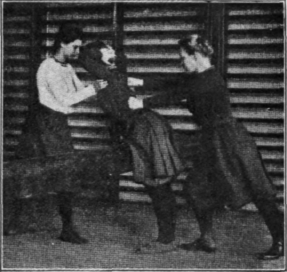
Fig. 144.

Fig. 145.
Continue to:


My Books

