


IV. Exercises For The Rotators Of The Trunk. Part 17
Description
This section is from the book "Massage And Medical Gymnastics", by Emil A. G. Kleen. Also available from Amazon: Massage and medical gymnastics.
IV. Exercises For The Rotators Of The Trunk. Part 17
D. Exercises which Correct by Pressure the Deformity of the Thorax and also the Curves.
Hanging Correction With Pressure On Both Curves And Counter-Pressure On Front Of Thorax
Given like the corresponding exercise for a single dorsal curve, but another gymnast gives pressure on the lumbar convexity.
Exercises for Rotation of Pelvis combined with a Lumbar Curve.
A. Stretching Movements.
Hanging Correction Of Pelvic Rotation
(a) If the hip on the side of the lumbar convexity is rotated forward (Fig. 146) the upper part of the body is fixed by a gymnast, standing on the side of the backward-rotated hip, grasping the patient's trunk, so that the heel of the posterior hand, with the help of the other hand, presses the lumbar convexity forward and inward, while another gymnast, with the same grasp as in ordinary pelvic rotation, performs rotation of the pelvis, i.e., pushes the forward hip backward and draws the backward hip forward. Repeated several times.

Fig. 146.
(b) If the hip on the opposite side to the lumbar convexity is rotated forward (Fig. 147), the upper part of the body is fixed by one gymnast, who grasps just below the patient's shoulders (one hand on the front of the shoulder on the convex side, the other behind the other shoulder). Another gymnast, standing at the side of the forward hip, grasps the patient and exerts pressure on the convexity of the lumbar curve as described in the preceding exercise, while at the same time he presses the forward hip backward with his own chest. Repeated several times.
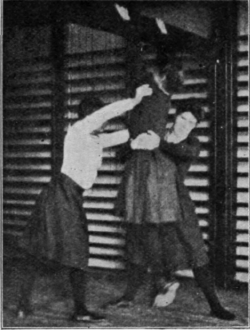
Fig. 147.
B. Exercises with Work in Strong Shortening for those Muscles which correct Rotation of the Pelvis.
Heave-grasp close-standing Stretch-grasp-close-standing
Hip-forward-turning.
The backward rotated hip is turned forward as far as possible, the other backward.
The gymnast stands in front of the patient and lays one hand in front of the hip which is to be turned forward, the other at the back of the opposite hip. The patient now turns the pelvis against the resistance of the gymnast, so that the posterior hip comes as far forward as possible and the anterior hip as far back, after which the gymnast turns the pelvis back to the frontal plane, but no further, against the resistance of the patient. Repeated four to six times.
Exercises which Raise a Low Shoulder.
1. Neck-rest or Stretch position for the arm on the side of the low shoulder.
2. (Left-) Talk-grasp-standing (Right-) Shoulder-lifting
(If The Right Shoulder Is Low) The gymnast stands behind the patient and lays one hand on the low shoulder; the other grasps the wrist. The patient now raises the shoulder as high as possible against the resistance of the gymnast, who then draws it down again to normal position (not lower) against the resistance of the patient.
List of "Between Exercises" which the Patient can take by himself during Treatment for Scoliosis.
1. Wing-standing Trunk-bending-forward and -raising.
2. Standing Arm-stretchings.
3. Hanging.
4. Sawing.
5. Hewing.
6. Slow marching, with Heel-raising, Knee-bending-upward, Knee- and Ankle-stretching (Cock-walk).
7. Balance-walking, along a line on the floor, on a boom (flat side) or other special apparatus.
8. Neck-rest or Stretch-standing Heel-raising and Knee-bending against wall, door-post, etc.
9. General Correcting Position = G. C. P. These have been already described.
Some Exercises grouped according to their Effects.
Respiratory Exercises.
These may be divided into : -
(a) Those which help inspiration.
(b) Those which specially help expiration.
(c) Those which help interchange of gases in the lungs.
For the general effects of respiratory exercises, see Standing 2 (double) Arm-carrying-forward-upward-outward-downward (p. 217).
Exercises which help Inspiration.
The exercises mentioned below are not all exclusively exercises for inspiration, but many of them at the same time also assist expiration or interchange of gases in the lungs, or both. Neither are all the exercises mentioned which in some degree assist inspiration, but only the most important.
1. Chest-lift-stroking.
2. Chest-lift-shaking.
3. Chest-lifting.
4. Circle-turning.
5. Grasp-standing Forward-drawing.
6. Chest-expansions.
7. Yard-sitting 2 (double) Arm-rolling.
8. Standing 2 (double) Arm-carrying-forward-upward-outward-downward or Outward-upward-outward-downward.
9. Stretch-sitting 2 (double) Arm-bending-stretching.
10. Plane Arm-carrying.
11. Trunk Bending-forward and -raising, and generally speaking, all Back-raisings.
Exercises which specially help Expiration.
1. Chest-lift-stroking.
2. Chest-lift-shaking.
3. Side-chest-shaking.
4. Stretch-grasp-standing Forward-drawing.
5. Stretch-sitting 2 (double) Arm-bending-stretching.
6. Trunk-bending-forward and -raising and other Back-raisings.
Exercises which help Interchange of Gases in the Lungs.
1. Chest-lift-shaking.
2. Side-chest-shaking.
3. Chest-clapping.
4. Back-hacking.
5. Back-clapping.
6. Screw-twisting.
Exercises which influence Circulation of the Blood.
These may be divided into : -
A. Exercises which help circulation in general.
B. Exercises which specially help pulmonary circulation.
C. Exercises which help portal circulation.
Continue to:


My Books

