


IV. Exercises For The Rotators Of The Trunk. Part 14
Description
This section is from the book "Massage And Medical Gymnastics", by Emil A. G. Kleen. Also available from Amazon: Massage and medical gymnastics.
IV. Exercises For The Rotators Of The Trunk. Part 14
Exercises which Increase the Mobility of the Joints of the Spinal Column, and thus prepare for and facilitate Scoliosis Treatment.
1. All Forms of Hanging, especially hanging in a head-suspension Apparatus (Fig. 128). - For this the leather collar is first applied, surrounding the patient's neck and chin. Then the patient stretches up the arms, and the transverse rod is placed so high that the patient can just reach it and grasp it with both hands. By slightly increasing or diminishing the distance between the rod and the collar, which can be done by fixing the rod higher or lower, and by regulating the length of the straps which support the collar, one may allow more or less of the weight of the body to be borne by the hands, and consequently diminish or increase the tension on the head or cervical spine.
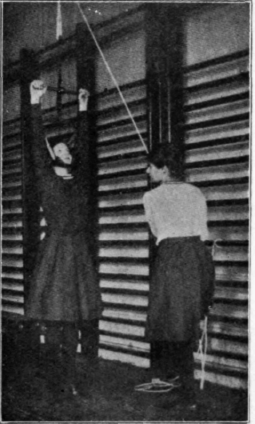
Fig. 128.
When the apparatus is adjusted it is raised to such a height that the patient can just reach the floor on tip-toe. At first the patient is not able to hang long in this position, but afterwards the time may be considerably extended, even to ten to fifteen minutes. The gymnast must all the time be ready to lower the patient when he shows signs of fatigue, for if the patient lets go his hands, and the whole weight of the body is thus supported by the cervical vertebrae, a severe accident may easily arise by rupture of ligaments or by dislocation. Apparatus for self-suspension is also made, but, as the weight in this is borne equally between the hands and the cervical spine and cannot be regulated, this apparatus is not so useful; neither do the patients like it, but always prefer the above method of suspension.
The effect of this hanging is of course to produce a strong tension of the ligaments and soft parts of the spinal column, especially in the cervical region.
2. Rolling in Rings, Ropes, etc. (Fig. 129). - The patient stands between the rings or ropes, which he grasps with more or less extended arms, when he allows his body to perform a circular movement, first one way and then the other, while the feet remain all the time on the same spot.
3. Trunk - rolling and Circle- Turning.
4. Head-rolling.
5. Quick alternate Trunk-turning (best in Yard-stride-standing position).
6. Hewing (see Movements for Lordosis.)
7. Sawing. - This is performed by the patient, after having taken "Reach position" of the arms, slowly bending forward and rising again, while performing repeated strong side-turnings of the trunk and with the arms performing a movement as in sawing, the arm of the shoulder going backward being bent and carried back, while the other arm is stretched forward (always at right angles to the trunk). The whole is repeated two to four times.
Exercises which cause Double-sided Work for the Back Muscles.
They are used in treating a tendency to curvature, as well as in the different forms of scoliosis.

Fig. 129.
1. All Double-sided Back Exercises (see Exercises for the Extensors of the Trunk).
2. All Double-sided Arm Exercises, especially 2 Arm-bending- and -stretching (see these exercises, p. 220).
Neck-rest-standing
Stretch-standing- Heel-raising and Knee-bending.
Performed slowly and with the greatest possible precision; if necessary, helped by the gymnast.
4. Correction in Belt (see Exercises for S-shaped Scoliosis, p. 287).
Exercises for a definite simple Dorsal Curve (Convex to the Right .
A. Exercises which Stretch the Ligaments and Muscles on the Concave (Left) Side-Stretching Movements.
1. Side-lying over Boom (Fig. 130). - The boom, furnished with a padded cushion, is placed at the level of the middle of the curve. The patient is placed across the boom with the highest point of the convexity immediately over the cushion, and turned slightly to the convex (right side), so that the pressure is applied to the region of the angles of the ribs in a direction from behind and outward obliquely forward and inward.
With the arm on the convex (right) side the patient grasps the boom; with the other hand stretched over the head and flexed at the elbow he grasps the handle of a strap fastened to the floor. The gymnast, especially at the beginning, must often support the patient's legs with his own knee or in some other way. He can moreover increase the effect of the exercise by careful pressure in front on the bulging ribs of the concave side. The longer the patient can remain in this position the better.
2. Stretch-grasp-side-against-standing Forward-drawing (right side against) (Fig. 131). - The patient stands with the right side turned towards the wall-bars or peg-post, with the hands grasping the handle of a so-called Forward-drawing-strap (see Gymnastic Apparatus). The gymnast stands facing the patient's left side with one foot supported against the apparatus, and encircles the thorax, grasping it at the level of the maximum convexity.

Fig. 130.
The patient is now turned so much to the left that the pressure which is exerted by the heel of the gymnast's posterior (right) hand at the angles of the ribs works, as in the preceding exercise, in a direction obliquely forward and inward as the gymnast draws the patient straight out from the apparatus.
B. Exercises which partly Stretch the Ligaments and Soft Parts on the Concave Side, partly give Work in Strong Contraction for the Muscles on the Convex Side.
1. (Left) Neck-firm-h.-r.-s. Side-bending (to right) with pressure (Fig. 132). - The gymnast stands behind the patient, places the right foot on a stool, and supports the right elbow against the knee, while the right hand, with extended wrist and fingers flexed at the metacarpo-phalangeal joints, is placed on the dorsal curve (at the angles of the ribs). With the left arm he grasps the patient just below the left axilla to help him with the side-bending. The gymnast now presses the dorsal curve strongly inward and forward by carrying in his right knee, while the patient at the same time, with the help of the gymnast's left arm, performs small side-bendings to the right. (N.B. - The side-bendings, on account of the pressure in the back, can only be done to a slight degree, and the patient's trunk is throughout almost upright.)

Fig. 131.

Fig. 132.
Continue to:


My Books

