


Chapter XXXVI. Water-Closets
Description
This section is from the book "Plumbing Practice", by J. Wright Clarke. Also available from Amazon: Modern plumbing practice.
Chapter XXXVI. Water-Closets
It would be a waste of time to give a history of water-closets, and no real advantage would be gained by filling pages with descriptions of those kinds which are now obsolete and, it may be said, forgotten. The writer had thought of describing all those in use at the present day, but had to give up the intention for two reasons: ist - that, instead of a short chapter or two exhausting the subject, it would fill several volumes of books, and take more time than he has at his disposal; 2ndly - there are so many that would have to be named and condemned in the same sentence as being far from good or suitable for their intended purpose, that is from a hygienic point of view.
One reason for their unsuitability probably arises from the fact that there are very few water-closet apparatus that have been designed or invented by plumbers, or those answerable for the healthy condition of our houses. A great many have been invented by others than plumbers, such as - watchmakers, locksmiths, carpenters, doctors, truss-makers, and such-like people. It is only just to some of these people to say that in some cases a really good fitting has been designed. Take for example the valve water-closet, which was invented by Bramah, and bears his name. At the present time it is made by all the most important manufacturers of closet fittings we have, and is still looked upon, by advanced sanitarians, as the best closet in the market. Several manufacturers have made improvements in the details, but none have invented anything to supersede it. Bramah was a cabinetmaker, although in some of his specifications, for patents, he describes himself as an engineer.
Figure 399 is a sketch of Bramah's valve water-closet, here shown to illustrate and compare with Figure 400, which is a modern valve water-closet with several patented improvements.
In Figure 399 the handle is placed on the left of the sitter. The basin is very large, the water-flush is at the back and distributed round the basin by means of a metal fan or spreader. If we may judge from the drawing, the size of the flushing pipe was much too small to thoroughly flush the basin. This evil would be aggravated if the head of water was low. In several old Bramah closets taken up by the writer, the water has only dribbled down the back side of the basin, the front part getting none at all. These closets are invariably found to be flushed by means of cranks and wires attached to a valve fixed over a service-box in a cistern. In some cases the cisterns are some height above, or some distance away from, the water-clostt. When this is the case, the handle has sometimes to be held up for several seconds before the water comes into the basin. The common result is, the handle is dropped before the water comes in and the paper in the basin gets jammed in the discharging-valve at the bottom, thus keeping it open and allowing the water, that should be retained in the basin, to dribble away down the soil pipe.
The overflow pipe from the basin is very small and connected with the valve-box under the basin. This overflow is trapped, but no provision is made for keeping the trap charged with water, in which case it becomes useless. It is just possible that when the handle of the apparatus is lifted, that a small quantity of water rebounds off the bottom valve into the pipe which connects the trap to the valve-box, but this is objectionable, as faecal matter may be carried into the trap in the same manner, where it would lay and give off unpleasant odours into the basin. The framework to which the apparatus is attached is objectionable. Being made of wood, it at times gets saturated with splashings and then gives off offensive smells.
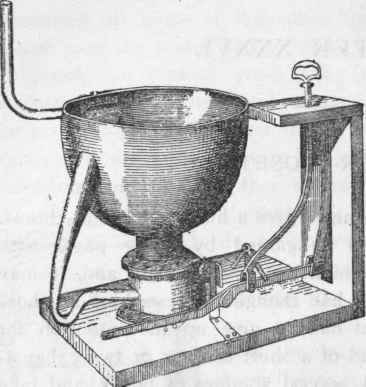
Figure 399.
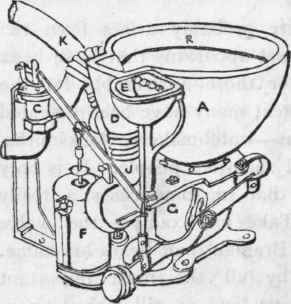
Figure 400.
The closet shown at Figure 400 is without all the above objectionable points. The handle is on the opposite side, and instead of the raised handle, has a sunk dish, E, made of porcelain. Or the closet can be had with a knob-pull, so arranged that the flap of the wooden enclosure can be closed before the handle is raised, and thus deaden the sound made by the inrush of water of which some people complain. The basin, A, is much smaller, has less surface to be kept clean, and has a hollow rim, R, from which the incoming water streams down over the inner surface of the basin on the front and sides equally with the back, thus exercising a cleansing force over the whole of the inner surface of the basin. The flushing-valve, C, is attached to, and forms a part of, the apparatus. By this arrangement water enters the basin immediately the handle is raised, this being a very great advantage. The valve slowly closes by means of the regulator, F. The size of the valve should be according to the head of the water-cistern, varying from 1 inch with a head of 20 to 25 feet, and 1 1/2 inch with a head of 3 to 8 feet. A closet, to be properly flushed, should have at least from two to three gallons of water enter the basin in four or five seconds, and it is impossible to get this through 3/4-inch supply-valves which is the size made by most makers. In Figure 400 the overflow, D, is large enough to take away the water as fast as it comes into the basin. Should the supply-valve get jammed by any means, so that it does not close when the handle is dropped, the overflow will take away the surplus water. On referring to the drawing it will be notices that the overflow arm, D, is open at the top so that a small mop could be pushed down to clean the inside. Water-closet overflow pipes generally smell offensive by reason of their dirty inside. The hollow rim of the basin is continued round the overflow arm, so that it and the trap beneath gets thoroughly flushed at the same time as the basin. The trap, J, to the overflow-arm of the basin is connected with a pipe, K, one end of which is continued out into the open air, and the other end connected with the valve-box, G, under the basin. The valve-box is porcelain-enamelled inside so that no corrosion can take place, and it is also made as small as convenient so that no large amount of bad air can be-retained in it. A vent-arm and pipe, K, are fixed so that when the contents of the basin fall down into the trap they displace the air out of the valve-box into the open air through the vent pipe. Without this vent the pent-up air would escape upwards through the valve-opening of the basin. In some cases this air is forced through the overflow-trap. This is a frequent cause of complaint, which, no doubt, led to the adoption of the vent-arm and pipe. Another use for this pipe is, that with a poor supply of water faecal matter will sometimes lay in the trap below and give off certain gases which could pass through the pipe into the open air, instead of into the house. The framework of the above water-closet is cast-iron.
Continue to:


My Books

