


Cylinders And Hot-Water Circulation. Part 3
Description
This section is from the book "Plumbing Practice", by J. Wright Clarke. Also available from Amazon: Modern plumbing practice.
Cylinders And Hot-Water Circulation. Part 3
In some instances a hot closet has been fixed in a kitchen, for warming plates and dishes, and connected with the boiler circulation pipes. For want of the proper knowledge some of these have been found to be failures. The writer had to inspect one that had been fixed but a few months, but no matter how hot the water was in the boiler the closet was always quite cold.
Figure 445 shows the arrangement. The man who fixed it said he would give it up and own he was beaten, but when asked if water or air was in the coil, Z, he at once saw where he had made a mistake. He then made the necessary alterations so as to allow the pent-up air to escape from the highest end of the horizontal coil. Acting on advice, he also connected both ends of the horizontal coil to the flow pipe from the boiler, and put a small perforated disc of copper at Y so that the water did not circulate past and miss the T-junction. This air-binding of pipes is of frequent occurrence and in a great variety of ways. In a row of six mansions a stupid blunder was committed in each house. The storage capacity for cold water was too little, with the result that the cisterns would frequently get emptied. Every time the cisterns were emptied and filled again it was found impossible to draw water at the hot-water taps. The reader is referred to Figure 446, which shows what was found. The cold-water supply to the boiler was connected to the bottom of the cistern, and, about 6 feet away, the pipe was lifted about 2 inches, so as to fix it with a pipe-hook to the wooden bearer on which the cistern was placed. On taking out the hook in each house, and lowering the pipe, air came bubbling back into the cistern, after which the water ran freely into the boiler and could be drawn at the various taps. It may be further explained that the bottom end of the supply pipe was sealed by the water in the boiler so that the air could not escape or be driven out at the bottom, although the cold-water cisterns were about 60 feet above the boilers. Great numbers of similar blunders could be given, but the writer does not consider it necessary to weary his readers by repetition of cases.
A common cause of complaint is that such a quantity of cold water has to be run to waste before hot water can be had at the taps. This occurs chiefly with long branch draw-off pipes to taps some distance away from the circulation pipes. In a great many cases it is possible to fix return pipes to these branches so that the water will circulate through them and thus avoid the evil referred to. Where it is impossible to circulate through the branches, the size of the pipes should be reduced as much as possible, so that less water will have to be run to waste. This applies more particularly to wash-hand-basins, where only a small quantity of hot water is required. For baths it is not so important to reduce the size of the pipes, as a few pints, or even a gallon, of cold water having to be drawn does not much matter, but if the pipe is reduced, the bather's patience would perhaps be exhausted by waiting for the bath to fill from a small pipe. In some cases it has been found to be an advantage to have two, or even three, sets of circulating pipes carried from the cylinder to the various parts of a house, especially when the shape of the house is large and straggling, and the draw-offs are wide apart. No matter how many sets of circulating pipes are fixed, it is always necessary to have a vent pipe from the highest end of each to allow the air to escape. In some cases a draw-off pipe has been fixed near the highest end, on opening which any air could escape, but this is not by any means a good system to adopt. When air pipes are fixed, it is scarcely necessary to add they must be carried to a level above the cold-water supply-cistern.
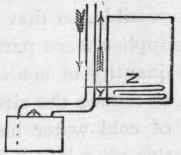
Figure 445.
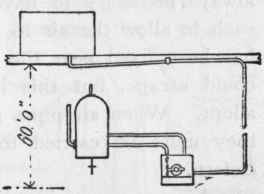
Figure 446.
A reason was given in an earlier chapter for connecting the return pipe to the cylinder instead of branching it into the boiler or the cold-water service pipe to the boiler. To prevent water from being drawn from the return or cold, instead of the flow or hot-water pipe, some makers will fix a small flap-valve inside the circulating pipes, that opens in the direction of the flow of water when circulating, but closes should the circulation by any means become reversed, or to prevent back-water being drawn when a tap is opened for drawing hot water.
A great many hot-water men fix stop-cocks in the circulation pipes, but this practice cannot be too strongly condemned. A few years ago a serious accident (?) occurred through this. The stop-cocks were closed while a new draw-off cock was being fixed, and it was forgotten to reopen them, with the result that when the fire was lighted the water in the boiler expanded sufficiently to burst it.
Elbows in circulation pipes should always be avoided as much as possible, it being much preferable to have bends of an easy sweep or radius. Some first-class men will always insist on the pipes being heated and bent to suit the various positions, instead of using those bought at the manufacturers, the reason being that every bend, especially when made to a small radius, causes a retardation of the free flow of water, and, as the force in the form of heat which puts the water in motion is very small, all obstructions and unnecessary friction should be avoided as much as possible. When galvanized-iron pipes are heated and bent the zinc coating is melted off. For common work no notice is taken of this, but for best work the pipes are bent first and galvanized afterwards. When done this way the bends should be carefully examined, as they have sometimes been found to be partly or entirely choked with zinc. Some men, who take a pride in their work, will make very nice bends, and when two or three are fixed together will make them match, so to speak, as shown at Figure 447, Figure 448 is an elbow drawn for comparison with the bends. Mention has been made of the expansion and contraction of hot-water pipes. If no allowance is made for this motion of the pipes the result will be that some of the joints will leak, and this occurs more especially with long straight lengths. As expansion and contraction are, to a certain extent, irresistible forces, it follows that provision should be made to allow for them. The introduction of bends, as shown at Figure 447, will allow for a great deal of motion of the pipes, and is a very simple and easy way of overcoming the difficulty. Figure 449 is a gland-joint that can be used for the same purpose, the lining sliding in and out of the gland-box.
Continue to:


My Books

