


Drain-Ventilation. Continued
Description
This section is from the book "Plumbing Practice", by J. Wright Clarke. Also available from Amazon: Modern plumbing practice.
Drain-Ventilation. Continued
Another principle for inducing an air-current through drains has been practised in a few cases. Figure 196 is a fractional section illustrating this. The air-inlet has a perforated pipe inside, and water is laid on to this and regulated by a stop-cock, as shown. The principle is simple and acts very well, the falling water drawing in a current of air. There are objections to this, however. In the first place, water must be plentiful; secondly, during a severe frost this place would become choked with ice, and so rendered useless, but this might be overcome by fixing the sparge pipe underground, beyond the reach of the frost. But it is an open question if the results gained would be worth the cost. Another firm of engineers drive air through the drains by means of either a centrifugal or an Archimedean fan, propelled by water-power. This is done by causing water under pressure to impinge against the perimeter of a horizontal wheel, which is connected by the necessary gearing, etc, to the fan.

Figure 196.
It is doubtful if any mechanical means will come into general use for ventilating drains, as, in addition to the first cost, there would be that of attendance, wear and tear, and future renewals, the provision of motive power, and, after all, the liability of a breakdown through neglect and inattention.
There are a considerable number of houses which have been built during the last few years, in which the syphon system of ventilating drains has been carried out, and an air-current caused to pass upward through the pipe A, Figure 195. Near the position marked B the pipe has a cast-iron chamber inserted. Inside this chamber is arranged a specially constructed gas-burner, which has to be kept continually burning. In addition to creating a strong current upward, the inventor claims that what he calls "sewer-gas " is rendered harmless, and that disease-germs are destroyed by the burning gas. Some years ago there was a long paper war on this principle, in which I am not sure that the inventor did not get the worst of it. But as this work is intended to be on principles and not inventions, the reader is simply referred to what has been said about other means for inducing air-currents.
Another illustration is given - Figure 197. In this case, so much faith was placed in the cowl at A that it was considered powerful enough to pull a current of air through the whole of the soil pipe at the back of the house, down the drains, and up the vent pipe fixed on the front of the house, and, in addition, act as a ventilator to the public sewer. This was arranged, as shown in above sketch, by fixing the pipe, B. It would be an economy, and simplify matters very much, to remove the trap, C, as it was rendered useless by the by-pass, B. The practice usually followed by most first-class sanitary engineers, is to make a provision for air to enter the drains, at a low level, near the trap placed to disconnect them from the public sewers, or, in country mansions, from the cesspool, when there is one. In this latter case, Figure 198 represents a section of a common way of arranging this air-inlet. A is the drain from the house or mansion; B is the disconnecting trap. The top part of this trap is continued to ground level, where a stone, with a grating let in, is placed for air to pass through, as denoted by the arrows. This grating is generally made strong enough to resist being broken by cattle walking over. It is not a good plan to fix the grating level with the ground - if fixed in a cultivated field, earth can fall through and choke up the trap. When fixed in a grass field, the gratings have been found to be entirely covered with long rank-growing grass, which has become so matted together as to entirely prevent any air from passing through, and so they have become perfectly useless.

Figure 197.
The best plan, when the trap is near the surface, is to build a small hollow brick pier near the trap (not over it, as it would be necessary to pull it down for access to the trap), with a stone over the top, and a grating let in the side about 1 foot or 1 foot 6 inches above the ground level. This prevents grass or weeds growing over the grating, and is high enough to be above an ordinary snowfall. Another advantage claimed for this is that leaves or other matter cannot drift and lay on the grating in the same manner as when it is laid flat. Straight-barred gratings are the best to use, and the bars should be placed upright so that nothing can lodge on them. Perforated air-bricks are not so good as the grating, as the holes are liable to become choked. In one case earth had drifted into the holes, in which grass seeds had taken root, with the result that there was scarcely any air-passage. Figure 199 represents the raised chamber with the grating let in, as described above. In a long length of drainage one of these chambers could be placed at intervals of 50 or 100 yards, so that should any offensive air become generated in the drains, it could pass out of them instead of being conveyed up to the house and distributed, by means of the ventilating pipes, in the air surrounding the house. But these chambers can only be applied under favourable circumstances. In some cases they are objected to as being unsightly. They can be hid by planting shrubs around them. In other cases old tree-stumps and roots and ferns can be planted so as to disguise them. A great many people object to any kind of drain-ventilation being seen, remarking that they are suggestive of a stink, but if the drains are well flushed and ventilated there cannot be much to complain of in the way of smem.

Figure 198.
At a nobleman's house in the country, during an examination which took three days to make, it was found that the whole of the drainage from the house, offices, and stabling (for about thirty horses) discharged into a cesspool 30 feet long by 10 feet wide, and in which was 6 feet of sewage in a horrible state of decomposition. None of the drains were trapped, or flushed except by the discharges from sinks and water-closets, and which kept continually stirring up the contents of the cesspool, thus setting free enormous quantities of sewage-gases. The cesspool was situated partly beneath the milk dairy, in the floor of which was a bell-trap. The dairymaid said she had to fill this trap with water every day to keep down the smells. A branch drain from the cesspool was carried to the dry area round the house for the purpose of taking away any water that might get in there, and this drain had no trap in IT. On raising a stone for access to this area, the stench that escaped was so bad that the men had to beat a retreat for some time until it had cleared away. The cesspool was emptied, and the drains from the stables were separated from those from the house. New ones were laid to convey the sewage about a quarter of a mile, where it was distributed by intermittent irrigation. Entirely new drains were laid round the house, with the necessary trapping and ventilation, and at the highest point of each main drain was fixed a forty-gallon automatic flushing tank. In the park was fixed air-gratings, similar to Figure 199, and, after an interval of two years the whole system is working to the owner's satisfaction. All solid sewage is retained in a specially-constructed chamber, so as not to choke the sub-irrigation pipes.

Figure 199.
To return to air-inlets to drains, Figure 199 has been fixed to several London suburban houses, where there has been a small shrubbery or garden, but in these cases the drains have been entirely relaid; where old drains have been left in, other precautions have been taken to prevent bad air issuing out of the grating during a reversal of the air-current by discharges down the drain. This is when a path or walk has been near.
Figure 200 is a sectional elevation of a manhole found at a house. A large iron grating was placed over it, and as this place was surrounded by trees and shrubs, the manhole had a considerable quantity of rotten leaves lying in the bottom, as shown at A, Figure 200. Rain fell on the leaves, causing the place to smell offensively. On moving the top leaves a great deal of fungoid matter was found to be growing. The drains were well laid and flushed so that whatever fell into the channel was washed away, and nothing offensive could be found excepting these rotten leaves.
In some cases a branch drain has been laid from the manhole to a distance away, with an upright pipe and domical wire grating on the end to allow air to pass into the drains, as shown in section, Figure 201. The domical wire grating on the end of the upright pipe has been objected to, as rain can fall through. If the pipe and horizontal air drain should retain any dust which may have had a vegetable or animal origin, and which would have been carried in by the air-current, any moisture would cause it to further decompose and give off offensive smells, and which would be discharged through the ventilation pipe at the head of the drain. It might be said in that case there would be no ill effects from smells, but it must be much better to avoid their cause than to do that which would assist their generation. If sufficient rain fell through to scour away anything that lay in the horizontal pipe it would be an advantage, but as only just sufficient falls through to do harm, it is better to put a conical cap over the grating (or use a louvred cap instead of the grating) to prevent this. The same objection could be raised against some kinds of blow-down cowls, which would catch a great deal of water in case of a driving rain. These arguments only apply when any part of the air drain is horizontal.
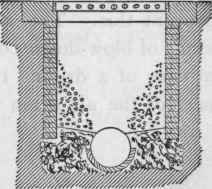
Figure 200.
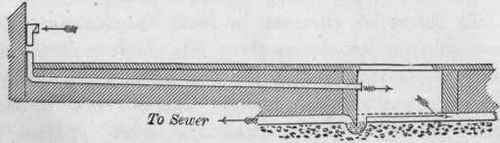
Figure 201.
Continue to:


My Books

