


Drains And Traps - Continued. Part 2
Description
This section is from the book "Plumbing Practice", by J. Wright Clarke. Also available from Amazon: Modern plumbing practice.
Drains And Traps - Continued. Part 2
Where expense is no objection, it is a good plan to use white glazed bricks for the face-bricks of manholes, as they always look clean and are impervious to moisture, and if they should become dirty, a man with a pail of water and a broom will soon wash them as clean as when first new.
Drain-traps, sometimes called disconnecting-traps, are now considered by all sanitarians to be very necessary to disconnect the house drain from the sewer, as many sewers are in such a condition that people are unwilling to incur the risk of using their soil pipes as sewer-ventilators. Each house should have a separate drain and connection, and each drain should have its trap. By doing this, it is argued that in the case of certain contagious diseases breaking out, any germs which find their way into the sewer shall not pass up the drains into adjoining houses. It has been disputed that water-traps form an effectual barrier, but from the experiments that have been made, and the eminent men who have made these experiments, we cannot do otherwise than accept their ruling that water-traps answer their purpose thoroughly well; and, until something better can be devised, they are the only fitting that can be applied with success. At all events they keep gases of decomposition from pouring in a continuous stream from the sewers, or cesspool, into and through the house drains - that is, when properly constructed. One of the oldest-fashioned traps that has been made for this purpose is what is called a dipstone trap, shaped as in Figure 151. They are simply small cesspools. Some are made 3 feet square and a corresponding depth, with a stone built in the side walls, so that its bottom edge dips into the water which is retained in the bottom of the chamber. I have seen them with the dip-stone so low down that the fingers could be passed between it and the cover-stone. The cover-stone is very rarely bedded down air-tight, and cases have occurred when it has been removed for access for cleaning out the trap, and then simply replaced without any bedding at all, so that when a smoke test has been applied to the drains it has poured out all around the cover. Another fault of this kind of trap is that when the top is removed for any purpose drain-air can pass freely through during the whole time the man is doing his work Experience has proved that this kind of trap very readily stops up. Paper and faecal matter float on the surface of the water on the inlet side until quite a heap has accumulated so as to form a dam across the end of the inlet drain. More sewage flowing in will detach and perhaps immerse a portion of this matter below the dipstone, on passing which it floats in a body and chokes up the end of the out-go drain. By making the trap larger these evils are aggravated, but their discovery is postponed for a longer period of time. So much faecal matter is retained in these traps that an enormous quantity of sulphuretted hydrogen and other noxious gases are given off; in fact, they act as gas generators, and are as bad, or possibly worse, than the evils they are intended to obviate. Sometimes nothing but solid matter is found in these traps, the liquid portion having leaked away into the earth through defects in the brick walls. In the middle of a public school playground one was found with no water in it, having leaked through the walls, and the stench from the drains pouring out in a continuous stream.
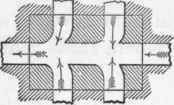
Figure 149.
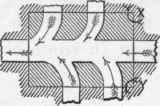
Figure 150.
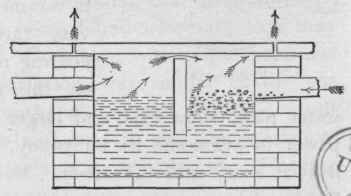
Figure 151.
The trap most commonly used is shown in Figure 152. Although it has some advantage over the dipstone trap, it retains some of the evils, although in a lesser degree. For instance, excremental matter is retained in the middle pipe, and it is very rarely that one is seen without floating matter on the surface of the water on the inlet side; small discharges of water pass below this, and larger discharges do not have sufficient power to overcome its buoyancy, to drive it out of the trap, and float it away into the sewer. Not having any foot or base, in the hands of an incompetent workman these traps are likely to be fixed so as to be useless for their purpose of keeping back smells, by being placed so that the water level is below the throat or dip. This kind of trap is also too large and contains too much water to be thoroughly flushed out with ordinary discharges through them. In choosing what kind of trap to use on house drains, capacity is of as much importance as shape. Take Figure 152 as an example. A 6-inch trap holds, when properly levelled and fixed, something like three gallons of water. In London, and several other towns, we are limited, by means of special apparatus, to not more than two gallons of water at each usage of a water-closet, and by the time this has passed through the drains and pipes it has lost all force or scouring power as it passes through the trap. If a pailful of water - about two or three gallons, is thrown down a sink and has to be strained through a grating, and then down a waste pipe into the drain, it has even less power of cleansing than the water-closet discharges; or if a bath is emptied it is generally through such a small waste pipe as to be useless for removing any floating matter out of the drain-trap.
The writer found on trial that fifty gallons of water, discharged from a bath into the drain, failed to get rid of a piece of crumpled-up paper, no larger than the hand, that was thrown into a similar kind of trap to the one under discussion.
Continue to:


My Books

