


Soil Pipes. Part 3
Description
This section is from the book "Plumbing Practice", by J. Wright Clarke. Also available from Amazon: Modern plumbing practice.
Soil Pipes. Part 3
At a country house taken by a lady and family for the summer months, the servants sat by their bedroom window the whole of the first and only night they were there, and could not stay in bed because of the abominable stench that appeared to be immediately beneath. On an examination being made it was discovered that the rain-water leader was connected to a drain leading into a cesspool, no trap of any kind being fixed to prevent smells escaping. Figure 361 illustrates the evil. Smells escaping through the pipe passed under the eaves of the slates, between the floor-joists and through the joints of the boards beneath the bedstead.
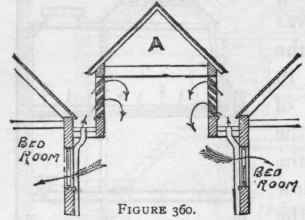
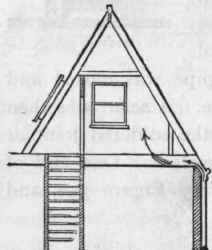
Figure 361.

Figure 362.
One more illustration is given of defects of construction often met with in a certain class of London houses. In this case a servant-maid had fever, which led to an examination for the cause being instituted. Figure 362 is a fragmental section of the ( third and attic floors of the house. The soil pipe, which was of lead, with good soldered joints, was connected at the top with a leaden gutter as shown. The attic rooms were used for sleeping in, and the above gutter was continued through each attic to receive the water from the back and front roofs. The only protection to prevent smells passing into these bedrooms was a board loosely laid over the trough gutter. In addition to this abominable state of things, appearances lead one to think at times this board had been removed so that bedroom slops could be emptied down, and thus add to the already insanitary state of things.
I should like to diverge from the subject of soil pipes for a few minutes, to show that it is not always the journeyman plumber who is to blame for bad work. No matter how skilful he may be, he cannot make a good job with bad or improper materials, and, when working to some one else's dictation, it is not fair the plumber should be charged with the dictator's mistakes. Further, the public - that is, those interested in houses as owners or tenants - are very much to blame for a great deal of bad work. As an illustration: In a great number of cases where the writer has been sent for to make an examination of a house, he has been met by the person interested, and it is really ludicrous the pains that are often taken to impress upon him (the writer) that there never has been any illness in the house, and there is nothing the matter. In these cases one is almost tempted to ask the person: "Why send for a sanitary man, then?" Novices at making examinations of houses would be influenced by the above class of people, and not thoroughly test the drains, etc, while old hands at it would simply smile and make a thorough examination.
A case occurred where the writer tested the drains of a house with smoke and found them very defective, the smoke escaping between the joints of the stone paving in passages and floor-boards of rooms. In spite of this proof the owner was not satisfied until he had called in another adviser, who made a report similar to the first one's. The services of both advisers were dispensed with, and a jack-of-all-trades employed to stop up the cracks in the flooring with mortar and putty.
Very often after an examination of a house has been made and the report sent into the owner, the sanitary man has to submit to all sorts of interrogations, such as "Is it as bad as you say? What will it cost to put right? Are you sure it is defective? How long will it take to do? I don't think it is so bad as you make out! Can it be done without the family leaving the house? You must have made a mistake, as no one has been ill! Could not the holes be stopped with putty?" After about an hour, and sometimes two, of this misery, when one wishes he had never been called in, he is dismissed with the remark, " I will think about it and let you know." This promise is very often not kept, but some talented expert, who can do wonders with paint and putty, is called in, with the result that very often the doctor's bill is considerably more than would have paid for that which would have prevented the illness of the family.
But to return to our original subject. In several cases of testing, smoke has been found to escape beneath the seat of an upstairs water-closet, and this sometimes when trying to find cause for smells in some other position. In taking down the wood enclosure of the water-closet it is often found that a small trap is placed beneath the lead safe to take away any water that overflowed the basin, the outgo of the trap being branched into that from the water-closet trap. The water has become syphoned out of the small trap, as the soil pipes were not ventilated, and the small pipe, called the "weeping pipe," which is arranged so as to recharge this trap with water at each usage of the water-closet, has become choked, so that no water can pass through to recharge the trap. Figure 363 is a plan of the two traps and soil pipe, and Figure 364 is an elevation on A B showing the apparatus fixed and the weeping pipe, at C. in these cases the water-closets are generally flushed by means of valves and service-boxes fixed in the cistern over. In other cases, where a valve and regulator flushing apparatus has been used, the weeping pipe has been branched into the pipe between the valve and arm of the basin.
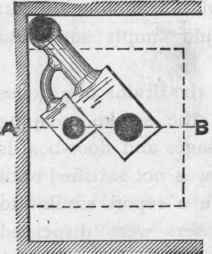
Figure 363.
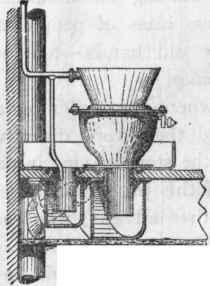
Figure 364.
Twenty to twenty-six years ago the writer assisted to fix large numbers of water-closet traps in the manner above described. At that time it was considered to be first-class work, and was done in all high-class houses. One case comes back to memory where the traps for a range of eight water-closets were arranged, as shown on plan, Figure 365. So much value was not attached to ventilation pipes at that time as now, 3/4-inch and 1-inch pipes being considered quite large enough for the purpose of preventing syphonage of traps. In some cases the D-traps were made very large - that is, 10 inches or 11 inches deep instead of 9 inches which was the usual size, and 7 inches wide, the dip pipe being kept a little distance from the heel, as shown in section, Figure 366. By doing this, space is made for a larger quantity of air to enter, with less displacement of water than is the case with a small size D-trap, in which the heel and sides are close to the dip pipe. But traps of that size have now fallen into disuse, being often described as small cesspools. Large soil pipes were also in much favour, as it was more difficult to fill them with water so as to start a syphonic action on the water in the traps. These precautions were taken in the case of the work shown in Figure 365, which, no doubt, was a thorough success when judged with the experiences of that age, but it was also found necessary to fix 3/4-inch flushing pipes to the water-closets, a larger size with a good head of water often upsetting all calculations on the point of trap-syphonage. In cases similar to Figure 365, which have been renewed within this last ten years, it has often been found that the safe-traps have been quite empty, partly by syphonage, and the rest by evaporation; the weeping pipes in these cases having become useless by being choked at D, Figure 367. This is not so likely to occur if the bottom end is left open and the other end tapered, as shown by dotted lines at E. Any dirt lodging on the top end of the pipe would be removed by the scour of the water as it passes toward the basin, whereas in the first instance anything getting into the end D would become further jammed by the water-pressure above it. In the case of stoppage in the soil pipe, the safe-trap, when arranged as shown at Figure 363, becomes perfectly useless. The outgo being branched into the soil pipe, any stoppage in the soil pipe affects this trap as much as that under the water-closet.
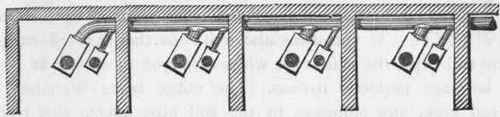
Figure 365.
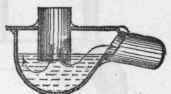
Figure 366.
In some cases the waste pipe from the safe has been branched into the cheek of the water-closet D-trap, as shown at Figure 368.
So long as the water is in the trap to the necessary height no smells can escape from the soil pipe. But the waste pipe is a serious evil in another way. Little puffs of air are driven out, as shown by the arrow, each time the water-closet is used, and sewage-matter is also driven out and lays in the bottom of the safe to an extent often injurious to health. There are several cases on record where this safe waste pipe has been branched into the trap above the water-line, as shown by dotted lines, and others where it has been branched into the soil pipe, and no provision whatever made for keeping smells from escaping. On the left hand of Figure 368 is shown a fragment of the cistern-waste branched into the water-closet D-trap. Several years ago this was con sidered the right thing to do, and the writer has done them that way. When newly fixed, as shown, it is highly dangerous to pull out the cistern stand, or cleaning-out, pipe as the water will rush down the waste pipe through the trap, and play up as a fountain through the safe-waste pipe. After being fixed for a few years the ends of the pipes in the traps become furred up so that no water whatever will pass, thus rendering these pipes perfectly useless for their purpose. Most sanitarians carry the waste pipe from the safe out of doors into the open air, with a hinged flap on the end to prevent any inward draught and to keep out birds, etc. Where this cannot be done, the lead safe should be continued in front of the water-closet enclosure, so that if a leakage occurs it can be seen.
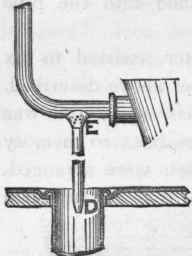
Figure 367.
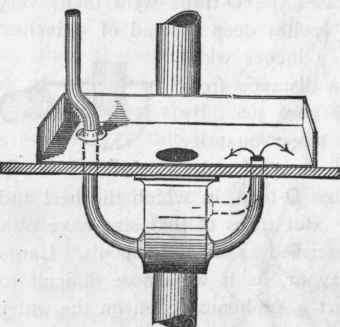
Figure 368.
Continue to:


My Books

