


Chapter XXXIII. Soil Pipes. Part 2
Description
This section is from the book "Plumbing Practice", by J. Wright Clarke. Also available from Amazon: Modern plumbing practice.
Chapter XXXIII. Soil Pipes. Part 2
Enough has been written to show the danger of fixing light iron soil pipes, with the rain-water leaders connected to them, on the outside of the house, but there remains to be told the evils of fixing the same class of work inside the house. Figure 354 is a very common example. One case was tested with a smoke-rocket, when smoke escaped from each joint of the pipes, and also through the wall into an adjoining bedroom. This will be more clearly understood by referring to Figure 355, this being a plan of one water-closet, the arrow showing the way the smoke passed through the wall, which, at this point, was only about 4 1/2 inches thick. The mortar was very poor, and as the chase for the pipes had been cut after the walls were built, the bricks were loose. The plaster on the walls was very much cracked, thus leaving little or nothing to act as a barrier against smells passing through. The soil pipe was continued to the small flat roof to receive the rain-water from that and also the upper roof. The overflow pipe from the cistern was fixed so as to discharge into the top end of the soil pipe.
Another class of house is shown in section at Figure 356. One water-closet was on the second floor, and the soil pipe from it was fixed inside the house in an angle of the drawing-room on the first floor and the dining-room on the ground floor. The pipes were of light iron and the joints defective. Each time the water-closet was used the noise of the water was distinctly heard in the above rooms, so that it was deemed advisable to remove the whole affair to a less objectionable position, and the soil pipe fixed outside an external wall.

Figure 354.

Figure 355.
In another case the water-closet was fixed over a drawing-room with a decorated ceiling. The space round the trap was packed with sawdust to deaden the sound of rushing water. The housemaids had been in the habit of bringing all bedroom slops to this water-closet, and, although the floor beneath the apparatus was partly covered with lead, water splashed over, and the ceiling beneath was disfigured with stains. In spite of all protests as to the unsuitability of the position for a water-closet the owner insisted on retaining it in its present place. This is in a house the rental of which is about £150 a year. There is not the least doubt the plaster of the ceiling below will become so loose that, should a pipe leak or water by any means get splashed over the water-closet safe, a large portion of the ceiling will fall down and perhaps do several pounds' worth of damage to furniture or whatever may be near, and then there will be another growl at the plumber who fixed the water-closet there.
There are several houses near Hyde Park, in London, that were built some twenty-five years ago, that are very badly designed with regard to the sanitary arrangements. Figure 357 is a section across the two upper floors and roof of one house the writer had to make several alterations to some years ago. The soil pipe was continued to the small flat roof next the party-wall of the next house. Beneath the floor of attic an open trough, made by lining between the floor-joists with lead, was made to carry away the water from the front gutter into the soil pipe. In addition to the smells escaping out of the end of the trough and entering the attic window, the floor-boards over the trough were so shrunken as to allow any smells to freely escape into the bedroom in which maidservants slept.

Figure 356.
The arrows denote this escape. The way this was improved was rather interesting. Space was made by the side of the soil pipe to fix a new lead pipe to receive the rain-water from the small flat roof. The lead trough beneath the flooring was taken out.
and, as the space was only 2 1/2 inches deep, a 6-inch lead pipe was flattened, as shown in section, Figure 358. 10-foot lengths of pipe were used, which necessitated three joints being made when the pipes were in their position. This was got over by cutting open the pipes about 18 inches each side of the joint, which was then soldered on the inside of the bottom and sides. After doing this the pipe was closed and the other part of the joint wiped on the outside. A seam was then wiped over the slits, paper being pasted over the soldered joint at the sides of the seam to prevent that being melted. One end of the 6-inch pipe was bent upward, as shown by Figure 359, and soldered into the bottom of the gutter, and the other end soldered into the vertical rain-water pipe fixed from the upper roof as predescribed.
Innumerable cases could be given of the evil of attaching rain-water leaders to soil pipes. Figure 210 is a plan of a house, one of the soil pipes in which was used as a rain-water leader. The top end was finished as shown in section, Figure 360. A is a skylight over a staircase, and which also gave light to several bedrooms. The sides of the light were louvred for ventilation, but, unfortunately, the skylight was in a valley between two high roofs, and it did not matter which way the wind blew there was always a draught into the house, carrying with it any smells that escaped from the combined rain-water and soil pipe. In this case a separate soil pipe was fixed and continued to a good height above the roof as ventilation to drains and soil pipe.
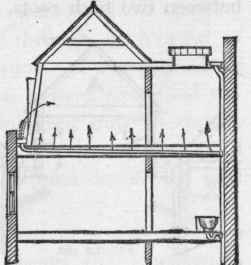
Figure 357.

Figure 358.
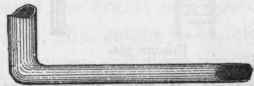
Figure 359.
Continue to:


My Books

