


XI. Clocks. Part 6
Description
This section is from the book "Colonial Furniture In America", by Luke Vincent Lockwood. Also available from Amazon: Colonial Furniture In America.
XI. Clocks. Part 6
Figure 849 shows a tall clock, the property of Mr. H. W. Erving. The case is inlaid with medallions, fan corners, and scrolls in the manner of the Sheraton school. The base is cut to resemble stone work and stands on ogee bracket feet. The hood has a scroll top. The dial is domed with a luna attachment, and above is the name "Nathaniel Brown, Manchester." The spandrels are in the design of Chippendale scrolls.
Figure 850 illustrates a clock in the possession of the Misses Andrews, made by Daniel Burnap, a well-known American clockmaker, who lived at Andover, Plymouth, and East Windsor, Connecticut, between 1780 and 1800. This clock was bought in 1799. A characteristic of his clocks is the silvered face, usually beautifully engraved, without spandrels. This clock has both the calendar and luna attachments, and the background for the luna attachment is tinted blue. The works are always of brass.

Figure 850. Burnap Clock, 1799.

Figure 849. Tall Clock, inlaid case, last quarter eighteenth century.
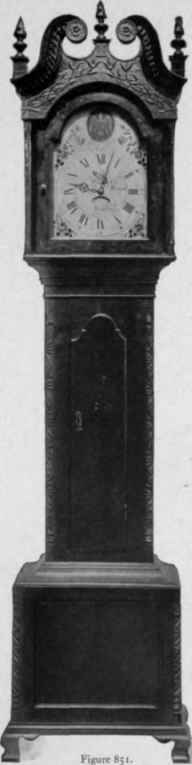
Tall Clock, about 1801.
Another tall clock of the period is shown in Figure 851 and is the property of the writer. The case is unusually ornate, the hood is scroll top, the inner ends of the scrolls being finished with rosettes. The surface above the opening is carved in a leaf-and-flower pattern, and about the door is inlaid a vine design in pigment instead of wood. The corners of the case are chamfered and the quarter columns inserted are carved with a leaf-and-flower design. The piece stands on ogee bracket feet. On the door are inlaid in pigment a floral design and "Chr. Fahl 1801." The dial is well enamelled with flowers and at the centre of the top is an American eagle with shield. A calendar attachment is in a semicircular slot. The maker is Benjamin Witman, Reading, and the case is Pennsylvania Dutch in character.
It was the fashion at this time to make miniature tall clocks, and an example, the property of the writer, is shown in Figure 852. The works are of brass and run eight days. In the dome top is a painting of a lake and castle, and the spandrels are United States shields. The clock stands only forty-six inches to the top of the urn.
Another miniature clock is shown in Figure 853 and is the property of Mr. H. W. Erving. The works are of wood and the dial is rather crudely painted. The edges of the case are finished with a reeding. Toward the close of the eighteenth century there was great demand for cheaper clocks, due to the poverty of the young republic, just recovering from the Revolutionary War, and to an inflated currency. To meet this demand, about 1790 a painted or white enamelled dial came in, taking the place, except in the expensive clocks, of the brass dial. These painted faces were made either of metal or wood, and large numbers were sold to clockmakers throughout the country, who added their names in place of the dials on works often not made by themselves. It was also at this time, and for much the same reason, that the wooden works began to be used. These wooden works usually had either bone or other hard substance for bearings, and there are still many to be found keeping good time. One of the best-known American clockmakers was Simon Willard. He belonged to an illustrious family of clockmakers whose influence on the clocks of the late eighteenth and early nineteenth centuries was very great. He had three brothers who were clockmakers, and also a son. The brothers were Benjamin, born in 1743; Ephraim, born in 1755; and Aaron, born in 1757. An interesting history has been written of this famous clock-maker by John Ware Willard, to which the reader is referred for more detailed particulars of the family.

Figure 852. Miniature Tall Clock, about 1800.
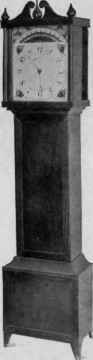
Figure 853. Miniature Tall Clock, about 1800.
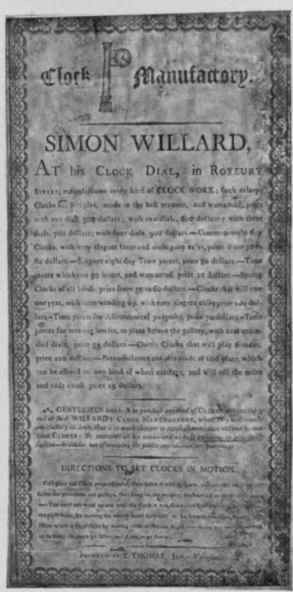
Figure 855. Advertisement in following clock.

Figure 854. Tall Clock with painted face, about 1800.
Simon Willard first worked at Grafton, Massachusetts, and later, prior to 1780, moved to Roxbury, where he lived the rest of his life, dying in 1848. His earliest clocks were of the tall variety, of which Figure 854 is a very good example, and is the property of Dr. G. Alder Blumer, of Providence. The dial is domed and is enamelled with flowers. The calendar attachment is in a semicircular slot below which is the name "Simon Willard." The clock is inlaid with fan ornaments in the corners and it stands on ogee bracket feet.
Within the door is pasted the advertisement which is given in fac-simile in Figure 855.
Simon Willard also experimented with mantel or bracket clocks and made a number which would run for thirty days. A very good example of one of these thirty-day clocks is shown in Figure 856, which is the property of Mr. G. Winthrop Brown, of Chestnut Hill, Massachusetts. It will be seen that the case merely surrounds the dial and bell. The dial is circular and of metal, and the name appears below the hands. The clock runs and strikes on a single weight.
From 1802 Willard took out a patent for an improved eight-day clock, which at once became a success and was widely imitated by other clockmakers, because never before had it been possible to get an eight-day small clock with weights. Mural or wall clocks had come into general use in England about 1797 and were known as Act-of-Parliament clocks, and it is possible that Willard had heard of these. These clocks had very generally ac-quired the name of banjo clocks, hut the name is modern.

Figure 856. Willard Thirty-Day Clock, about 1800.
Continue to:


My Books

