


Seventeenth Century (Flemish). Part 2
Description
This section is from the book "Dutch And Flemish Furniture", by Esther Singleton. Also available from Amazon: Dutch and Flemish Furniture.
Seventeenth Century (Flemish). Part 2
On the right is a colossal buffet or sideboard, the pillars being caryatides, and behind these is a half-hexagon cupboard. Busts and vases adorn the top. Below is a fine salver, evidently in the style of Collaert (see Plates XXI and XXII). A very ornate doorway leads into an adjoining apartment; it is ornamented with caryatides and decorated with elaborate carving. Opposite to this is an open portal that seems to be the entrance from the garden, or courtyard. This door is supported by Corinthian columns. Three large and narrow windows give abundant light. Their panes are small. The room is hung with gilt leather and above the moulding are three landscapes in simple frames. A picture - The Sacrifice of Abraham - stands over the sideboard and a landscape over the door on the right. A long, low bench is placed under the window, on which a gallant is lounging. The chair occupied by the lady with her back to us is a survival of the one shown in Fig. 9, and also generally resembles those in Plates XXVI and XLII and XLVI; a favourite type of chair with the artists of the seventeenth century. The group in the foreground are sitting on stools. The wine-cooler is also worth noting. There are a number of pets in the room - dogs, cats, a monkey and a long-tailed parrot over the door.
The compartment ceiling - an extraordinary combination of octagons, hexagons and crosses - should be noticed.
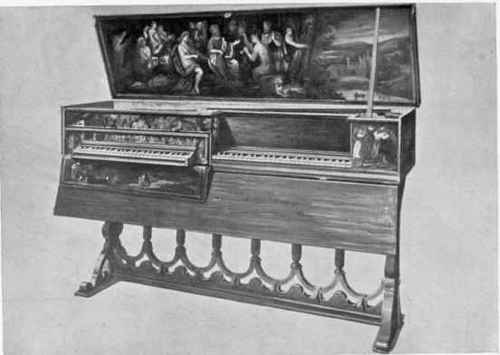
Plate XXIIIa. - Spinet, by Ruckers. STEINERT COLLECTION, YALE UNIVERSITY, U.S.A.
Although Rubens did not know it, Antwerp received a fatal blow to her prosperity at the very moment he settled there. In the truce with Holland concluded in 1609, the Archduke Albert neglected to stipulate for the free navigation of the Scheldt; this enabled Amsterdam to develop her own commerce at the expense of her rival. The effects soon appeared. Seven years later, the English ambassador, Rubens's friend, describes Antwerp as "magna civitas, magna solitudo, for in the whole time we spent there I could never set my eyes on the whole length of a street upon forty persons at once: I never saw coach nor saw man on horseback. In many places, grass grows in the streets, yet the buildings are all kept in reparation . . . splendidapaupertas, fair and miserable."
As if in compensation for the loss of her commercial supremacy, Antwerp saw the dawn of an art of which Rubens was the originator and most brilliant representative.
The pupils of Rubens did not confine themselves to painting and ornamental design. They were often practical carvers also. Only a month before his death, Rubens wrote a testimonial for Louis Faydherbe, stating that this pupil had lived with him for three years and had made great progress in painting and carving, excelling especially in ivory carving. He therefore exhorts nobles and magistracies to encourage him to settle among them and embellish their dwellings with his works. Thus we see how the style Rubens extended.
The universality of the style Rubens in Western Europe for half a century is undeniable. This great genius was known and honoured in Italy: he was a favourite of the King of Spain and his brother, the Viceroy of the Netherlands; when he was not painting nor designing something, he took a rest by going to some foreign court on an embassy. On one of these, Charles I of England knighted him; Philip IV made him Secretary of the Privy Council. Pupils flocked to him as if his studio in Antwerp was the Mecca of art. He had scarcely established himself there when he wrote (1611): "On every side I am overwhelmed with solicitations: without the least exaggeration I may assure you that I have already had to refuse more than a hundred pupils."
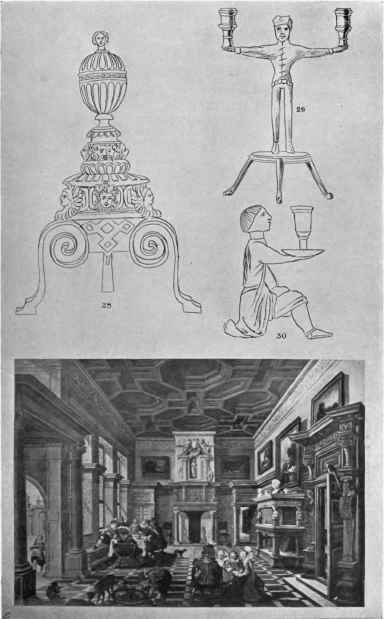
Plate XXIV. - Interior, by Barthol van Bassen (Seventeenth Century). RIJKS MUSEUM, AMSTERDAM.
Fig. 28: Flemish Andiron (Sixteenth Century); Fig. 29: Dinanderie, double Candlestick; Fig. 30: Dinanderie, single Candlestick.
Every kind of decoration and design was subject to his brush. The Flemish tapestry weavers pestered him for cartoons: the famous printer, Moretus, must have him design title-pages, borders and vignettes for the "Imprimerie Plantin": chapel ceilings, cars for cavalcades and triumphal arches all came alike to him; Marie de' Medici was not satisfied until he had immortalized her in grandiose canvases on the walls of her new palace.
One of the Flemish artists who played a particularly important part in the introduction of the new Italian style into the Low Countries was Jacques Franquart (born in Brussels in 1577 and died there in 1651), an architect, who studied in Italy. He became the chief architect of the Archduke Albert, and engineer of the King of Spain in the Netherlands. Philip III made him a knight. Among his important works were the Church of the Jesuits in Brussels (the cornerstone of which was laid by Albert and Isabella in 1606) and the Church of the Grand Beguinage in Mechlin (1629-47).
The next name of importance is that of Artus Quillyn, or Quellin, born at St. Trond in 1625. He studied sculpture with Artus Quillyn the elder in Antwerp, studied in Rome and returned to Antwerp, where he died in 1700.
The churches of Antwerp are full of his bold and masterly works. His masterpiece, the statue of God the Father, was executed in 1680 for the Cathedral of St. Sauveur in Bruges, where it still stands.
With Quillyn ranks Peter Verbrugghen of Antwerp. It is generally believed that he carved the fine pulpit at St. Walburge in Bruges, a work unexcelled among the sculpture of the seventeenth century. A kneeling figure representing Religion supports the pulpit with one hand and holds a cross in the other. Her attitude is noble, gracious and animated, and her expression admirable and exalted. Each corner of the base is ornamented with the figure of an angel in a niche and decorated with four medallions representing the four evangelists whose features are of imposing majesty. The sounding board in the form of a light and graceful shell, although supported by two cherubim with outstretched wings, seems suspended in the air. The stairway is flanked by four figures representing Adoration, Eloquence Meditation and Study; and the balustrade, which is beautifully pierced in designs of branches and figures, is ornamented with figures representing the four elements: Earth, a rabbit chase; Air, hunting the falcon; Water, fishing with a line; and Fire, sacrifice of a material love. It would be impossible to carve oak more elaborately and boldly.
Continue to:


My Books

