


Seventeenth Century (Flemish). Part 7
Description
This section is from the book "Dutch And Flemish Furniture", by Esther Singleton. Also available from Amazon: Dutch and Flemish Furniture.
Seventeenth Century (Flemish). Part 7
The library of the Pitsembourg was well stored with religious works. The chapel, a beautiful edifice built in 1228 and dedicated to St. Elizabeth of Hungary, contained some fine carvings, two crucifixes, one of silver and one of copper, organs, carved statues, silver chandeliers/and exceptionally rich vestments, altar-cloths and Flemish lace.
It will be noticed that all the principal rooms in this establishment were hung with leather, or "leather tapestry "in accordance with the taste of the age.
The leather hangings of the seventeenth century are even more brilliant than those of the past; and on the bright background of scarlet, blue, sea-green, gold or silver, a wealth of ornamentation appears - animals, birds, flowers, fruits, mascarons and other favourite devices of the time. Leather hangings are always present in wealthy homes of Holland. An excellent example is shown in the picture of The Young Scholar and his Sister by Coques (Cocx), now in the Cassel Gallery. The room, which is richly furnished, is hung with blue and gold leather. This picture was painted in the seventeenth century.
The Low Countries by this time had become renowned for their fine leather and exported a vast amount of it. Notwithstanding the rivalry of the French and Italian workshops, there was a special shop in the Rue St. Denis in Paris where Flemish and Dutch leathers could be obtained. Some of the French inventories of this century mention especially "tapestries of leather "from the Netherlands; for example, Fouquet has at his Chateau of Vaux, in 1661, "a rich hanging of tapestry of cuir dore from Flanders, consisting of eight pieces "; and in 1698, a rich Parisian owns "a hanging of tapestry of cuir dore de Hollande," with a red background.
The Rijks Museum in Amsterdam contains a great number of gilt leather hangings of the seventeenth century; at the Hotel de Ville of Furnes, there are some hangings of Spanish leather and the Antiquarian Museum of Utrecht also contains some embossed gilt leather hangings.
In the seventeenth century, the great centres for the production of tapestry shifted to Paris and London. This is the period when the famous looms of the Gobelins and Mortlake were established. The directors and workers in these famous establishments were Flemings. It was largely owing to the influence of Le Brun that Paris triumphed over Brussels with her Gobelins manufactory established in 1662. This was really the outgrowth of the high-warp looms established by Henry IV in 1597, under an excellent tapestry-worker named Laurent. These workshops were first situated in the house of the Jesuits in the Faubourg St. Antoine, and were transferred to the Louvre in 1603. The King sent to Flanders for tapestry-workers over whom he placed the Sieur de Fourcy. In 1607 he sent for more workers, among whom were Marc Comans (or Coomans) and Francois de la Planche, who were given charge of the workshops at Tournelles. These were removed to the Faubourg St. Marceau. The tapestries had to be made facon de Flandres.
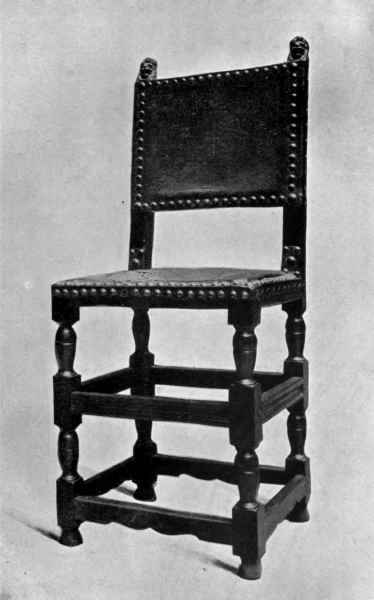
PLATE XXVUL - Flemish Chair. CLUNY MUSEUM, PARIS.
The King's enterprises were not universally approved. "They cost large sums to his Majesty," says a contemporary, "and loss and ruin to his subjects. Witness the Brussels tapestries at St. Marcel, the Flemish linens at Mantes and the cloths of silk and gold of Milan."
After the King's death, Comans and De la Planche continued to work in Paris, and in 1630 were engaged at the manufactory that afterwards became the Gobelins.
Flemish workmen were also employed at Maincy near Vaux in 1658. When, owing to the wars, the Gobelins was closed in 1694, some of the workmen entered the army, twenty-three returned to Flanders and others went to Beauvais. This great factory was no less indebted than was the Gobelins to the Flemings. It was established in 1664 by a "marchand tapissier," named Louis Hynart, a native of Beauvais, who owned a large number of workshops in Flanders as well as in Paris. As Beauvais was at that time an important centre for woollen stuffs, Hynart proposed to the municipality that he should establish workshops of high-warp tapestry "in the manner of those of Flanders." Hynart obtained a subsidy and brought a number of Flemish workmen to Beauvais. He was negligent, however, and in 1684 the directorship of the Beauvais manufactory was given to Philippe Behagle (originally Behagel) of a famed family of tapestry-weavers of Oudenarde. Under Behagle the "Royal Manufactory of Tapestry," flourished until his death in 1704. Another workman who contributed greatly to the success of Beauvais was Georges Blommaert, who was also called to Beauvais in 1684 from Lille, where he had established a workshop in 1677.
When Georges Blommaert left Lille to go to Beauvais, he was succeeded by Francois and Andre Pannemaker, descendants of the famous Pannemaker family of tapestry-makers. In 1688, they had a rival in Jean de Melter, of Brussels, who was particularly fond of reproducing compositions after Rubens. The Panne makers devoted their skill chiefly to "Verdures."
The looms at Nancy, established in the seventeenth century, and closed in 1625, were also worked by men from the Low Countries, among them one Melchior van der Hameidan. The Brussels looms were still busy in this century, but the corporation of tapestry-workers was recruited from a few families, such as the De Vos, De Castros, Raes, Van der Borchts, Van der Heckes, and Leyniers. They repeated the cartoons of the last century; but in the middle of the seventeenth Teniers produced many rustic scenes that, known as Tenieres, became very popular. Flemish tapestry-weavers are found in Rome; in Denmark (twenty-six were there about 1604); in Russia (Martin Steuerbout of Antwerp had a manufactory in Moscow in 1607); and in England.
The Mortlake manufactory, established by James I near London in 1619, was practically a Flemish manufactory. In a short while its only rival was the Gobelins. The King sent specially to Flanders for skilled workmen and no less than fifty arrived in one month, among whom were Josse Ampe of Bruges, Simon Heyns, Jacques Hendricx, Josse Inghels, and Pierre Foquentin of Oudenarde. Rubens and Van Dyck were commissioned to supply cartoons; but many of the old favourite historical and religious sets of the past century were reproduced. Paris and Hampton Court Palace contain a number of these.
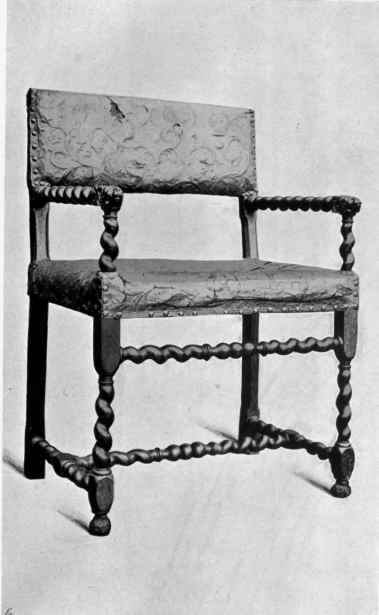
PLATE XXIX. - Flemish Chair. CLUNY MUSEUM, PARIS.
Continue to:


My Books

