


Heppelwhite's Hall Chairs
Description
This section is from the book "English Furniture", by Frederick S. Robinson. Also available from Amazon: English Furniture.
Heppelwhite's Hall Chairs
Generally speaking, the chair designs given by Heppelwhite in his book are good, and the low relief carving of his wheat-ears and long waved and serrated leaves set close together very attractive. Occasionally he goes astray. There are two hall chairs which show him at his worst. One with a solid oval back has five wheat-ears sticking up unsupported in a fan shape above the top; the other has a back formed entirely of a huge urn. But such aberrations as this are exceptional. The arms of his chairs are much better in the actual object than in the designs, many of which are ill-drawn in this respect. Taking a bird's-eye view of the arms, we find that they have a graceful horizontal curve besides the vertical curve which sweeps down from the junction (sometimes rather high up) with the back, to the supports.
In various less important objects Heppelwhite was seldom at fault. His upholstered window-seats are very elegant. Generally they have stuffed ends which project upwards above the legs and roll over outwards at the top, showing a volute on the front. Occasionally the ends are open, with light bar-work. The propensity to draping, which Sheraton carried to a greater degree, is noticeable in some of these designs. The front of the seat is sometimes draped with a scalloped edge, or with small closely caught up festoons of drapery, varied with tassels between the curves.
Sofas have serpentine, convex-curved, or straight upper edges to the back. The ends either have an open arm and support above the leg, or are upholstered and projecting at an angle from the back, or curving all in one piece with it. The only open-backed design is that for a four-shield, or, as Heppelwhite calls it, a 'bar-backed' sofa. The general scheme of all these follows the French style of the Louis XVI. period. Tea-caddies, square, round, oblong, and sometimes with sides and front in the 'bombe' shape, all afford opportunities for pretty designs of inlay or paint. Ovals or circles with leaf rosettes or fan patterns straight or waved are commonest on the tops as a centre, with leaf or scroll ornaments outside of them to fill up the field. The same ornaments appear on the slanting-topped knife-boxes with serpentine fronts which are a speciality of Heppelwhite and Sheraton as appurtenances of their sideboards, and were not known to Chippendale. The urn-shaped knife-box (Plate CXXIX.), of which Heppelwhite was equally, perhaps more, fond, gives opportunity for gadroon or flute carving, with leaves, and the draped ornament so often used wherever there was any length in which to display it.

Plate CXXIX.
Knife-Case, One Of A Pair, Inlaid With Various Coloured
Woods Hepplewhite
CXXIX. Knife-case, one of a pair, inlaid with various coloured woods. Heppelwhite (?). V. & A. M.
Height 18¾ inches.
Round the bodies of the urns it runs, divided by oval-shaped paterae, and it reappears very frequently upon the rectangular cupboards which were often made as pedestals to support a single urn. For the plainer brass-bound cellarets it is not possible to have much admiration. Octagonal or oval in shape, upon short tapered legs, they are certainly superior to the sarcophagus of a slightly later date; but they have not the elegance of the urn shapes, which recall those being made in Sevres porcelain at the same time. The lids of these urns are made to slide on a central shaft sufficiently high for the extraction of the knives which they contained.
Heppelwhite's 'Desk and Bookcase' is a very severely shaped piece of furniture. The front is always straight, and the glass cupboard above has two doors. There is one design of a cupboard with projecting centre and two wings, the middle part being the highest, but this is an exception. The only curved lines are to be found in the lower rail of the bureau part, which is shaped in one piece with the short legs. These curve slightly outwards, and make the straight lines of the sides of the bureau have a slightly concave ending. The chief variant for the foot, if the lower rail is straight, is a bombe bracket shape showing on the front and side an almost ogee moulding. This foot, commonly known as the 'scroll' foot, is found on large and small pieces of furniture, from bookcases, tall-boys (Plate CIX.3) and dressers (Plate XLIII.2), to toilet - glasses (Plate cxxv.) and clocks (Plate cxlv.) of the period, and was not a speciality of Heppelwhite though very characteristic of him. It was used by Chippendale. If the lower part of Heppelwhite's desk and bookcase has not the sloping bureau top, but is rectangular with a draw-out and fall-down front, guided by metal quadrants, it is then a secretary and bookcase, but apart from this difference the general scheme is the same.

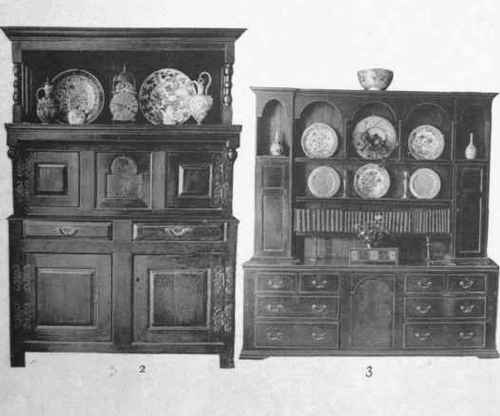
Plate XLIII.
1 - Dresser, Oak 17th Century
2 - Welsh Court Cupboard, Oak Late 17th Century
3 - Welsh Dresser, Oak, Inlaid With Mahogany 18th Century
XLIII. (1) Dresser, oak. Seventeenth century. Rev. F. Meyrick-Jones.
Length 60, Height 29, Depth from front to back 18½ inches.
(2) Welsh Court Cupboard, oak. Late seventeenth century. Shows the ' raised and splayed' panel, and three tiers or stages. The property of the author.
Dimensions: Height 77¼, Breadth 54⅝, Depth from front to back 21⅛ inches.
(3) Welsh Dresser, oak, inlaid with mahogany. Eighteenth century. The property of the author.
Dimensions: Height 89¼, Length 83⅜, Depth from front to back 19¼ inches.
Not all of his designs are fitted with the flimsy open wire-based work at the top; and there is no reason to be found in their proportions why one should have it and the other be exempt. The cornices are all of about the same size, light and elegant, with small dental courses above a frieze which is sometimes fluted upright, and otherwise moderately adorned, but often plain.

Plate CIX. I And 2 - Chippendale Tallboys, Mahogany 3 - Heppelwhite Tallboy „
XC. Breakfast-Table, mahogany. Chippendale. Sir Charles Robinson, C.B.
Dimensions : Height 27⅜, Length of top 36, Width 27 inches.

Plate CXXV. Chest Of Drawers And Toilet Glass, Heppelwhite, Mahogany
CXXV. Chest of Drawers and Toilet-glass, mahogany. Heppelwhite.
Dimensions: the chest of drawers, inlaid, is in Height 46, Breadth 45½, Depth from front to back
23I inches. Sir Charles Robinson, C.B. The toilet-glass, with ivory handles, etc., is in Height 22, Breadth 16⅛, Depth from front to back 8 inches. Gerald Robinson, Esq.

Plate CXLV. Dressing Table, Satinwood, Painted Sheraton
CXLV. Dressing-Table, satin-wood painted. Sheraton (?). V. & A. M.
Continue to:


My Books

