


Louis XIV. Style. Part 3
Description
This section is from the book "Furniture", by Esther Singleton. Also available from Amazon: Furniture.
Louis XIV. Style. Part 3
We have seen that the French were slower than the Dutch to adopt Oriental design. Huygens, a Dutchman, was fairly successful in his efforts to imitate the real lacquer and exploited his discoveries in Paris. Before the end of the century there were three manufactories for furniture painted and varnished in the "Chinese style" one of which made "cabinets and screens in the Chinese style."
Lacquer-work on black background or red background and "laques de Coromandel" were also used for panels, armoires and for folding-screens.
Louis le Hongre and Martin Dufaux made paintings and varnished cabinets for Versailles; lacquered furniture was made at the Gobelins and "objets Chinois" or "objets Lachine" were to be had in many shops.
Furniture now began to be affected: the forms remained European but the decorations often show an Eastern origin. "Certain models of decoration introduced in the midst of rocaille work are indeed copies of Oriental motives that are very well known. Chinese are the dragons carved on the feet of a beautiful console in gilded wood now in Fontaine-bleau, which M. Champeaux attributes to the epoch of Louis XIV., but which I would rather give to the Regency; Chinese is the dragon which forms the bronze crosspiece that decorates the shelf of a mantel-piece designed by Blon-del; Chinese is the dragon decorating a console d'applique in gilded wood in the collection of M. Hoentschel; and, finally, I think no one would question the origin of the two exquisite handles of bronze which Cressent has placed on the commode in the Wallace Collection. These examples, which could be multiplied, will serve to show that if the style rocaille applied to a period of French art which rebounded through the whole of Europe is legitimate, it borrowed from Chinese art much of its charm and fantasy.
"The Louis XIV. Style did not disappear completely at first; but it dwindled away and became more delicate, the swelling curves more graceful though used with less reason, the introduction of decorative elements that artists of the preceding period had not found noble enough, and the abandonment of absolute symmetry greatly to the advantage of ornamentation but engendering always a sort of coldness which showed the poverty of invention. Gradually the aspect of the French style was changed: the monkeys and grotesque personages of Claude Gillot, the espagnolettes - those delicate female busts with coquettish faces - that seem to have been taken from Watteau's compositions, give to French Furniture a lightness and gaiety until then unknown. Notwithstanding all this, old traditions were not forsaken; the beautiful furniture of the Eighteenth Century continued to give importance to the bronze mounts, according to the traditions of Boulle; and the artist who was most in the fashion in the first part of the Eighteenth Century under the Regency - Charles Cressent - like all the ebenistes that were his contemporaries, even increased this taste for beautiful bronzes." 1
1 Molinier.
In the second period of Louis XIV., dominated by Berain, all the motives of ornament become more delicate and refined till the style Louis Quatorze merges into the style Regence.
It is to be noticed that the curve gradually appears on the legs of chairs and the transverse stretcher is supplanted by a bar.
Jean Berain succeeded his father as draughtsman to the King. He is supposed to have been born about 1630. With his brother, Claude, the King's engraver, he issued a great number of designs for decorative panels, vases, candelabra and furniture of all forms. Molinier finds the arabesques of Jean Berain very closely related to those of Jacques Androuet Du Cerceau, and considers Andre Charles Boulle, notwithstanding his first great talent, an imitator in composition of Berain, just as Berain is, on his part, a reflection of Le Brun.
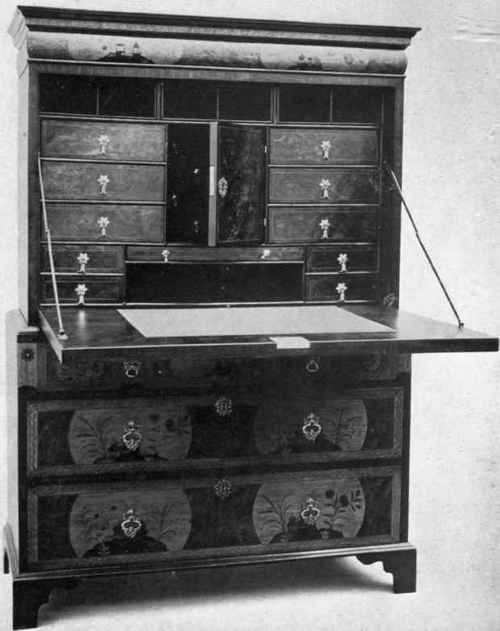
Plate XXIII - Marquetry Writing-Desk, Chinese Designs, Queen Anne Period (open) - Metropolitan Museum
"Berain," says Mariette, "frequently gave to furniture ornamentation particularly appropriate for tapestry or to be painted on panels and ceilings; in short, what we call grotesques. From Raphael who had so happily imagined in the style of the ancients what appeared to him to have a good effect and subjected it to his own taste, so Berain selected what would conform to the taste of the French nation and this idea succeeded so well that even foreigners adopted his style of ornamentation."
"Mariette's expression is perfectly just," adds Molinier: "he reduced to the French taste the artistic heritage of the past used by the artists of the Louis XIV. period; and this explains how it was that they created an original style that was soon adopted by all Europe."
Claude Gillot (1673-1722) was another who prepared the way for the Regency. His singeries are much in the style of Berain; and having ignored all the serious, pompous magnificence of Louis XIV., they announce the joyous, fantastic spirit that his pupil Watteau was to carry even farther. The change was felt not only in the forms of furniture, but even in the bronze mounts and ornamentation; and some of the works that came from Boulle's workshop also reveal the new style. The curve is timid, but it is present.
Continue to:


My Books

