


Louis XIV. Style. Part 2
Description
This section is from the book "Furniture", by Esther Singleton. Also available from Amazon: Furniture.
Louis XIV. Style. Part 2
Jean Lepautre (born in Paris, died in 1682), and his brother, Antoine (1621-1691), had also great influence, particularly Jean. More than two thousand plates came from his hand. Lepautre's style by reason of his heavy forms much overcharged with ornamentation belongs rather to the period of Louis XIII. than to that of Louis XIV.
"Le Brun, pompous as he is, is less luxuriant in his decorative compositions than Lepautre, who proceeds directly from the Italians. A master carpenter himself, he supplied the models for most of the sculptors in wood of his day: the consoles, tables, settees and doors inspired by his designs may be counted by hundreds. All the furniture that he originated is heavy and powerful in form. His big tables destined to support heavy marbles are solidly placed on their feet, are rectangular and have heavy supports, - a noble style that probably appeared less heavy in the rich architectural surroundings in which they were placed." 1
1 Molinier.
Domenico Cucci, an Italian designer, is little known except to the erudite; but the influence of his mind in the decoration of the royal palaces, and, consequently on the taste of the day was very great. The account-books call him "ebeniste et fondeur." He was noted for his ornate ebony cabinets, ornamented with Florentine mosaic-work and superb bronzes that were made in the Gobelins foundry. Cucci also made decorative locks, door-handles, window-bolts, door-frames, garden-furniture, and even an organ case. It is more than probable that he was the author of some of the bronze ornaments for Boulle's furniture.
Filippo Caffieri, also an Italian, was a fine wood-carver. He came from Rome about 1660, and was employed to make furniture and picture frames for the royal palaces. He seems to fill a gap between the Italian style of Cucci and Le Brun. The folding-doors of the great staircase in Versailles, decorated with panels in which the sun, helmets, the royal monogram, chimaerae, cornucopias, laurel leaves and the lyre are carved, are his work.

Plate XXI - Jacobean Court-Cupboard - Metropolitan Museum
Caffieri made a great many gueridons, or tripod tables, carved arm-chairs and folding-chairs, most of which were intended to be gilded, silvered or lacquered.
This period is particularly distinguished by the furniture made by Andre Charles Boulle, who, like many others of the period, came of a family of decorative artists. His father and uncle were menuisiers da roi and had lodgings in the Louvre; and Boulle himself had several sons who continued his work after his long life of ninety years ended. Boulle's name is chiefly associated with - indeed is used to define - a special kind of marquetry composed of incrustations of metal and tortoise-shell on wood; but Boulle was not the inventor of it, as is sometimes claimed for him. Marquetry-work of this kind was made by the Italians who flocked to France under the rule of Mazarin, and was practised by Boulle's four sons and his many imitators who kept it in fashion during the second half of the Eighteenth Century. Work of this character was also ordered by the King from the Flemish cabinet-maker Alexandre Jean Oppenordt.
Boulle's furniture is excessively luxurious and harmonizes only in a rich setting. He made consoles, armoires, commodes, cabinets, tables, desks and clock-cases. His designs are heavy and generally taken from the Louis XIII. models; but they also are frequently in the newer taste. His commodes are often bombe and sometimes the upper part of his armoires swells into the large curve. Boulle was very clever in his use of bronze and copper ornaments. His console-tables and commodes are greatly admired. (See Plate XXVI.)
Father Boulle did an enormous amount of work and received orders from the King and numerous princes and other rich patrons. It would, however, have been impossible for him to have executed all the pieces attributed to his hand. The specimens in the Wallace Collection, the Louvre, the Mazarin Library, Paris and Windsor Castle, are authentic. Sometimes Boulle borrowed the models of Lepautre, Le Brun and Berain. Cucci is thought to have been responsible for many of their ornamental figures in copper.
Boulle's official title was "ebeniste, ciseleur et marqueteur ordinaire du roi"
"In the earlier furniture made by Boulle the inlay was produced at great cost, owing to the waste of material in cutting; and the shell is left of its natural color. In later work the manufacture was more economical. Two or three thicknesses of the different materials were glued together and sawn through at one operation. An equal number of figures and of matrices or hollow pieces exactly corresponding were thus produced, and, by countercharging, two or more designs were obtained by the same sawing. These are technically known as boulle and counter, the brass forming the groundwork and the pattern alternately. In the later boulle the shell is laid on a gilt ground or on vermilion. Sometimes the two styles are distinguished as the first part and the second part. The general opinion on the relative value of each seems to be that, while admitting the good effect of the two styles as a whole, the first part should be held in higher estimation as being the more complete. We there see with what intelligence the elaborate graving corrects the coldness of certain outlines; the shells trace their furrows of light, the draperies of the canopies fall in cleverly disordered folds, the grotesque heads grin, the branches of foliage are lightened by the strongly marked edges of the leaves, and everything lives and has a language. In the counterpart we can find only the reflection of the idea and the faded shadow of the original."1
1 Havard.
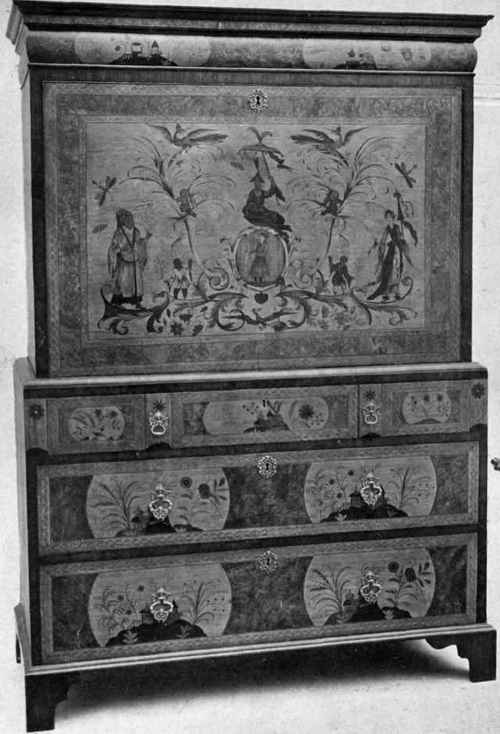
Plate XXII - Marquetry Writing-Desk, Chinese Designs, Queen Anne Period (closed) - Metropolitan Museum
Continue to:


My Books

