


The Style Refugie
Description
This section is from the book "Furniture", by Esther Singleton. Also available from Amazon: Furniture.
The Style Refugie
In 1685, the Revocation of the Edict of Nantes induced fifty thousand families of the best French blood, intellect and craftsmanship to seek voluntary exile. The Huguenots took refuge from the Dragonnades in England, Holland and Germany; and those countries benefited by the short-sighted policy of a bigoted king. The goldsmiths, carvers, architects and designers and painters among the emigrants were so numerous that their subsequent work became known as the style refugie.
The most commanding figure in the band was Daniel Marot, a member of a family of French artists and a pupil of Lepautre, whose style he closely followed. William of Orange appointed Marot chief architect and minister of works and Marot designed many palaces and fine country homes, including the interior fittings, chimney-pieces, staircases, cornices, china-shelves, brackets and furniture. He also designed gardens. He accompanied William III. to England at the Glorious Revolution; and when William and Mary transformed Hampton Court into a Dutch palace, the work was designed and supervised by Marot and Sir Christopher Wren. Marot, indeed, designed most of the furniture, some specimens of which are still to be seen there. Hampton Court Palace was a perfect model of the style refugie. All the characteristics of Lepautre's pompous and massive taste are to be seen in Marot's work, together with the characteristic ornamentation of the Louis XIV. Style. His chairs and tables are supported on heavy legs connected by straining-rails, the seats and backs of his chairs and sofas are usually stuffed and upholstered; his mirror-frames are carved with scrolls, mascarons, shells, swags and chutes of the bell-flower; the heads and arms of his caryatides and other female figures are functional as well as decorative; his clock-cases afford models for the future Chippendale, and, occasionally, the dawning Regency Style is apparent.
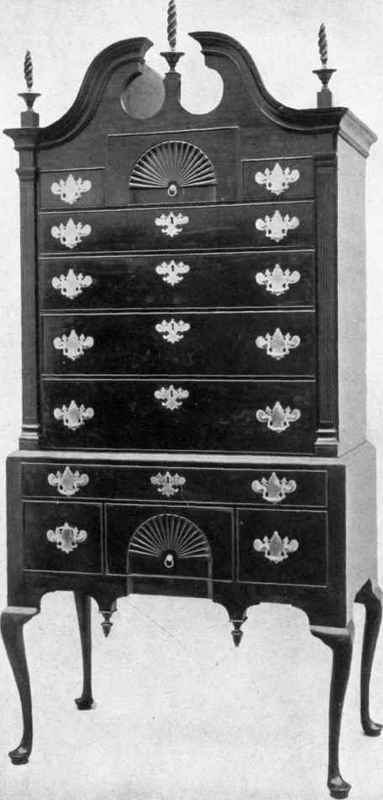
High Case of Drawers, Mahogany with Brass Mounts - Metropolitan Museum
Marot was extremely prolific, too, in designing sumptuous upholstery in rich textiles for his bedsteads, chairs, screens, curtains and lambrequins. He made a great use of upholstery.
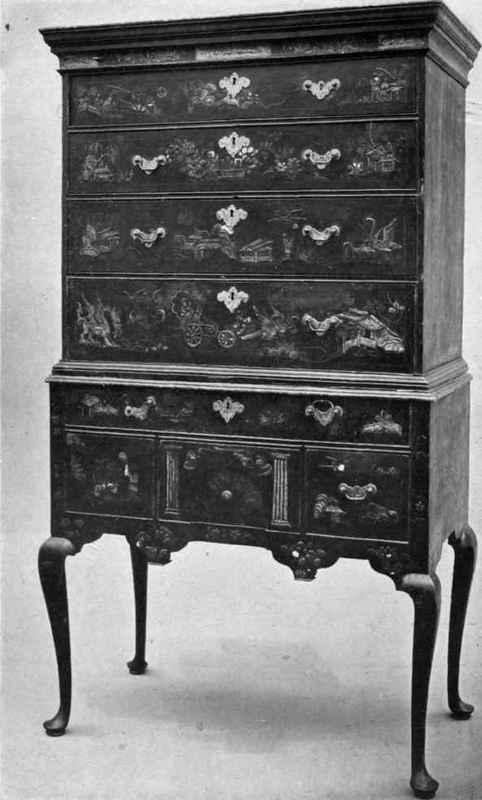
Plate XXIV - High Case of Drawers, Lacquered (1730-1740) - Metropolitan Museum
Marot's designs for rooms show the limit to which porcelain could be used as a decorative feature. In every possible place he introduced a bracket - over the doors, by the sides of the chimney-piece, and over the windows, he always has a little ledge for the support of a vase, a jar, or a cup. The chimney-piece, with its shelves, is particularly the show place for the valued Oriental curios. Some of his plates show brackets and shelves that support as many as three hundred articles, - all of which are so arranged as to belong to the scheme of decoration. It is not strange, therefore, to find evidences of the "Chinese taste" among his designs.
The mirror on Plate XXVII. is in the Marot Style. Here we have a square frame of walnut or some dark wood with gilded border and gilded ornaments. The pediment is of the graceful swan-neck, and between the scrolls is carved a cartouche. Another interesting piece of the period (see Plate XXVIII.), is a "show-table," dating from the time of William and Mary. The glass case is intended for the exhibition of curios. The stand is ornamented in the characteristic style of the day. The legs are decorated with the bell-flower and are connected by typical stretchers.
Marot worked through the short reign of Queen Anne (1702-1714). He died in 1718, four years after Her Majesty. Louis XIV. died in 1715. Therefore the Queen Anne Style may be described as a transitional one, partaking of the characteristics of the late Louis XIV. and the dawn of the Regency.
Was it not a Marot room that Addison had in mind when he described a Lady's Library in 1711 ?
"At the end of her Folios (which were very finely bound and gilt) were great jars of china, placed one above another in a very noble piece of architecture. The Quartos were separated from the Octavos by a Pile of smaller Vessels which rose in a delightful Pyramid. The Octavos were bounded by Ten Dishes of all shapes, colours and sizes, which were so disposed on a wooden Frame that they looked like one continued Pillar, indented with the finest Strokes of Sculpture and stained with the greatest variety of Dyes. That part of the Library which was designed for the Reception of Plays and Pamphlets and other loose Papers, was enclosed in a kind of Square consisting of one of the prettiest grotesque Works that I ever saw, and made up of Scaramouches, Lions, Monkeys, Mandarins, Trees, Shells and a thousand other odd Figures in China Ware."
Among the other French exponents of the style refugie in England the names of Samuel Gribelin and J. B. Mon-noyer should be mentioned.
During the long reign of Louis XIV. all the Stuart styles pass before us in England and her colonies. The Age of Oak is succeeded by the Age of Walnut. Mahogany begins its career; and new styles came in from the Low Countries, especially with William and Mary.
During the Seventeenth Century, the tendency of Dutch furniture was to break away from the heavy carved oak chairs and tables and massive bedsteads and constantly to become lighter in form, turnery supplanting carving in the posts of bedsteads and in the supports of tables, chairs and cabinets. A style of furniture now came into favor, particularly with the well-to-do middle class, that lasted half through the Eighteenth Century. A typical piece appears on Plate XXIX. The chest-of-drawers at first stood upon spindle legs connected by stretchers; and as time wore on upon the form of leg shown in the "high boy" on Plate XXIV. This early form of cabriole leg with the hoof foot was, in turn, succeeded by the cabriole leg with the claw-and-ball foot as shown in the two chairs on Plate XXX. These are the starting point of a great family of chairs - those designated "crown-back" and "Hogarth" have no difficulty in showing their parentage. A little later in the century the jar-shaped splat was variously carved and pierced, the top rail variously waved and the feet terminated in the bird's claw clasping a ball which the Chinese say is taken from their dragon holding a pearl. This brings us to the so-called "Chippendale chair," which is conspicuously absent from Chippendale's book.
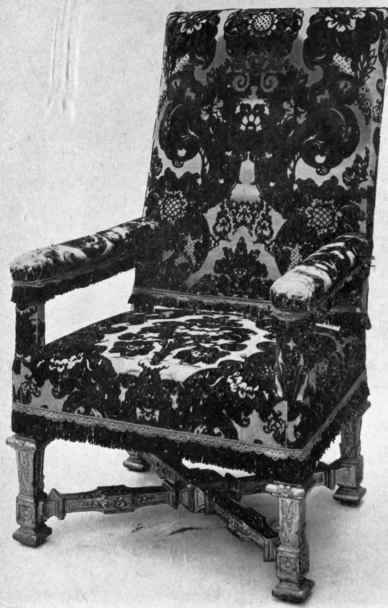

Plate XXV - Louis XIV. Arm-Chair covered with Genoa Velvet - Metropolitan Museum
Chaise Confessionale, Transitional from Louis XIV. to Regency - Metropolitan Museum
Continue to:


My Books

