


Tables. Part 6
Description
This section is from the book "Furniture", by Esther Singleton. Also available from Amazon: Furniture.
Tables. Part 6
Heppelwhite described "Rudd's Dressing-table" as "the most complete dressing-table ever made, possessing every convenience which can be wanted. It derives its name from a once popular character from whom it was reported it was invented." In this piece of furniture the drawers could be made to swing about in any desired position, when the owner was dressing.
Library-tables were from 3 to 4 feet long, of mahogany, and covered on top with leather or green cloth. Some have cupboards in front for books or papers. Then there was a tambour writing-table and bookcase which was supplied with three drawers and a cylinder tambour-shutter that rolled back, revealing pigeon-holes and a writing-desk and nests of drawers. The upper part was a bookcase or series of shelves enclosed by two doors.
Pier-tables were "made to fit the pier and rise level with or above the dado of the room, nearly touching the ornaments of the glass." Above the pier-table the mirror hung, "fixed very low," nearly reaching the slab of the pier-table.
In the dining-room Heppelwhite called for "a set of dining-tables." This comprised a central, square table, and two semi-circular tables, which were used to extend the square table (one being placed at each end). When not in use, they stood between the windows, like the pier-tables in the drawing-room.
Sheraton also designed every variety of table, and among them novelties, for he kept up with and changed with the fashions of the time. Like Heppelwhite he considered pier-tables as indispensable to the furnishing of a fashionable drawing-room. He says:
" The pier-tables have marble tops and gold frames, or white and gold. The glasses are often made to appear to come down to the stretcher of the table; that is, a piece of glass is fixed in behind the pier-table, separate from the upper glass, and by reflection makes the table appear double. The small piece of glass may be fixed either in the dado of the room, or on the frame of the table. As pier-tables are merely for ornament under a glass they are generally made very light, and the style of finishing them is rich and elegant. Sometimes the tops are solid marble, but most commonly veneered in rich satin or other valuable wood, with a cross-band on the outside, a border about two inches, richly japanned, and a narrow cross-band beyond it, to go all round. The frames are commonly gold, or white, or burnished gold. Stretching rails have of late been introduced to these tables, and it must be owned that it is with good effect, as they take off the long appearance of the legs and make the under part appear more finished; beside, they afford an opportunity of fixing a vase or basket of flowers, which, with their reflection when there is a glass behind, produce a brilliant appearance. Some, in place of a stretcher, have a thin marble shelf with a brass rim round it, supported by a light frame; in which case the top ought to be of marble also."
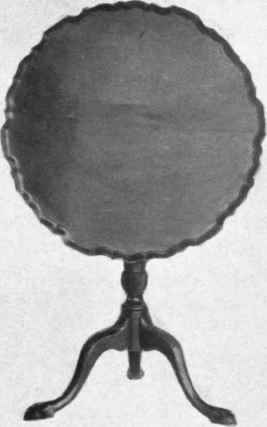
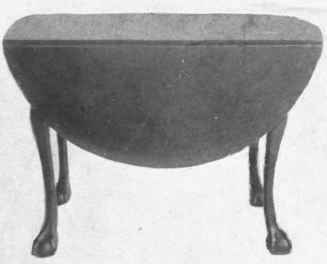


Plate CXII - Eighteenth Century Tables: Mahogany Tea-Table "Tip and Turn" with "Pie-crust" edge; Mahogany Drop-leaf Table; Chippendale Tea-Table with Pierced Gallery; Chippendale - Tea-Table with Pierced Gallery
The Pembroke-table is still in favor, and differs little from the Pembroke made by Heppelwhite. "It is used," says Sheraton, "for a gentleman or lady to breakfast on. The style of finishing these tables is very neat, sometimes bordering upon elegance, being at times made of satin-wood, and having richly japanned borders round their tops with ornamental drawer fronts." Another variety, called the Harlequin Pembroke-table, supplied with ingenious machinery and containing a nest of drawers that could be raised any height, "serves," Sheraton informs us, "not only as a breakfast-table but also as a writing-table, very suitable for a lady."
Sheraton was particularly happy in his designs for dainty furniture for ladies. The Ladies' Cabinet Dressing-Table, for instance, which appeared to be an ordinary commode, had on top a case or nest of drawers, innumerable little drawers fitted up with all the conveniences necessary for a lady's toilet, a cabinet in which she could keep her rings and other jewels, and glasses that folded in behind little doors in the most ingenious fashion. Under one of the drawers a slider was concealed, which could be drawn forward, when the fair owner wanted to write. A special drawer contained materials for writing. Work-tables also attracted his attention. Many of them were writing-desks as well, and contained an astonishing number of compartments arranged with great economy of space. His "French work-table" was generally made of satin-wood, with a brass moulding around the edge. In his "Pouch tables," made about 1803, a work-bag is attached to the frame which draws forward. "When required to be elegant," Sheraton remarks, "black rosewood is used; otherwise they may be very neat of mahogany." In some of them the top is a chess-board.
Shaving-stands and dressing-glasses for gentlemen were equally convenient and well planned. Like Heppelwhite, Sheraton makes great use of the tambour-shutter for his bason stands, night stands and dressing-tables.
"Tambour tables," he explains, "among cabinet-makers, are of two sorts - one for a lady or gentleman to write at; and another for the former to execute needlework by. The Writing Tambour Tables are almost out of use at present, being both insecure and liable to injury. They are called Tambour from the cylindrical forms of their tops, which are glued up in narrow strips of mahogany and laid upon canvas which binds them together, and suffers them, at the same time to yield to the motion their ends make in the curved groove in which they run, so that the top maybe brought round to the front, and pushed at pleasure to the back again when required to be open. Tambour tables are often introduced in small pieces of work when no great strength or security is required."


Plate CXIII - Mahogany Card-Table; Mahogany Writing-Desk; Mahogany Dumb-Waiter; Mahogany Spoon-Case and Knife-Boxes
Continue to:


My Books

