


The Sheraton Style
Description
This section is from the book "Furniture", by Esther Singleton. Also available from Amazon: Furniture.
The Sheraton Style
Thomas Sheraton covers two periods - that of Louis XVI. and the Empire, and consequently all the characteristics of each are found in his work. He seems to have followed the French taste very closely; but instead of using Sevres plaques in his commodes, etc., he inserted compositions by Wedgwood. He restricted the use of mahogany to the dining-room, library, and bed-room; and for chairs with carved backs. His drawing-room furniture was white and gold; rosewood; satin-wood; or wood painted and japanned. Silk or satin designed with oval medallions or pretty stripes were used for the coverings of his seats. The cabinet, the commode and the secretary received much attention from his hands, and he designed most elaborate beds, draperies and dressing-tables. The latter were often provided with tambour-shutters and ingenious devices for concealing mirrors and other toilet appliances. Pretty articles for ladies attracted his attention, and his combinations of work-table and writing-table, with tambour-shutters, or bags, are marvels of compactness and convenience. The cellaret sideboard was much developed by him and also such small articles as knife-cases, dumb-waiters and supper-trays received attention. In short, everything that the man of wealth, or his wife, or the butler within his gates could desire are found in his books. Sheraton used a great deal of brass ornament, in the way of handles, key-plates, claw-feet and rails, and also in the form of beading and thin lines of inlay. The lyre, the bell-flower, the festoon, or swag, the urn, the patera (the latter used to hide the joining of chair-frames and screws of the bed) are his favorite ornaments. His chair leg is often reeded or turned. One of his great accomplishments lay in veneering with satin-wood. Sheraton kept up with the taste of the day and condescendingly said that Chippendale's designs were "possessed of great merit according to the times in which they were executed" but were now "wholly antiquated and laid aside."
1 R. S. Clouston.

Plate XXXVI Louis XVI. Commode, by Benneman
No one would imagine that the designs in The Cabinet-Maker and Upholsterer's Drawing-Book, published in 1791, and those in The Cabinet Dictionary and Sheraton's Encyclopaedia, published in 1803 and in1806 - 07, came from the same hand. The Empire influence is seen at its worst in many instances in the two latter; and instead of being somewhat redeemed by the fine bronze work of the French, the ornaments were carved in wood and gilded or colored in bronze green. Sheraton must have tried to please all tastes, for side by side with these abominations some very attractive models are to be seen.
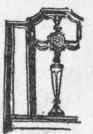
Chair-Back By Sheraton, 1791
The chair on Plate XL belongs to Sheraton's early period and is a splendid example of his work. Here the central splat consists of the draped urn. The open square back is of beautiful proportions. This chair and its companion are in the Metropolitan Museum, New York.
On Plate XLI. appears a Sheraton cabinet, which also belongs to his early period and is made of rich materials harmoniously brought together. Perhaps it would be better to classify it as a commode.
This piece is 6 feet 8 1/2 inches long and of satin-wood, tulip-wood, hare-wood and painted panels. The central door, inlaid with trellis and rosette design, contains an oval panel of the Three Graces adorning a statue of Pan in a landscape. This was painted by Angelica Kauffmann. The sides are concave and are decorated with panels inlaid with vases of flowers in colored woods. The frieze, legs and feet are enriched with finely chased ornaments of or moulu, festoons of flowers attached to circular bosses, paterae mounts at the angles, and rosette and reeded and ribbon borders. The feet are or moulu representing acanthus foliage. The top is decorated with twelve circular medallions representing classical female figures painted by Angelica Kauffmann, encircled by two rows of inlaid husks; and above a semi-circular design of shells and husks in colored woods, brightened with mother-of-pearl, completes the decoration.
The chairs on Plate XLII. belong to Sheraton's later period and are the parents of the "Fancy Chair" that became popular at the beginning of the Nineteenth Century. These chairs have cane seats and the backs a rectangular panel of open trellis and rosette design in the centre. The top rail is painted. The turned baluster legs are also painted but in grisaille. A suite of this kind usually consisted of six chairs, two arm-chairs and a settee with quadruple back.

Plate XXXVII - Adam Console-Table and Top
Continue to:


My Books

