


Tapestry in Beauvais
Description
This section is from the book "A History Of Furniture", by Albert Jacquemart. Also available from Amazon: A History Of Furniture.
This section is from the "" book, by .
Tapestry in Beauvais
Two years after the foundation of the Gobelins, that is in 1664, Colbert founded a royal manufactory at Beauvais; low-warp looms were specially used there, and if some very remarkable tapestries have issued from it, they rather sought to make it a centre for the manufacture of valances, curtains, and chair-seats, than a branch establishment or repetition of the great royal manufactory.
One of the oldest and most brilliant specimens, belonging to Sir Richard Wallace, displayed the arms of France on a red ground, surmounted by the royal crown and a sun " in its splendour"; on the top, the sceptre and the hand of justice.
Two tapestries of a series of the hunting parties of Louis XIV., executed for the Marquis de Villacerf (Colbert) and Mademoiselle de la Ferte-Sennecterre, his wife, were executed from 1696 to 1736. They form part of the cabinet of Baron Jerome Pichon.
Under Louis XV., and at the time of Oudry's directorship, we find door-hangings (portieres) with pastoral trophies on a white ground, having farm-yard animals and fowls at the foot. A beautiful red border frames these brilliant tapestries, which also form part of the splendid furniture of Sir Richard Wallace.
Another tapestry, belonging to M. Maillet-Duboullay, is signed by J.- B. Oudry; it shows Mars standing with his hand resting on the armorial escutcheon of the Duc de Boufflers, which is placed on a pedestal; Minerva, seated on the opposite side, is surrounded by trophies of arms and groups of flowers.
The name of the manufactory of Beauvais is seen rather often inscribed on these productions; but the works are still more frequently anonymous, or bearing a mark and initials. The mark is a "fleur-de-lis," as at the Gobelins; as to the initials, they seem difficult to explain; we find AC at the bottom of a composition of Leprince, representing some Russians seated round a table, near a tent, listening to a woman playing a guitar; other women seated on the ground complete the audience and are weaving flowers (belonging to Sir Richard Wallace). ACC indicates subjects borrowed from La Fontaine's Fables (belonging to M. Delaherche, of Reauvais). AG is seen on seats. DM. Beauvais, on pastoral tapestries (M. Leopold Double).
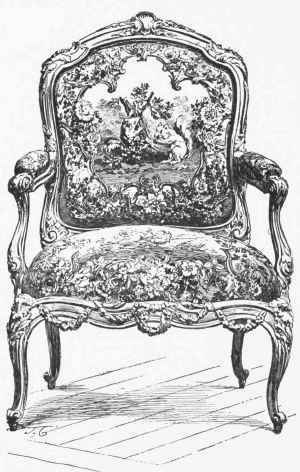
Arm-chair of wood carved and gilded, and covered with tapestry; subject from La Fontaine'e Fables. Louis XV. period. (Collection of M. Double).
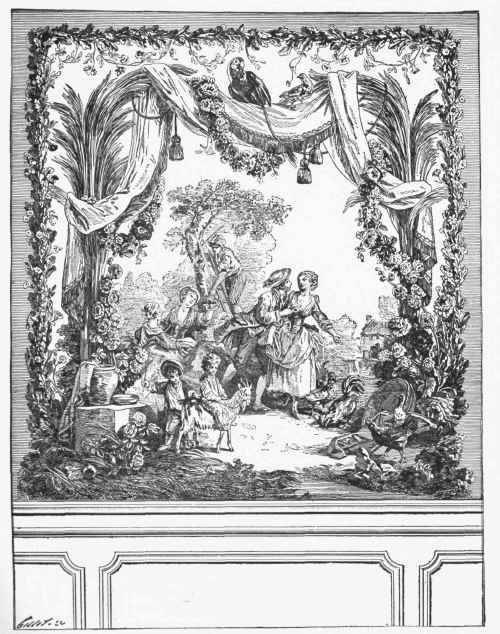
Beauvais Tapestry : Pastoral, copied from F. Boucher, marked with a fleur-de-lis and the inscription D. M. Beauvais (Collection of M. L. Double).
We will now mention, amongst the most remarkable tapestries, the four pieces in the Musee de Cluny representing the Labours and the Pleasures of the fields, by Teniers. The celebrated "tinnieres" of Flanders are certainly not more perfect in delicacy of expression and harmony of ensemble. These hangings were preserved at the chateau de Rosny, and did not leave it until the sale of the furniture of the Duchesse de Berry.
The good traditions of art have been preserved at Beauvais, and it is impossible to carry to a greater extent than does this manufactory the perfection of effect, the charm of execution, the grace and the taste of the compositions. All this is owing to the exceptional talent of M. Chabal-Dussurgey, one of our most clever flower-painters, seconded by a first-rate body of assistants of whom we are happy to mention the names; they are: MM. Lefevre, Verite, Fallou, Dufour, Cantrel, Emile Livier, Prejean, Regimbart, Alexandre Mahu, Sene, Fontaine, Lacroix, Beaucousin, Lalonde, Caron, Paul Mahu, Charles Leveque, Derecusson, Scufflier, Jules Levequc, Pinchon, Senau, Ducastel, Langlois, Henri Rohaut.
Continue to:


My Books

