


Louis Seize. 1774-1793. Part 2
Description
This section is from the book "The Practical Book Of Period Furniture", by Harold Donaldson Eberlein And Abbot McClure. Also available from Amazon: The Practical Book Of Period Furniture.
Louis Seize. 1774-1793. Part 2
Articles
The articles of furniture in use during the Louis Seize period are practically the same as those listed in the chapter devoted to Louis Quatorze and Louis Quinze. The catalogue includes chairs, stools or tabourets, canapes or sofas, bedsteads, tables, consoles, cabinets, commodes, armoires, bureaux or escritoires, cartonniers, torcheres, mirrors, and clocks.
Contour
In the Louis Seize period there was a noticeable return to rectilinear principles in the design of furniture. Vertical and horizontal lines were emphasised and some of the cabinet-work possessed a distinctly perpendicular aspect. While curved surfaces did not altogether disappear from cabinet-work, carcases were in the main rectilinear. Although the amenity of curves in the shapes of chair seats, backs and arms and in the rounding of corners was not disdained, the legs of tables, chairs, sofas, stools and cabinets were almost altogether straight, and the same may be said of stretchers where they occur. Legs and stretchers displaying curves were only the exceptions that proved the rule. Had it not been for the grace of well-placed embellishment, not a little of the furniture might have been open to the charge of angularity. As it was, however, ornament was so adroitly disposed that it enhanced the classic purity of structural lines without the loss of distinction resulting from superfluity.
Chairs
Like all other furniture of the period, the chairs displayed greater purity and restraint of line than had been characteristic of the florid types prevalent during much of the preceding reign. The saccharine Louis Quinze curves in backs, arms, seats and legs were replaced by straight lines or the simple curves incident to rounded corners or circular or oval backs.
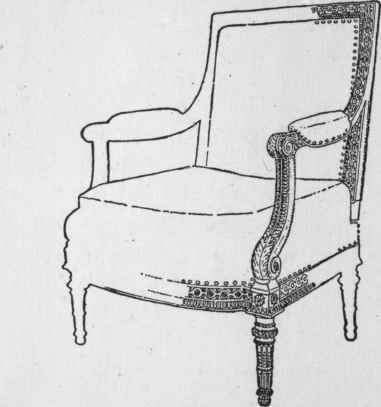
Fig. 1. Louis Seize Arm-chair. By Courtesy of Metropolitan Museum of Art, New York City.
Backs were both carved and upholstered. Upholstered backs were square (Fig. 1) with straight top rails, approximately square, with a raised or arched top (Plate XXIX, p. 226, and Fig 2), hoop- shaped, the top being rounded, and wholly oval or round, in the latter case the supporting uprights adjoining the lower part being prolongations of the back legs in the manner of Hepplewhite back supports. Caned backs followed the same general line as upholstered backs. Wooden or carved backs were often hoop- or "balloon"-shaped, or else made in the form of a lyre. In the hoop-backed or "balloons" backed chair there was a vertically pierced splat while the strings in the lyre backs fulfilled the functions of a splat.

Fig. 2. Louis Seize Arm-chair. By Courtesy of Metropolitan Museum of Art, New York City.
In arm-chairs the arms either sprung horizontally at an angle from the uprights of the back or else fell away from them in a single curve (Fig. 2, and Plate XXIX, p. 226). In either case the arms were not shaped but came forward in a straight line to join at right angles the supports that came straight up as extensions of the front legs (Fig. 2). When the supports were not vertical and continuations of the front legs, they swept forward in a single curve from the end of the arm to the top of the leg at the line of the seat rail.
Seats were either round or square or approximately square with rounded corners or shaped fronts.
Legs were straight and round, fluted, reeded or turned or square and carved or fluted and in all cases were tapered.
Continue to:


My Books

