


Cutting Spiral Gears. Part 3
Description
This section is from the book "Machine Shop Work", by Frederick W. Turner, Oscar E. Perrigo, Howard P. Fairfield. Also available from Amazon: Machine shop work.
Cutting Spiral Gears. Part 3
Bilgram Gear-Planing Machine
The Bilgram gear-planing machine, shown in Fig. 290, operates upon a principle similar to that of the machine just described, but with this important difference. In the Gleason machine the tool is caused to move so as to trace the exact contour of the side of the gear tooth, in addition to its reciproeating movement for cutting. In the Bilgram machine, on the other hand, the tool has only a reciprocating motion, while the gear blank and its supporting mechanism are given the rolling motion similar to that imparted by one rotating gear to another, or that of a rolling cone. To accomplish this, the axis must in the first place be moved in the manner of a conical pendulum. Therefore the bearing of the arbor which carries the blank is secured in an inclined position between two uprights to a semicircular horizontal plate, which can be oscillated on a vertical axis passing through the apex of the base cone of the blank. To complete the rolling action, the arbor must in the second place receive simultaneously the proper rotation; and this effect is produced in the machine by having a portion of a cone (corresponding with the pitch cone of the blank) attached to the arbor, and held by two flexible steel bands stretched in opposite directions, one end being attached to the cone and the other to a fixed part of the mechanism, thus preventing this cone from making any but a rolling motion when the arbor receives the conical swinging. motion. In the engraving A is the blank to be cut; B the ram carrying the cutting tool; and C the indexing and rolling mechanism.

Fig. 289. Gear Planer Courtesy of Gleason Tool Company, Rochester, New York.
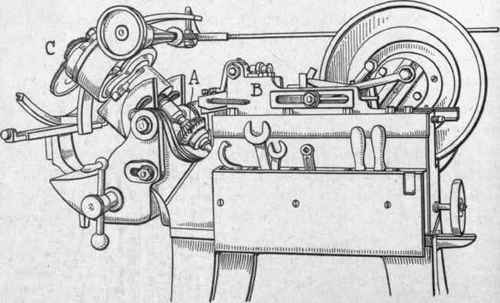
Fig. 290. Gear-Planing Machine.
Continue to:


My Books

