


Axial Or Simple Plain Turning. Part 7
Description
This section is from the book "Turning And Mechanical Manipulation", by Charles Holtzapffel. Also available from Amazon: Turning and Mechanical Manipulation.
Axial Or Simple Plain Turning. Part 7
In hardwood and ivory, the external forms marked off as before, are shaped with the gouge, and finished with flat, point, round, half round and bead tools, held in the horizontal manner and presented to the work as in figs. 438. 439 and preceding illustrations. The apertures are commenced with a hand drill, and when deep are conveniently enlarged with half round or other boring bits, followed by right side, round and other tools used upon the armrest.
In several of the foregoing and in turning many other hollowed works, the following sequence is observed; the external form is first roughly approximated to the required shape, but left everywhere much too large in diameter, the aperture is next bored nearly to the depth and enlarged, but left less than its finished size in about a corresponding degree. The external form is then nearly reduced to its longitudinal measurements and finished diameters, followed by the completion of the aperture; after which the external form and its enrichments receive their final corrections. This alternate system is pursued to avoid risk of splitting the work, to permit small alterations in the design, the necessity for which may arise from imperfections appearing in the material, and to counteract expansion in the apertures, a source of inconvenience which will be further noticed.
The finished work, perhaps lightly touched with glass paper and polished, is separated from the portion remaining in the chuck, in softwood, by the chisel, as in fig. 349, or by the parting tool; in hardwood, most readily by the parting tool appropriate to that material. A flat under surface or at least one that is not convex, is necessary that the finished work may stand steadily; the base may be made slightly concave by directing the tool at a small horizontal angle from circumference to center, the little neck unavoidably left at the center of the face by the parting tool, being subsequently cut away by hand. When a flat base is required, the work is re-chucked reversed, that it may be treated as in turning a surface, figs. 349 and 418. Works of short length are then lightly held within the rebate of a plain wood chuck, or in a wood spring chuck, those of greater length in the same manner, but when adjusted to run true the latter generally receive the support of the popit head to prevent their accidental displacement; with the popit head, the softwood surface is turned with a chisel, that of hardwood, with the point or bevil tool, fig. 414.
The Black bottle stands, figs. 624. 626 to 630, and the Ash or Pin trays, figs. 637 to 639, varying from about one to three inches high, may also be turned from single pieces of the material. When of softwood the length way of the grain,, the piece mounted between centers would first have a narrow width turned down at the end, by which it is placed in a plain chuck, the general form would then be given with the gouge, after which the cylindrical or curved apertures would be finished to their required size and form. Some would then be entirely finished as to external form; with others, the curvatures upon the upper portions would alone be turned to shape with the gouge and finished with the chisel, and then the annular surface turned flat under the guidance of a straight edge, held across the diameter of the work. The finished portions are then treated with glass paper if required, and polished with a handful of their shavings. The work is next detached from the chuck, reversed and remounted by its aperture upon an external rebate, turned upon a plain wood chuck, fig. 257; the flat surface of the base may then be turned together with the lower curvatures, with far greater convenience than in their former position, while if necessary the part previously within the plain chuck may be used to add to the height of the foot.
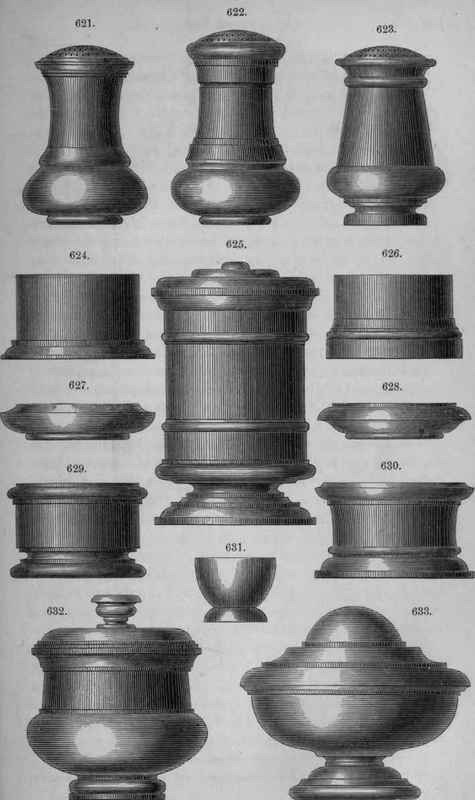
Plate V.
The rebate upon the chuck for holding these or any parts of work partially turned, is formed with precision ; the cylindrical portion is first turned accurately true and to the diameter, but of rather less length than the depth of the aperture in the work, the vertical face or shoulder is then turned flat and at right angles to it, as tested by the right angle of a small steel square, used in the same position as the blade of the turning square in fig. 427. After which, the cylinder of the rebate is turned very slightly taper towards the end, just sufficiently for it to more easily enter, and to avoid any risk of splitting the work. The true annular face of the latter coming in exact contact with the true face of the rebate, the work becomes true edgewise, and also fitting upon the concentric, quasi-cylinder of the rebate by its true aperture, it again revolves upon the same axis as before, and all the forms then turned upon it are concentric with those previously completed. This mode of chucking has also an additional advantage, the slight elasticity of the wood precluding damage to the finished edge of the work.
When the aperture is of inconsiderable depth, or contains some projecting surface but a little distance from the margin, the cydindrical portion of the fillet on the chuck is then made the longer, that its true end surface may abut against the internal surface, or the ridge within the aperture; the end surface of the fillet and its vertical shoulder, being rarely both required to touch the work. The fitting on the chuck is made to the same angle as that in works having conical apertures, and to the form of those that are curved, and is used when these works cannot be held within a chuck by their exterior margins, a more secure method. The length of fitting is increased in such cases to acquire greater surface contact, but it often happens in curved hollows that the edge or some portion of the curve is either concave or approaches the cylinder; advantage is taken of either and the rebate is turned to fit such portions, truth being always ensured when possible, by the contact of the true shoulder or the true end surface of the fillet, with some corresponding true portion of the work.
Continue to:


My Books

