


Vejyaissin - Veni Beni

Description
This section is from "The American Cyclopaedia", by George Ripley And Charles A. Dana. Also available from Amazon: The New American Cyclopædia. 16 volumes complete..
Vejyaissin - Veni Beni
Vejyaissin
See Comtat-VenaissijST.
Velleius Paterculus
See Patercultts.
Velletri (Anc. Velitroe)
Velletri (Anc. Velitroe), a town of central Italy, at the foot of Mt. Artemisio, in the province and 20 m. S. E. of the city of Rome; pop. about 13,000. It has a fine cathedral and several public and private palaces. Wine and olives abound in the vicinity. Originally it was a Latin or Volscian city of considerable importance. According to inscriptions described by Cardinali (Rome, 1823), it had an amphitheatre and fine temples. Garibaldi defeated the Neapolitans here in March, 1849. Velletri was the capital of a papal delegation till. 1870, when it was incorporated with the kingdom of Italy.
Vellum
See Paechment.
Vems's Girdle
Vems's Girdle, the common name of the cestus Veneris (Les.), an acaleph or jelly fish of the order of ctenophorm or beroid medusae, allied to pleurolrachia. (See CtenophorAe.) It is gelatinous and free-moving, but elongated in a direction at right angles to the alimentary canal, forming a ribbon-shaped body 4 or 5 ft. long and 2 or 3 in. high; the edges are provided with vibratile cilia; the mouth is below and in the median line. It is common in the Mediterranean, near Naples, appearing at night like a band of phosphorescent flame.
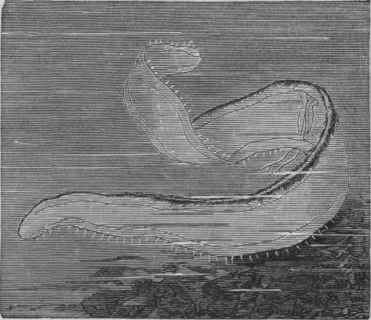
Venus's Girdle (Cestus Veneris).
Venceslav Hanka
Venceslav Hanka, a Bohemian philologist, born at Horzeniowes, June 10, 1791, died Jan. 12, 1861. He had made himself popular by several poetical productions in Czechic, when he became famous by the discovery in 1817 (the genuineness of which is, however, still contested) of the "Manuscript of Koniginhof" (Rukopis kralodvorsky), a collection of Czechic poems supposed to have been written about the beginning of the 14th century. He was appointed in 1818 librarian of the national museum of Prague, and in 1849 professor at the university. He is the author of a number of important grammatical, lexicographical, and critical works on the Bohemian and other Slavic languages and literature.
Vendome (Anc. Vindocinum)
Vendome (Anc. Vindocinum), a town of France, in the department of Loir-et-Cher, on the Loir, 18 m. N. W. of Blois; pop. in 1872, 9,938. It was formerly capital of the district of Vendômois, which comprised parts of the present departments of Loir-et-Cher and Sarthe. It contains the ruined château of the dukes of Vendôme, a lyceum, a public library, and manufactories of leather, gloves, and cotton goods. Several combats took place in the vicinity previous to and after the German occupation of the city (Dec. 16, 1870).
Veni
See Beni.
Veni Beni
Veni Beni, or Paro, a river of Bolivia, formed by a number of head streams rising in the Andes, N. W. of Cochabamba. After flowing N. W. 300 m., and receiving the waters of the Queloto, Tipuani, Mapuri, and other large rivers, it bends, and holds a N. E. course to the frontier of Brazil, where it swells the united streams of the Mamore and Itenez to form the Madeira, the principal tributary of the Amazon. The whole valley of the Beni not having been yet explored, little else is known than that the river waters extensive plains of great fertility in the departments of La Paz and Beni.
Continue to:



My Books

